Промо на dev.uaCrypto
19 September 2025, 12:45
2025-09-19
The best memecoins and the power of the crowd: how communities lead projects to success in 2025
In 2021, Dogecoin, created by Billy Marcus and Jackson Palmer as a joke asset eight years earlier, suddenly found itself at the center of global financial news. Its capitalization approached $85 billion, and the Shiba Inu meme became the symbol of an entire segment of cryptocurrencies. The main catalyst for growth at that time was Elon Musk: his publications about Dogecoin regularly led to price jumps.
In 2021, Dogecoin, created by Billy Marcus and Jackson Palmer as a joke asset eight years earlier, suddenly found itself at the center of global financial news. Its capitalization approached $85 billion, and the Shiba Inu meme became the symbol of an entire segment of cryptocurrencies. The main catalyst for growth at that time was Elon Musk: his publications about Dogecoin regularly led to price jumps.
The Shiba Inu meme token, which launched in August 2020 and gained popularity as the “Dogecoin killer,” became another example of the power of the crowd. In a short period of time, the coin rose in price by over 11,000,000%, making it one of the most striking stories in the cryptocurrency market. The Shiba Inu community actively promoted the project on social networks, developing an ecosystem with NFTs and decentralized services. As a result, the token entered the top 15 in terms of market capitalization and still remains an important player among meme coins.
Floki Inu also showed that memes can gain traction in the market through user engagement. Its community organized advertising campaigns in London and sponsored sports clubs, creating a constant demand for the project's coins. Floki Inu is the power of memes and audience engagement that can compensate for the lack of unique technology.
In 2025, the capitalization of memecoins remains at the level of tens of billions of dollars, and it is the communities that continue to determine the dynamics of the market. New projects such as Wall Street Pepe, Maxi Doge, Snorter, PepeNode or Bitcoin Hyper demonstrate that social networks, NFTs and mechanisms for incentivizing owners, as before, are still generating a stable demand for such assets. In 2025, memecoins have established themselves as a full-fledged segment of the cryptocurrency market.
New memecoins of 2025: community-backed projects
The first memecoins initially did not have a clear strategy and were just a random experiment. There is no need to talk about the technological uniqueness of Pepe. But in 2025 the situation has changed: new projects enter the market with a well-thought-out concept and tokenomics, built-in useful functions and support for large networks. As a result, the meme remains the basis, but an ecosystem is formed around it, which keeps users interested longer.
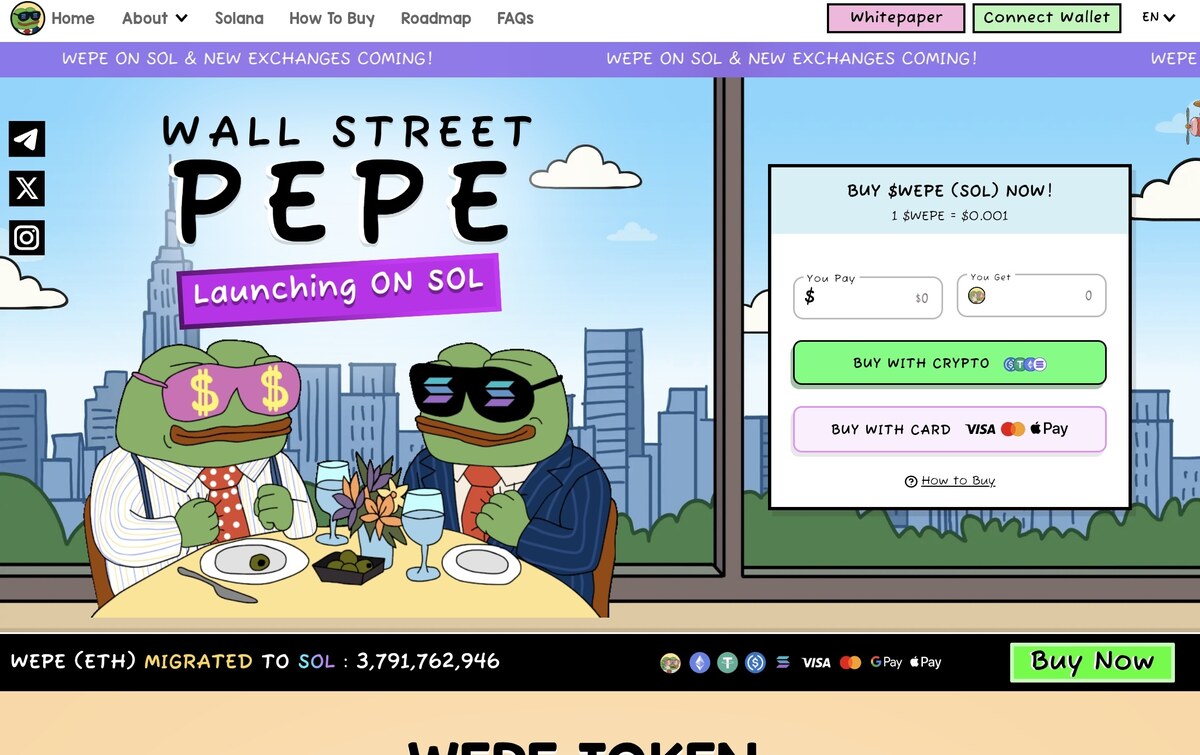
Wall Street Pepe ($WEPE) — Pepe the frog has become the main mascot, and the project itself runs on both Ethereum and Solana. The economy is built on a limited coin issue and supported by arbitrage between networks.
Maxi Doge ($MAXI) is a meme coin that plays off the “final form” of the well-known Doge, created as a hyperbolized symbol of power and risk. Aggressive marketing and active community support are the basis of the project concept.
Snorter Bot ($SNORT) is a Telegram bot that allows you to trade memecoins directly in the chat messenger. It supports copy trading and offers smart contract verification.
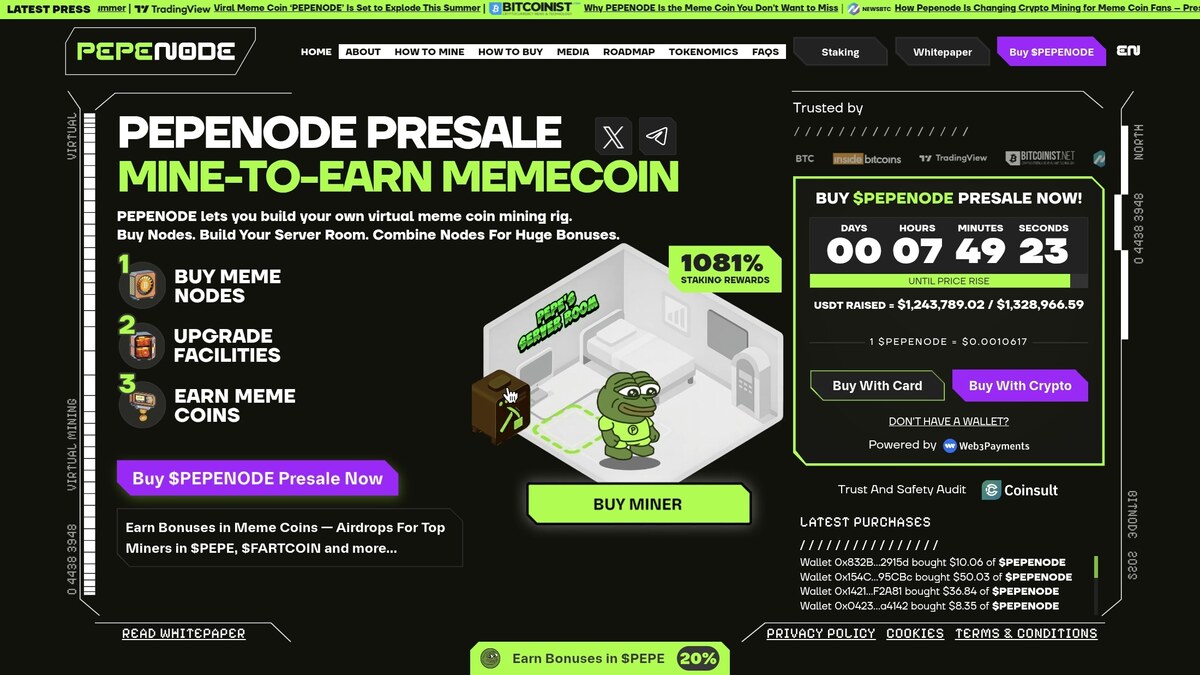
PepeNode ($PEPENODE) is a project based on a “mine-to-earn” gaming model, where users create virtual farms and mine tokens for themselves. Additionally, a burn mechanism is used to reduce the supply.
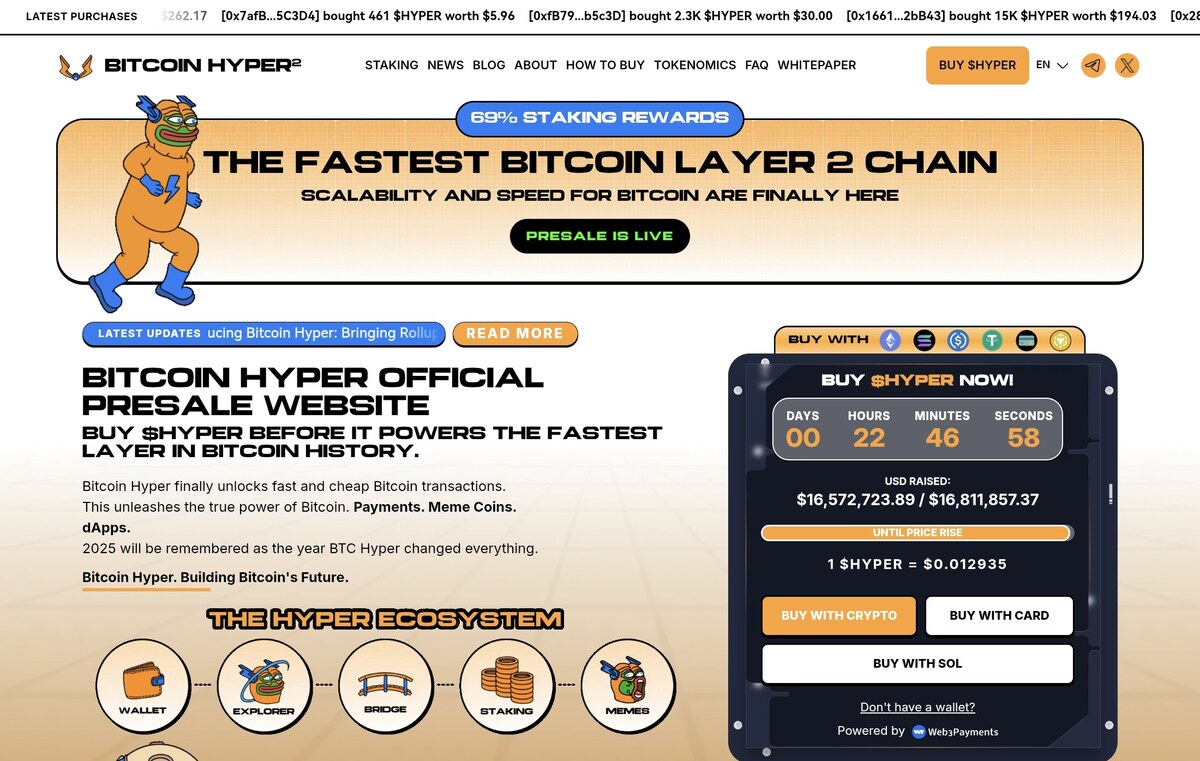
Bitcoin Hyper ($HYPER)is an SVM-based memecoin that acts as a Layer-2 for Bitcoin. It combines a lightweight meme format with a truly valuable infrastructure.
Wall Street Pepe
Wall Street Pepe is a meme coin based on the image of Pepe the Frog as a Wall Street trader. The token operates simultaneously on Ethereum and Solana, and equilibrium is maintained through arbitrage and a burning mechanism. The emission is limited to 200 billion coins, which makes the economic model transparent and protects holders from an increase in supply. More than 3.6 billion $WEPE have already been burned, and each purchase of the token on Solana is accompanied by the removal of an equivalent number of coins from Ethereum. This mechanism keeps the total emission at a fixed level and prevents dilution of participants’ shares.
The project is gradually moving its activity from ETH to Solana, a network that offers low fees and high transaction speeds, which is especially important for memecoins that are often traded in small volumes and require high throughput.
The ecosystem is also developing through NFTs: a collection of 5,000 tokens opens access to a closed Alpha Chat with trading signals and brought in over $33,000 on the secondary market OpenSea. The minimum value of tokens is gradually increasing: individual copies reach 1 ETH.
Wall Street Pepe’s main resource is its community. It is the project participants who create info drives, develop the NFT direction, and maintain interest in the token, which helps the project maintain attention even in the saturated memecoin sector.
Integration with Best Wallet simplified the storage and management of $WEPE, making access to the asset convenient for a wide audience.
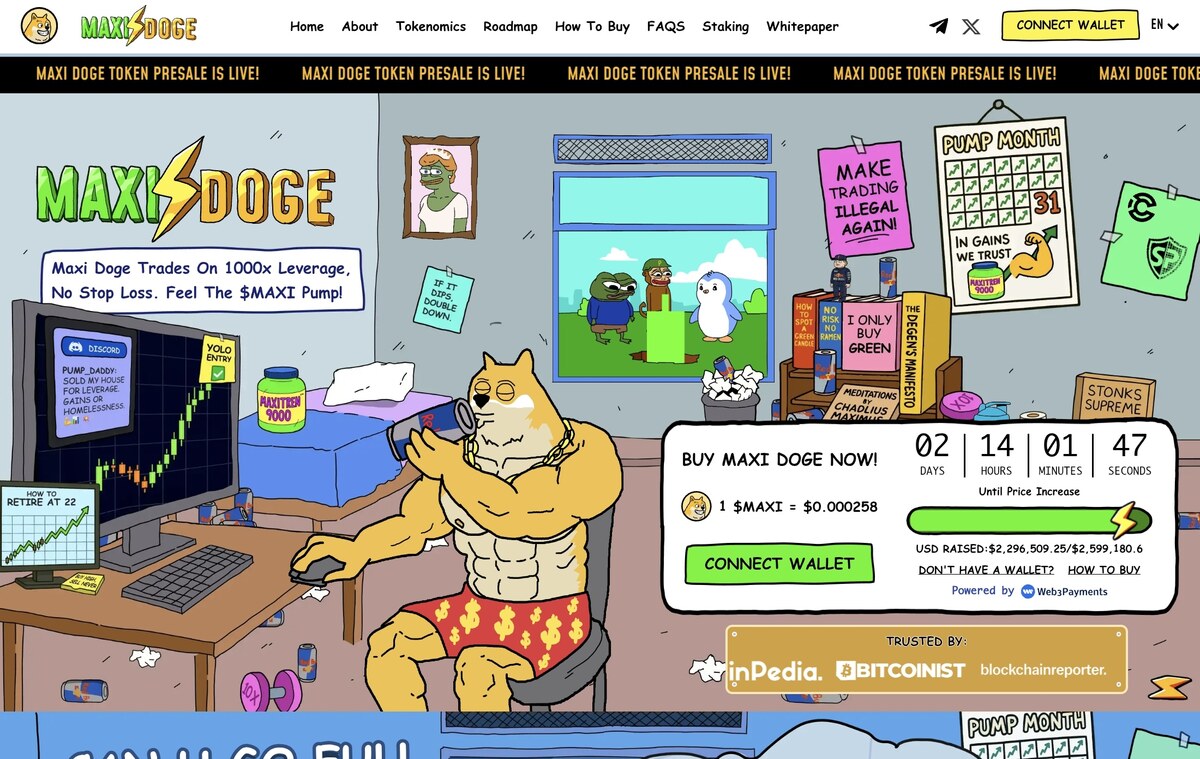
Maxi Doge is a new meme coin built around the image of the “final form of Doge.” Here, the meme is presented as a hypertrophied dog — a caricatured alpha symbol of strength and risk. This visual accent immediately distinguished the project from other meme coins and ensured its rapid popularity on social networks.
At the start of the presale, over $100,000 was raised in a matter of minutes, and the total investment volume exceeded $2.2 million. The token plan provides for the distribution of 25% of the issue in the MAXI Fund, created for marketing and stimulating community activity. This solution allows you to constantly fuel interest in the project and create a network effect.
Maxi Doge is betting on viral marketing and a risk culture: sharp price fluctuations are perceived as part of a speculative model. The team is discussing launching instruments with leverage up to 1000x, which emphasizes the focus on aggressive trading.
The current value of $MAXI is $0.0002575, and token holders are offered staking with a return of up to 145% per annum, allowing them to earn rewards even outside of active trading. Thus, Maxi Doge combines a meme image, risky mechanics, and simple earning opportunities, making it a shining example of the new generation.
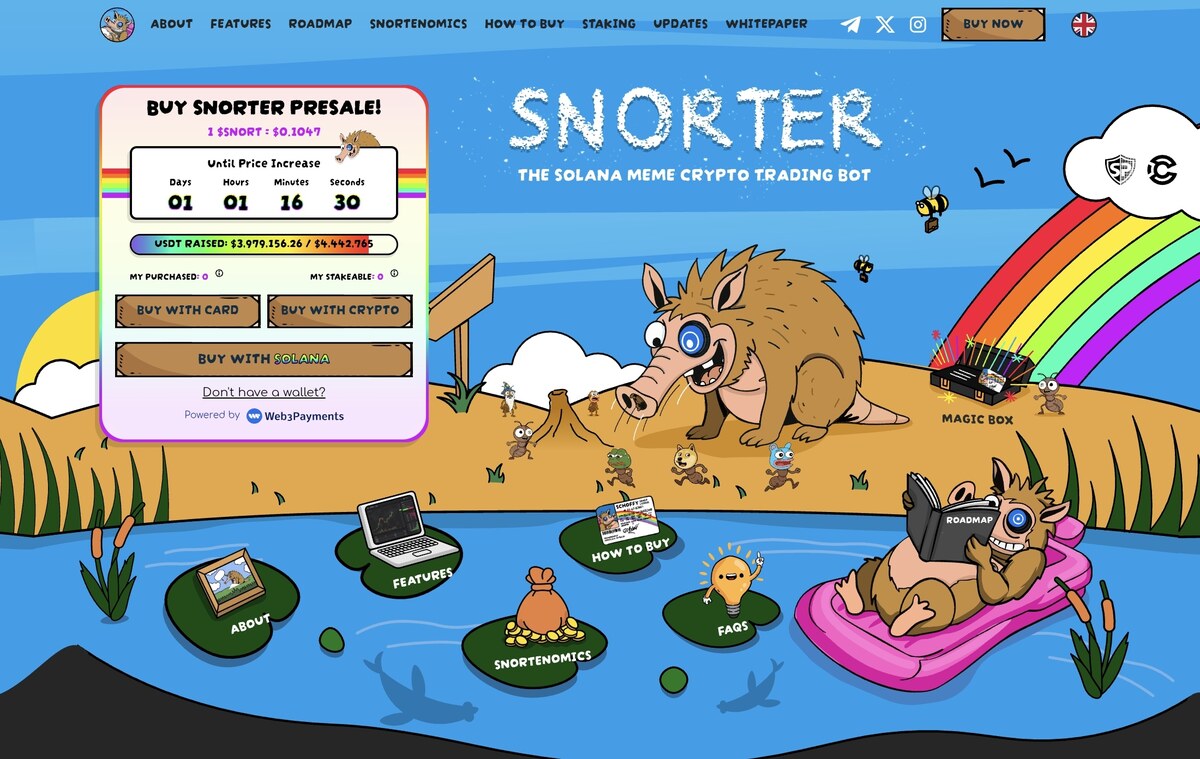
Snorter Bot is a chatbot on Telegram that has become one of the most prominent tools in the memecoin sector. It runs on the Solana network and allows you to buy new tokens directly in the messenger without using complex applications. This format has made the project a convenient entry into the world of cryptocurrencies for thousands of users.
The main advantage of the robot is the speed of transactions. Snorter was nicknamed “The Fastest Solana Sniper Bot” because it allows you to enter projects in the first seconds of their appearance. When investing in memecoins, this often becomes a decisive factor in obtaining a profit.
Snorter Bot has a copy trading feature - the ability to repeat the actions of experienced players, reducing the risk of mistakes and eliminating the need for users to study the market for a long time before starting a trade. The service also checks smart contracts and protects against MEV attacks, which helps to avoid falling into fraudulent schemes.
The $SNORT token is the foundation of the ecosystem. It reduces transaction fees from 1.5% to 0.85%, opens up access to advanced functionality, and supports staking with a return of up to 118% per annum. The presale raised $3.9 million, and the current value is $0.1045. Owners receive not only bonuses when working with the bot, but also the opportunity to participate in voting.
High volatility and frequent price drops are typical of the memecoin market, so investors in this segment need tools that help them act quickly, safely, and impartially. Snorter Bot solves this very problem.
PepeNode is a project that offers to mine memecoins using an unusual “mine-to-earn” mechanic. While in traditional schemes, investors have to buy expensive equipment and spend huge amounts of electricity, here owners build virtual installations and receive rewards for their upgrades.
PepeNode combined meme and thoughtful tokenomics. Pepe's image became the symbol of the project, and the model gives the community incentives for activity. Each improvement of the virtual farm is accompanied by the burning of up to 70% of tokens, creating a shortage of coins and increasing the interest of participants.
The current price of $PEPENODE is $0.0010617, with over $1.3 million raised in the presale. The project operates on the ERC-20 standard in Ethereum and is compatible with major DeFi protocols. For those who prefer passive income over dynamic game mechanics, staking with a return of 1140% APY is also available in the PepeNode ecosystem.
One of the main principles of the project is that the benefits of participation primarily go not to insiders, but to the community. The ecosystem does not contain closed allocations, protection against bots is implemented, and priority in receiving rewards is given to early owners. Additional bonuses are a 2% referral program and a rating of the most active participants with incentives.
Bitcoin Hyper is a project that stands out among other meme coins by combining meme culture with a serious Layer-2 infrastructure solution. The architecture is based on the Solana Virtual Machine (SVM), which provides compatibility with Solana and Ethereum.
Transactions in the ecosystem are performed using the wrapped BTC. Transactions are initially executed within the Bitcoin Hyper network, and then the transaction data is recorded in the main Bitcoin chain. When a user wants to return the assets, they burn the wrapped version and receive the BTC back in Layer-1. This approach speeds up transfers and reduces fees, while maintaining the security of the underlying network.
The $HYPER token performs several important functions: it pays for fees within the network, is also used for voting, and provides an opportunity to receive income through staking. The APY of the latter reaches 70% per annum, which helps to maintain the interest of owners even in times of market decline. Since the launch of the presale, more than $16.3 million has been collected, and the value of $HYPER is $0.012925. These figures confirm that the project has received broad support from investors.
Importantly, Bitcoin Hyper is not being deployed on traditional networks like Binance Smart Chain and Solana, where most meme coins are launched, but on its own Layer-2 infrastructure. This emphasizes the developers’ desire to carve out a niche in the sector and show that a meme can be the basis for a technologically useful product.
The combination of light humorous presentation and practical value made Bitcoin Hyper a vivid example of the new wave of memecoins, thanks to which the community receives not only a symbol, but also a full-fledged tool that has weight in the cryptocurrency market.
Many meme coins do not have complex technologies: as we have said before, their growth is ensured by the enthusiasm of the community and the network effect. The more actively the participants create info drives and promote the project, the higher the probability that the token will gain attention and soar in price.
The main tool is viral content. It spreads faster than regular news and becomes a signal for thousands of traders. One successful meme info-drive can trigger a wave of purchases, and the fading of community interest leads to a decrease in demand from the market. The capitalization of meme coins is often determined by whether the flow of content associated with the coin is uninterrupted.
Stories show that the crowd effect can override any rational factors. Dogecoin, launched by Jackson Palmer as an accidental joke, is a full-fledged market participant precisely because of the close-knit community behind it. Elon Musk’s tweets have repeatedly led to sharp jumps in the coin’s value, and attention to the token has been maintained for months. Shiba Inu has also consolidated its success thanks to an aggressive campaign of supporters, who promoted the project under the slogan “Dogecoin killer”. And political memes around Donald Trump have shown that an active group of people is able to turn a token into a symbol that goes beyond the financial context.
In new projects, developers deliberately provoke community activity using technical elements. Smart contracts allow you to build staking, decentralized voting, and bonuses for participants into the ecosystem. This turns the meme from a mascot into part of a game model, where every step of users is reflected in the dynamics of the coin. Unlike passive storage , such mechanics draw the audience in more and allow you to control the growth of tokens.
Memecoins often retain their value only as long as the community is active. The value of coins directly depends on the involvement of people, so for investment it is worth choosing projects where the developers take care to maintain the interest of the community.
Conclusion
Memecoins have finally established themselves as a separate segment of the cryptocurrency market by 2025. Their value cannot be measured solely by technology — one of the priority factors is the community. It is the users who create the flow of meme publications, launch campaigns on social networks, maintaining liquidity and transforming tokens from empty entertainment into assets with billion-dollar capitalizations.
The classic stories of Dogecoin, Shiba Inu, and Floki Inu have shown that a meme can be the foundation for long-term interest. New projects like Wall Street Pepe, Maxi Doge, Snorter Bot, PepeNode, and Bitcoin Hyper have taken this idea further. The viral image at the core is now supported by thoughtful token economics, staking, NFTs, or even Layer-2 infrastructure. This allows for real incentives for investors and keeps them engaged for longer.
The main conclusion is simple: Mecoms live as long as their community is active. Therefore, when choosing a project in this segment, it is necessary to consider not only graphs and numbers, but also the strength of the community, its willingness to get involved and set trends.