Хочете будувати кар’єру в Data Science та AI? Vodafone Big Data Lab відкриває новий набір —>
Наталя ХандусенкоGadgets
11 November 2026, 12:20
2026-11-11
Forearm as a touchpad: researchers create miniature radar sensor to control smartwatches
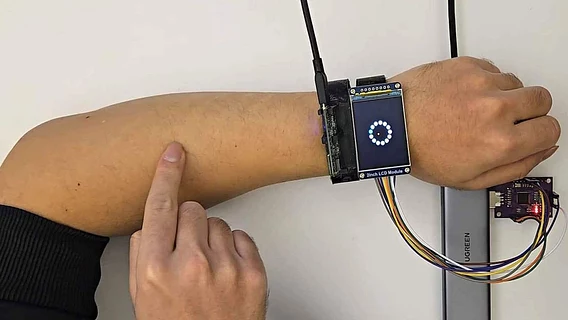
Researchers at North Carolina State University have developed a new technology prototype called the EpiPad that turns the wearer's forearm into a touchpad, allowing smartwatch users to scroll pages, zoom in on images, and tap items without having to touch the device's tiny screen.
Researchers at North Carolina State University have developed a new technology prototype called the EpiPad that turns the wearer's forearm into a touchpad, allowing smartwatch users to scroll pages, zoom in on images, and tap items without having to touch the device's tiny screen.
How EpiPad works
The system is based on a compact millimeter-wave radar sensor measuring approximately 5 by 4 millimeters, which is attached to the wrist in the form of a bracelet. Instead of a conventional touchscreen, the radar tracks finger movements and measures the force of pressure on the skin of the forearm through changes in the reflected signals.
To recognize gestures and interpret input, scientists have developed a special signal processing method based on millimeter-wave phase dynamics, as well as lightweight machine learning models. Before use, the user must go through a short calibration that takes less than four minutes (3 minutes and 54 seconds).
Test results
During experiments with 20 volunteers, the system demonstrated high results:
the gesture recognition accuracy was 92.8%;
The accuracy of determining the pressing force reached 90.2%.
In real-time benchmark tests (comparing a traditional touchscreen, a tilt-based cursor, and the EpiPad), the researchers' design outperformed other methods in terms of efficiency and error rate.
Prospects and cost
The current prototype resembles a bracelet with an open circuit board, but in the future the components could be integrated into the design of a regular smartwatch. According to preliminary estimates, the cost of the functional components (including the radar array) could be less than $10.
The technology also opens up possibilities for controlling devices without screens — such as smart glasses, allowing the skin to be used as an interactive surface for entering commands without physical buttons or displays. At the same time, the developers note that at the moment this is a conceptual prototype and research with a small group of people, and not a finished commercial product.