Хочете будувати кар’єру в Data Science та AI? Vodafone Big Data Lab відкриває новий набір —>
Олександр КузьменкоAI Eng
9 July 2026, 18:42
2026-07-09
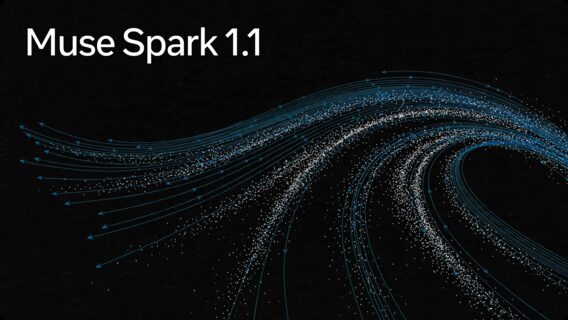
Meta introduces Muse Spark 1.1 multimodal model for AI agent development
Meta Superintelligence Labs has released Muse Spark 1.1, an updated multimodal reasoning model focused on agent-based tasks. The tool has improved programming skills, interaction with the computer interface, understanding context, and use of third-party services.
Meta Superintelligence Labs has released Muse Spark 1.1, an updated multimodal reasoning model focused on agent-based tasks. The tool has improved programming skills, interaction with the computer interface, understanding context, and use of third-party services.
This was announced on the official Meta blog, and the details of the release were shared on his social media pages by the company’s CEO Mark Zuckerberg. According to him, the main goal of the update is to make advanced technologies more accessible to developers. «Our goal is to provide powerful agent and multimodal models at a very low cost,» Zuckerberg emphasized.
The new model is already available to users in the «Thinking» mode in the Meta AI app and on the company’s website, and a public preview of the Meta Model API has been launched for developers.
The main feature of the update was optimization for AI agents. Muse Spark 1.1 is able to manage complex projects, coordinating multi-agent systems to reduce latency. The model can act as both a main agent that plans tasks and delegates them to others, and a sub-agent that performs narrow tasks and returns results on time. In addition, the AI supports work with MCP (Model Context Protocol) servers, third-party tools and actively manages a context window of 1 million tokens, compacting intermediate data to preserve important information.
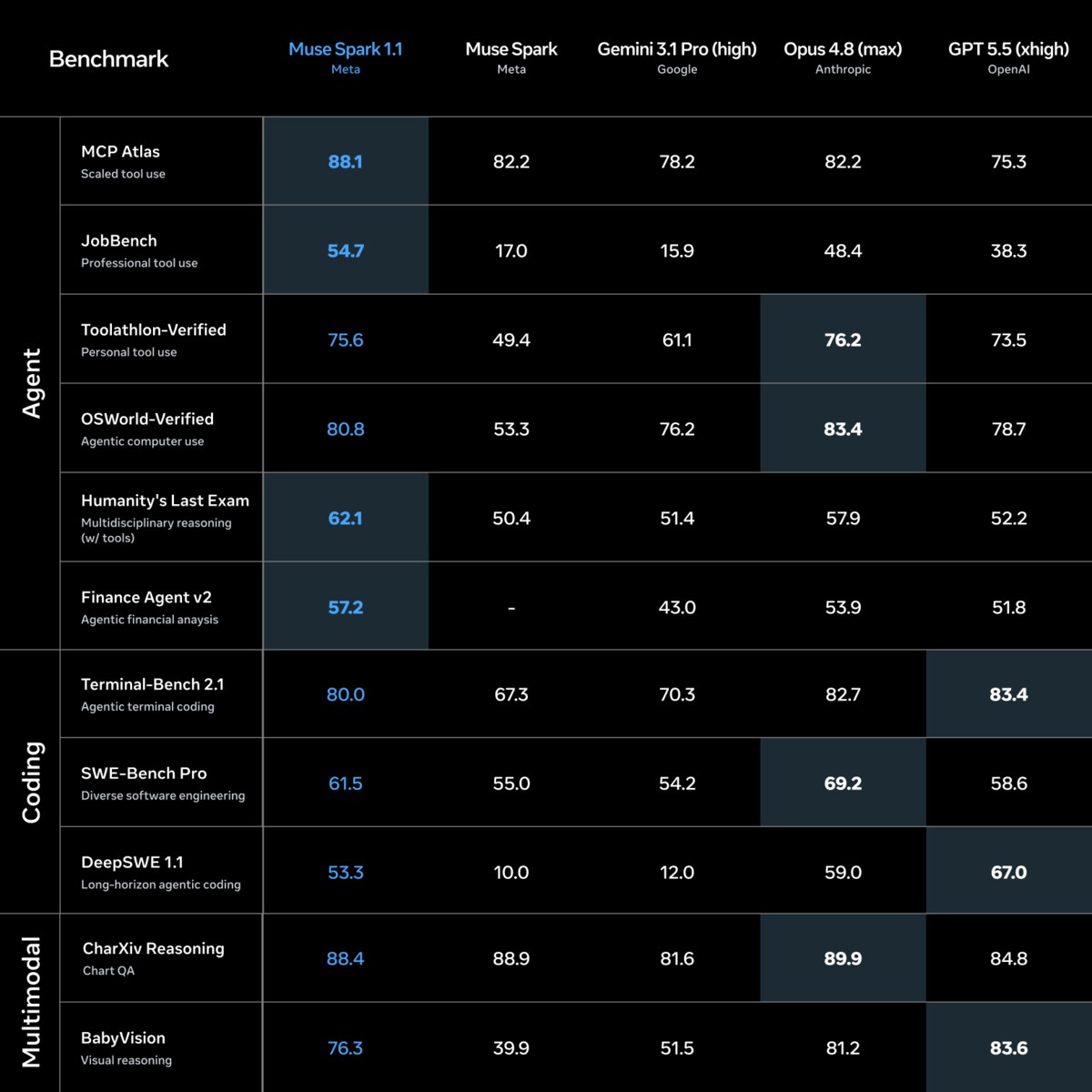
Comparison of Muse Spark 1.1 with competitor AI models. Image: Meta
When interacting with a computer, the model was trained to adapt to dynamic interfaces on desktops, mobile devices, and browsers. It independently chooses the optimal way to complete tasks: writing scripts to automate routine processes or directly interacting with interface elements (clicks) if this is more efficient.
In the programming area, Muse Spark 1.1 has been integrated into agent-based development environments. The model is able to detect and fix errors in large corporate code bases, implement new features, and perform code migration. In particular, in the OpenCode environment, the AI can automatically create web applications, take screenshots to find visual bugs, and immediately make changes to the code. In the company’s internal test, Meta Internal Coding Bench, the model demonstrated better results than the previous version.
The updated version’s multimodal capabilities allow it to process visual and audio data simultaneously. For example, AI can analyze a smartphone video of a product, extract its characteristics, automatically open the user’s browser, and independently create an ad on Facebook Marketplace.
Before release, the model underwent security testing within the Advanced AI Scaling Framework internal evaluation system. Tests confirmed a low probability of generating malicious content, resistance to attempts to bypass restrictions (jailbreak), and a reduced level of hallucinations compared to previous versions.
«В жовтні випускаємо VR-шолом для аватарів, в «чіпування» Neuralink Маска вірю мало». Про що глава Meta Цукерберг 3 години говорив в подкасті Джо Рогана
25 серпня вийшла чергова серія популярного подкасту The Joe Rogan Experience, гостем якого став глава компанії Meta Марк Цукерберг. Розповідаємо про головне з майже 3-годинного інтерв’ю.
Як нейромережі бачать вільну та незалежну Україну? Тест dev.ua
Нейронні мережі для генерації зображень бачать світ по-своєму, їхню логіку зрозуміти часом зовсім неможливо. Але таки хочеться. На честь Дня Незалежності України редакція dev.ua вирішила провести невеликий експеримент.
Ми задали чотирьом різним нейронним мережам п’ять однакових запитів: «прапор України», «День Незалежності України», «український Крим», «перемога України» та «українці». Отриманими результатами ми ділимося з вами нижче.
Have important news to share? Message our Telegram bot
Key events and useful links in our Telegram channel