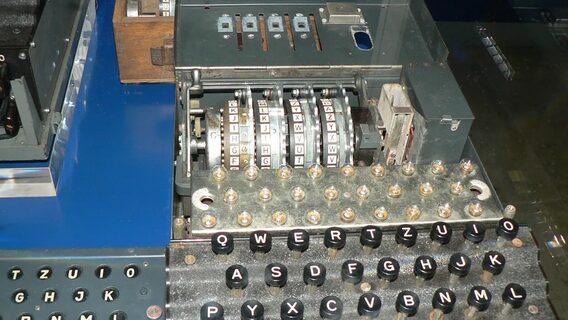
A fully working Enigma machine in a wooden case was sold at a Christie's auction in Paris this week for more than double its expected price.
This auction became especially interesting for collectors who are passionate about both World War II and computers, as it sold one of the rarest Enigma models - an M4 with four rotors, writes Tom's Hardware.
This example of the machine is fully operational, complete with lead-acid batteries. It is also believed that this machine is one of only eight operational models remaining.
All of this may explain why the lot reached double its estimated value: an unnamed buyer paid $555,233.
While the German Enigma war machines of World War II are interesting in their own right as the first encryption device, they are now perhaps best known for accelerating the development of computers.
German Admiral Karl Dönitz ordered the development of the M4 model (like this auctioned model) in 1941 to strengthen the protection of submarine communications.
In 1943, British engineer Tommy Flowers completed the Colossus Mark I. It was the first programmable electronic digital computer, although it was specifically designed to break the Lorenz cipher used in German High Command communications. A year later, the Colossus Mk II was introduced, which was faster than its predecessor.