Хочете будувати кар’єру в Data Science та AI? Vodafone Big Data Lab відкриває новий набір —>
Ігор Вишневський Hot News
6 March 2025, 09:00
2025-03-06
“We need to end the war. We know what to do next.” A big interview with the Vice President of Global Branding at Avenga about juniors, military IT and women in IT
Marta Romanyak has been Vice President of Global Branding at Avenga since the beginning of 2023. Prior to that, she headed Avenga’s Ukrainian office since 2019. In addition, she is an ambassador for the IT Ukraine association, and at one time was included in the top 25 women in Ukrainian IT according to Forbes.
In an interview with dev.ua, the top manager shared her thoughts on what can return Ukrainian IT to a position before a full-scale invasion, what indicators Avenga and the entire sector expect in 2025, how IT education has changed recently and what prospects the juniors have in the market today, what «buns» the company offers for its specialists and whether it supports mobilized employees, as well as about the risks of wartime and how to overcome them.
Marta Romanyak has been Vice President of Global Branding at Avenga since the beginning of 2023. Prior to that, she headed Avenga’s Ukrainian office since 2019. In addition, she is an ambassador for the IT Ukraine association, and at one time was included in the top 25 women in Ukrainian IT according to Forbes.
In an interview with dev.ua, the top manager shared her thoughts on what can return Ukrainian IT to a position before a full-scale invasion, what indicators Avenga and the entire sector expect in 2025, how IT education has changed recently and what prospects the juniors have in the market today, what «buns» the company offers for its specialists and whether it supports mobilized employees, as well as about the risks of wartime and how to overcome them.
About Avenga
Avenga is an international IT outsourcing company with offices in 21 countries and over 6,000 specialists on staff. Founded in 2006.
In Ukraine, as of March 2025, Avenga has offices in Lviv, Ivano-Frankivsk, Vinnytsia, Lutsk, Khmelnytskyi, Cherkasy, and Poltava, which together employ 949 specialists.
In December 2023, the IT company Avenga was acquired by the KKCG investment group headquartered in Lucerne, Switzerland. After that, Avenga began the process of merging with the Czech Qinshift. The international IT holding Avenga itself, headquartered in Cologne, is headed by Frenchman Ludwik Godet.
About the IT market, hiring and staffing
Most top managers of IT companies are looking rather cautiously towards 2025. What are your expectations for both Avenga and the industry in general?
We are not unique in our expectations. I don’t know — unfortunately or fortunately — but our forecasts are to remain at the level of 2024. Because, in principle, 2024, compared to 2023, was already much better for the industry.
Yes, the export of services decreased by 4% compared to 2023. But in 2023, the export of services, according to the NBU, decreased by 8,5% in general, and according to some calculations — even more. Therefore, staying at the level of last year is what our company and the industry as a whole plan to do.
And what about in terms of personnel? Last year, layoffs in the market became a common occurrence… You had them too, if we understand correctly.
In Ukraine, we currently have a little less than 1,000 specialists, of which about 750 are technical specialists and 250 are non-technical. That is, we maintain a balance in this aspect of about 75% to 25%.
Again, for this year we are planning a small growth within 5%. Yes, of course, like everyone else, we also had reductions. But mainly these reductions were associated with the completion of individual projects. And we did not have cases where clients «fell away».
Mostly it was in the format of — a project or assignment is over, so accordingly we have to let the person go. But, which is very important, we did not have any dramatic and massive layoffs.
In the years of full-scale invasion of the Ukrainian IT market, finding employment is often a one-star task even for middle and seniors. And for juniors, if we use this analogy, it is a two-star task. Is Avenga hiring juniors now?
We have always grown our own Juns. In the good old days, before Covid and the full-scale war, and until last year, we had our own Avenga Academy that worked very well. Its work was aimed at providing a relatively easy path to IT. I think we did the most schools in the areas of Salesforce, DevOps, iOS.
A person with certain skills could take a crash course at Avenga Academy and get a position with us. But we also considered it a social responsibility, so we provided opportunities to get a job in other companies. There were many great examples when a person, for example, graduated from our academy, went to other companies as a junior, and returned to us as a middle. Therefore, this was a staffing supply not only for our company, but for the market as a whole.
It is important now to preserve the Juns we already have and expand their qualifications to midshipmen. It is obvious that there is not the same influx of new customers and the same number of new orders as before the full-scale war.
So, accordingly, this does not allow for the kind of hiring that was possible before full-scale. But this does not apply exclusively to juniors, it applies to all specialists, because hiring has slowed down at all levels.
The challenges are much more complex now. Everyone wants quick and qualified solutions, so this opportunity to «learn» and gain experience for specialists is disappearing a little. But, again, it all depends on the clients, that is, on the requests they come with. This is not some kind of manifestation for or against Junos, but the realization that this is a business, and the rules are dictated by the client for us.
That is, at the current stage and with the current state of affairs, is it not time to fully resume the work of Avenga Academy? Is such an option still being considered?
We are talking about this in the company. Perhaps the academy’s activities will change its format a little, and we will conduct training online. But we do not yet have a specific date for its resumption.
We have the programs, they are developed. We also have specialists, so this can be done exclusively with Avenga’s internal resources. Our specialists are ready to share their knowledge, and what is important — not only theoretical, but also practical.
So we really want to get back to it. But again, the market has to wake up a little bit for us to be able to make these investments. Because for us, it was still part of corporate responsibility.
For Avenga Academy to work, we need to get out of the flat level a little bit, at least into a small plus, in order to resume such initiatives.
Speaking of education and professional skills, are you satisfied with the level of university graduates who enter IT after university?
It seems to me that the peculiarity of a Ukrainian IT professional is that he will never count on success without constantly developing. This also applies to students who have a classical university education in the IT profile.
Still, they continue to take various courses, to join certain communities. No university exists on its own anymore — because universities are already taught by practicing IT specialists, our colleagues. Universities already have a number of programs from various companies, there are already various internships that you can take in IT companies, there is access to a lot of different information. Therefore, fortunately, universities have long ceased to live their separate lives, as they did some time ago. Now it is already a certain ecosystem in which many things are interconnected.
And what opportunities are provided to Avenga employees to improve their own skills?
We have an entire self-development center that deals with just such things — from English courses to custom courses for individual teams.
At the request of managers, we conduct courses for teams on any topic. For example, a manager may come with a specific request and tell us: «I want to work on presentation skills with my team.» Accordingly, we fulfill this request.
That is, in addition to a number of stated regular courses, we can also provide such customized courses upon request.
And what is the company’s policy regarding open vacancies, for example, when it comes to promotions? Are they offered to fill them first to their own specialists?
We have this policy. Before we advertise a vacancy, we try to fill it internally and with our own resources. After all, again, we are interested in the growth of our colleagues.
About the war and its impact on IT
How would you describe the impact of the full-scale war on Avenga’s Ukrainian office? Can we talk about any significant outflow of international clients?
There are a lot of risks, but it seems to me that in three years of full-scale invasion, we have already shown international clients everything we can. Our specialists work from shelters and the most fantastic thing about all this is that, despite blackouts, enemy drones, in bomb shelters, we always deliver the result. I think that is what surprised our clients the most. And this is not only about Avenga clients, it is about the industry in general.
There are problems, of course. There are many companies that have compliance and cannot work with offices in countries where military operations are taking place. This is spelled out in the policies of a number of international companies. We ended cooperation with some clients precisely because of military operations, and they went to other geographies. And this is already one big minus for all of us.
But it is also important to understand that over the past few years, it is not only Ukraine that has changed due to the war. The world has also changed — in different contexts.
For example, many companies have already exhausted the reserve of free money that could be invested in IT. Large companies have already undergone their digital transformation. For many of our projects, in which we carried out development, we simply switched to support. That is, the client did not disappear, but the terms of cooperation with such a client changed.
But on the other hand, we also see the numbers. And we see that the volume of IT services exports is one of the key and stable sources of foreign exchange earnings. So, we are ready to continue working — everything has just become much more difficult for both us and our clients.
Three years of full-scale war are a terrible period. But they have hardened us so much that we have shown the world that we can work in any conditions.
The war also has an impact on the economic sphere, legislation… How did you perceive the increase in military levies under the «Diya.City» regime? Last year, this became one of the biggest stumbling blocks between the authorities and the IT business.
Now we all understand perfectly well that you are either in the Armed Forces of Ukraine or for the Armed Forces of Ukraine. We would all like complete stability regarding the declared regime, but in conditions of war it is difficult for each of us to plan something for tomorrow — let alone talk about 25 years. Therefore, these changes were ultimately adequately perceived by both colleagues and business…
We like the way «Diya. City» works, and we are comfortable with it. It’s more about expectations — that we preserve this regime, and, conditionally, that after the war ends, something does not change radically and abruptly.
It is important for us that everything that was announced under the «Diya.City» regime meets these promised requirements and principles. Because it is about our stability and predictability. It is really very important for us that all of this is preserved.
About booking and mobilization
One of the most pressing issues for IT businesses in Ukraine during full-scale operations is booking. How is Avenga doing with this? What are you doing to avoid losing key employees due to mobilization?
The reservation issue is a pain point for IT, but frankly, it is equally painful for all industries. Everyone has the same problems now. The reservation mechanism needs to be improved to ensure the stable operation of the industry. And we still do not see clear legislative norms regulating this issue.
But as of now, we have reserved a certain number of employees for the company. How many exactly? About 5%. This is the average figure for the market, but this is definitely not what we are looking for. After all, our clients also ask us if we can give them any guarantees. And we need to understand what we can promise our clients.
Actually, top managers of IT companies say that we have a good dialogue with the Ministry of Digital Affairs and the government as a whole. But, conditionally, these 5% of those booked remain, they do not become at least 30%…
Yes, you are absolutely right. We have a lot of the right initiatives in place for this, but everything related to booking is moving very complicated. We constantly ask ourselves how much we can influence this. Unfortunately, there is not much we can actually do.
When you «push» such initiatives, you understand that we still have a full-scale war going on. And everywhere there are some limits. Of course, we want more, but, again, given the war, we understand the reality perfectly.
How many Avenga specialists were mobilized? Do you offer them any benefits such as job retention or other support?
As of now, we have 36 mobilized colleagues. We keep their jobs and pay them 50% of their compensation every month without any deadline, and we fully provide them with ammunition.
In total, 53 of our colleagues have joined the ranks of the Armed Forces of Ukraine since the start of the full-scale operation. Some of them have already returned to work, so we have 16 war veterans…
Avenga also has a lot of volunteer initiatives to support our military — both within the company and organized by our colleagues themselves. Many different fundraisers, this happens all the time. Every year we also have a charity event like Charity Store. This is our online store, where we can buy our merch for the money that we then donate to the Armed Forces of Ukraine.
My colleagues also organized a series of garage sales where everyone could bring some of their belongings, which could be sold and the funds then donated to the Armed Forces of Ukraine. So yes, this is something that always happens on an ongoing basis.
In addition, Avenga provided assistance to those who needed it most. In particular, the company supported the Children of Heroes Foundation, providing medical coverage for 142 children whose parents died in the war. The company also transferred UAH 1 million for the restoration of Okhmatdyt and the same amount for the reconstruction of a residential building in Lviv destroyed by the Russian attack.
About my own role in the company and women in IT
You held two positions in Avenga’s top management — first you headed the Ukrainian office, and since 2023 you have held the position of Vice President of Global Branding for the entire business. How difficult was it to switch from one location to the global level?
I joined Avenga in 2019 as a Regional Director. Among the full range of tasks related to developing Avenga’s Ukrainian business, I was responsible for developing the Avenga brand, and we began to implement a number of initiatives that came from our office globally.
This became especially relevant when in 2022 we began integration with the Ukrainian company Perfectial, and in 2023 another company joined the Avenga group, IncluIT in Argentina. Then the question arose for the Avenga business to create a position that would implement brand positioning and strategy, combine marketing and PR at the global level. We realized that we had to control a number of things not locally by country, but globally.
When changing roles in the company, the hardest thing for me was to «tear off» my sentiment from Ukraine and switch to the Global level. And also to master cultural peculiarities. Because we can be very different even within the same country, and what can we say when we have to unite offices from Malaysia to Argentina with certain tasks. By the way, the book Culture Map by Erin Meyer helped me understand and overcome these cultural differences. I recommend it to all colleagues who face these challenges. By the way, at Avenga we even have a whole course on cultural differences. It is not only for management, but for everyone who wants to. Sharing this knowledge is part of our corporate culture.
You do a lot to systematically promote women in IT. Why is this topic important to you? Do you still see any gender stereotypes in the industry?
I would start from the opposite statement — for me, IT is the most genderless field. IT is about equal opportunities for men and women.
Therefore, I am trying to break this stereotype that has formed in many people’s minds when we hear: «This is a male profession, because it is technical.» You just have to be wise, have a desire to develop and learn, and this industry is open to you.
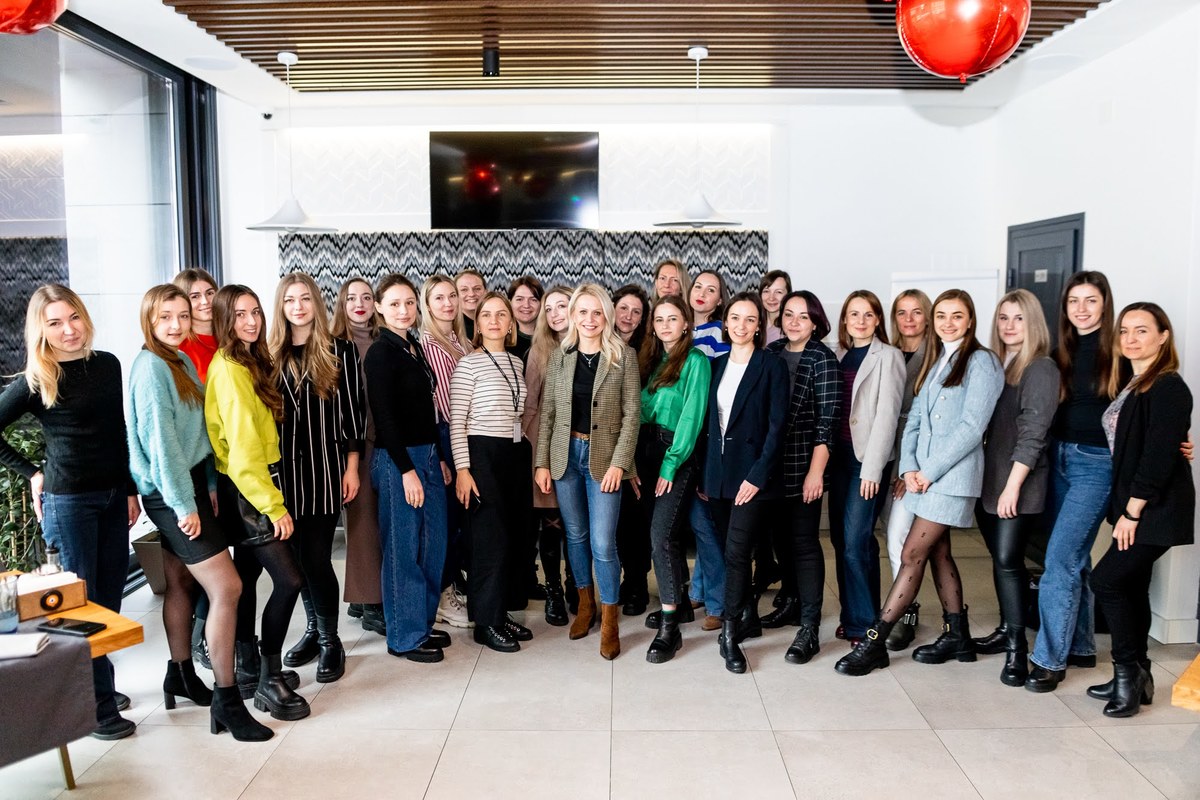
Strategic session within the Avenga Women’s Community
I mean, I just want to inspire women, to say: «Listen, this is for you too, because you have the knowledge, the desire to work and develop.» Therefore, in my opinion, motivation and insecurity are probably the main problem. But that is already changing.
To make matters worse, a few years ago there were very few women in leadership positions in IT companies. But this trend is also changing.
I don’t know if the war indirectly affected this, because women are able to freely leave the country and be closer to our clients, but the changes are tangible.
If we talk about our company, the gender ratio is quite classic for the market — approximately 70% men and 30% women. By the way, Avenga Ukraine signed the Principles for the Empowerment of Women during the UN Congress, so this is already a practical step we have taken on this path.
You are also very active in IT associations. For you, is this just about the community or about solving some practical problems for the entire industry?
We believe that these are the platforms where we are heard. There we all come from one clear position and defend our interests. And the word «interest» should not be perceived with any negative connotation. After all, when we talk about our interests, it is about how we can further develop our Ukrainian IT business, how to maintain the industry.
And, in particular, IT Ukraine, where I was a Board Member for three years, is now one of the most effective platforms where this dialogue takes place. The same applies to the Lviv IT Cluster, the Kharkiv IT Cluster, Diia City United. I am also a Board Member of UK-UA TechBridge. You know, all this is done in order not to sit and wait on the sidelines when something happens, but to take part in it, to have the opportunity to speak with the voice of the industry.
It is important for us not only to do our job well, but to do a little more. Participation in such associations is an opportunity to do «a little more». In addition, this is how we create accelerators where Ukrainian startups have the opportunity to travel, learn, get a great base and investments. Again, this is a business-government dialogue. It is good that this dialogue works in Ukraine. It is also a great way to enter the international market.
On expectations from the IT industry
What challenges is it important for Ukrainian IT to overcome in 2025?
The biggest challenge is war. I don’t know how many times I’ve mentioned this word today, but that’s how it is.
We need to end the war. We know what to do next. We have specialists with extensive experience — we didn’t show up yesterday or the day before. We have a great portfolio of clients.
The peculiarity of Ukraine is that we work in probably all possible technologies. That is, our engineers cover all the needs that arise on the market.
Before the full-scale war, we had a real industrial boom. We had already started investing in universities and education. Think about how many new faculties were opened, how many accelerators appeared, how much investment went into IT companies, how many Ukrainian IT companies started buying companies around the world.
It is important for us that the number of specialists and the number of customers grow. It is very important for us that our customers continue to work with us. It is also very important for us that new customers appear. But all this will become possible only when the war is over.
But is the war in Ukraine the only major economic and political risk for the IT industry? After all, the world is currently shaking significantly on all sides…
Looking at what is happening in the world now, where everything is so unpredictable, it is, of course, difficult for us to plan global steps. Therefore, instead of planning, we work. We need to work, deliver results, and contribute.
This is a mindset that works in all of us when it is difficult to predict something. Given everything that is happening around us, we need to be even more focused on Ukraine. And even more focused on what we are doing.
IT holding Avenga is merging with a Czech company, and the new CEO is a Frenchman instead of a Ukrainian. What changes will there be for the team from Ukraine?