Scientists from the OpenWorm project have been trying to create a complete computer model of the worm for 14 years. What it gives and how far scientists have come
The OpenWorm project started in 2011 and has made significant progress to date.


The OpenWorm project started in 2011 and has made significant progress to date.
The OpenWorm project started in 2011 and has made significant progress to date.
Scientists from the OpenWorm project have almost created a complete computer model of the worm, writes Netpeak Group CEO Artem Borodatyuk.
As part of the international scientific project OpenWorm, scientists are trying to create a complete computer model of the nematode Caenorhabditis elegans, a microscopic worm that has only 959 cells, 302 of which are neurons.
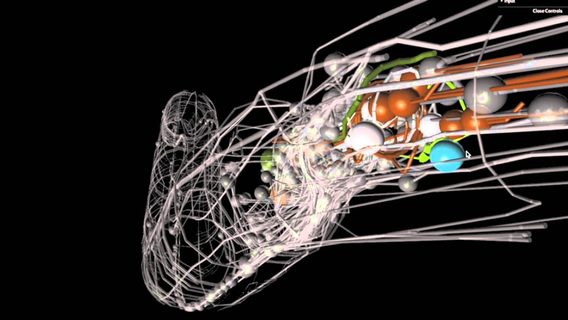
This project was launched in 2011 and was the first of its kind. Its goal is to create a complete digital model of the body, including neurons, muscles, tissues and even skin. The project was initiated by Stefan Larsson, a biologist and researcher who sees the future of medicine and science in the simulation of organisms. His team was joined by scientists from the United States, Europe and China.
OpenWorm is working to make a worm behave like its living counterpart. The idea seems simple, but it's the first step towards understanding much more complex organisms, including humans.
By developing such a model, scientists will one day be able to simulate our brain with its 86 billion neurons, which could change our understanding of the nature of consciousness and reality.
OpenWorm uses modern biological, mathematical, and software approaches to create an accurate model of the worm. The key point is a digital description of the nervous system with its 302 neurons that interact with each other and generate behavior. The results of the work are available in open source and for other researchers to use.
Organism modeling is a new way to study biology. OpenWorm allows you to test hypotheses without experiments on living beings, opening up new possibilities for understanding neurobiology and treating disease.
Team performance results as of 2024:
— A physical engine called Sibernetic has been developed to simulate worm movement.
— Models of neural connectome and muscle cells were created in NeuroML format.
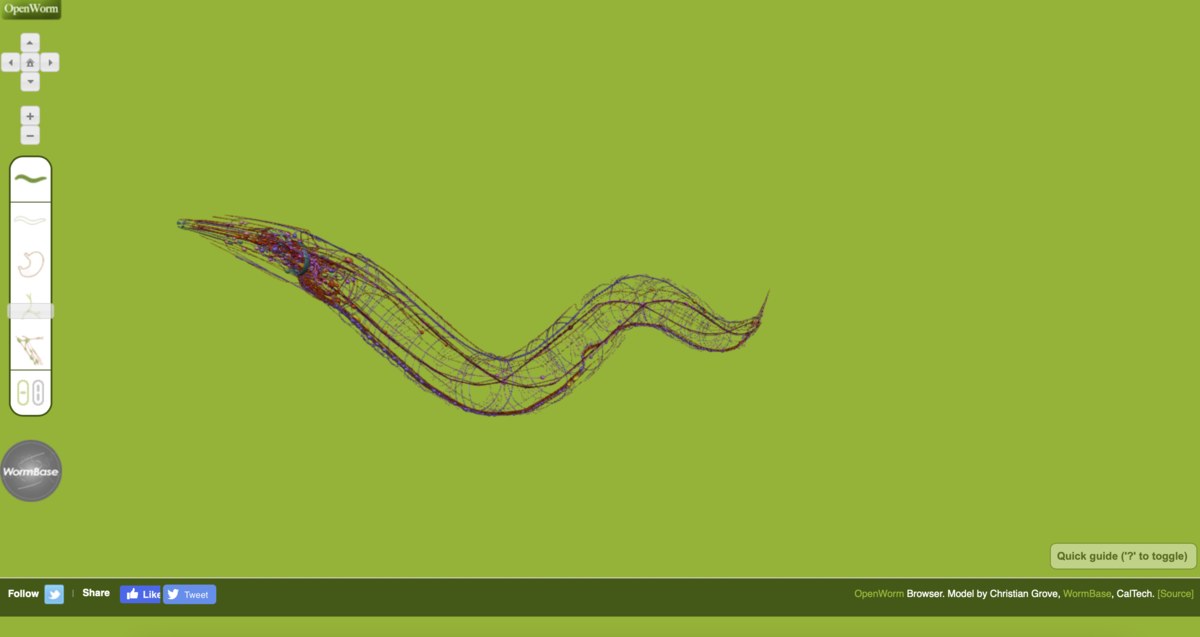
— 3D anatomical atlas of the worm is available via a web browser.
— The Geppetto platform is being developed for multi-scale modeling of biological systems.
Currently, a full simulation of all 959 C. elegans cells is not yet complete.
Supporters of OpenWorm believe it is a breakthrough in science. Open data facilitates global collaboration, and modeling organisms will become the basis for research into more complex systems, such as the human brain.
Critics wonder if we can test whether the model actually works like a living thing? Even in an organism as simple as C. elegans, it is difficult to accurately model all the cellular, physical, and neural processes. In addition, not all of the organism’s biological mechanisms are well understood or documented. Another problem may be that realistic simulations require significant computational power.