Хочете будувати кар’єру в Data Science та AI? Vodafone Big Data Lab відкриває новий набір —>
Марія БровінськаAI Eng
9 September 2026, 08:03
2026-09-09
OpenAI's internal system claims to have solved the 90-year-old Navier-Stokes problem. 10,000 AI agents worked on the proof
OpenAI’s internal system has created an analytical proof that the company claims solves one of the seven millennium problems—the existence and smoothness of solutions to the Navier-Stokes equations. OpenAI has also presented a formalization of the proof in the Lean language.
OpenAI’s internal system has created an analytical proof that the company claims solves one of the seven millennium problems—the existence and smoothness of solutions to the Navier-Stokes equations. OpenAI has also presented a formalization of the proof in the Lean language.
It is one of the most famous unsolved problems in modern mathematics. The question of whether three-dimensional equations of fluid motion can, under certain conditions, give rise to a singularity has remained open for about 90 years.
OpenAI emphasizes that the company is not claiming the Clay Mathematics Institute’s prize money for this work. The result is published as a demonstration of the capabilities of its new AI system.
What exactly were they trying to prove?
The Navier-Stokes equations describe the motion of liquids and gases. They underlie many practical problems, from aircraft design and weather forecasting to blood flow modeling.
The problem is not whether these equations can be solved for a particular situation. Mathematicians have been trying for decades to figure out a more fundamental question: whether the smooth initial motion of a three-dimensional incompressible fluid always remains smooth, or whether a singularity can arise in it after a finite time.
In this context, a singularity means a situation where the velocity of particles in a mathematical model increases without limit over a finite period of time.
This is particularly interesting because of the presence of viscosity. It, on the contrary, should smooth the motion of the fluid. That is, the mathematical construction should show how the system itself reaches a point where its description breaks down, despite this stabilizing effect.
The equations are related to the work of Claude-Louis Navier and George Gabriel Stokes in the 19th century. In 1934, Jean Leray proved the existence of generalized solutions, but the question of whether they remain smooth remained open.
In 2000, the Clay Mathematics Institute included the Navier–Stokes problem among the seven millennium problems.
AI finds a scenario in which a liquid «breaks»
According to OpenAI, its system has created analytical proof that a fluid that is initially at rest and smooth can eventually form a singularity.
In this case, a smooth external force acts on the system, and the energy of the fluid remains finite throughout the entire process — from the initial state to the moment of singularity formation.
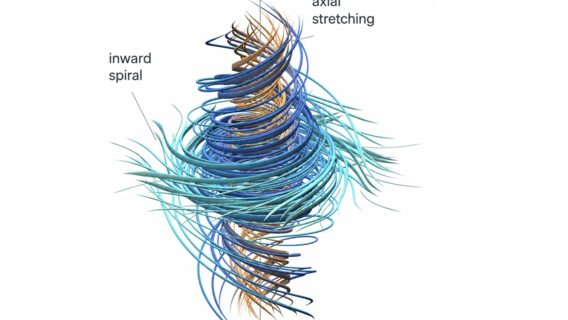
The solution is a vortex. It twists inward and simultaneously stretches along its axis—OpenAI compares its shape to spaghetti. The central region of the vortex contracts and accelerates, but the total energy remains finite.
This is where the mathematical complexity lies. The equation simultaneously involves acceleration, pressure gradients, momentum transfer, and viscosity. They must become very large, but they must exactly compensate for each other. As a result, the external force remains smooth, while the velocity of the fluid increases indefinitely.
OpenAI claims that this result is consistent with statement C, as well as D in the official statement of the Millennium Problem.
About 10,000 AI agents worked on the task simultaneously
The interesting part of the story is not just the evidence itself, but the way it was obtained.
On August 28, OpenAI began training a new internal model. And on September 1, the company’s team received information that two millennium problems could allegedly be solved.
After that, OpenAI launched a system that was supposed to test all the unsolved millennium problems and several other complex mathematical problems.
Instead of a single agent, the company used a system of coordinated AI agents. They could work with a cached version of the internet and run code, as well as share information within their groups.
The Navier-Stokes group had about 10,000 concurrent agents. OpenAI says it maintained the same safeguards during the experiment as it has during other frontier model evaluations, including isolation and monitoring.
Different versions of the problem were formulated for different groups of agents. In the case of Navier-Stokes, some systems were offered versions A and B, where a proof had to be found, and others were offered versions C and D, where the result was a counterexample.
This made it possible not to force the entire system to move in one direction.
First, the AI solved another problem — about Euler’s equation
Before Navier-Stokes, agents also worked on a somewhat simpler related problem—the regularity of Euler equations, where the term responsible for viscosity is missing.
Here, the system also found a result that OpenAI describes as a refutation of the corresponding hypothesis. It took nearly 100 agents about 50 hours to work on it.
The team then decided that Navier–Stokes was the most promising target and redirected resources from other Millennium Problems to it.
OpenAI also used Codex to aggregate the most useful results obtained by different groups of agents.
88 hours for searching and another 17 for formalization
The agents received their result on September 5 — approximately 88 hours after the job was launched.
After that, it took another 17 hours to formalize and verify the proof using Lean and GPT-6 Astra.
As a result, OpenAI published not only a mathematical text, but also a formalized proof that can be verified using a formal mathematics system.
During the entire experiment, agents sent 4.9 million messages and used about 300 billion output tokens.
Directly during the work on Navier-Stokes, they sent 2.7 million messages and used approximately 130 billion output tokens.
That is, this is not a story about a single request to a chatbot like «solve a problem that mathematicians have been unable to solve for 90 years.» This is about a huge multi-level system in which thousands of agents simultaneously searched for various mathematical constructs, checked them, and passed the results to other agents.
OpenAI is not claiming $1 million
There is an important clarification: Even OpenAI itself does not call this receiving the Millennium Prize.
The company explicitly states that its goal is to demonstrate the progress of AI models' capabilities, not to claim a cash prize.
Formally, the prize for the Navier-Stokes problem is $1 million and is awarded by the Clay Mathematics Institute. To do this, the result must undergo an appropriate process of mathematical recognition and verification. Therefore, it is more correct to say that OpenAI has published an AI-generated proof that, according to the company, solves the problem, rather than that the mathematical problem has been finally closed by the entire scientific community.
According to co-founder and IT entrepreneur Yaroslav Azhnyuk, this is a huge breakthrough that will have implications for aviation and rocketry, medicine, weather forecasting, energy, shipbuilding, semiconductor electronics, and other areas.
«But it will have a greater impact on the application of AI for further scientific inventions. To date, this is the most outstanding achievement of AI in the field of science. Obviously, this is just the beginning. And yes, of course there are two scientists, one of whom also works for OpenAI’s competitor, Antropic, who claim to have been the first to find a solution, and there is a controversy raging around this now. We live in incredible times, my friends. Incredible times,» he noted.