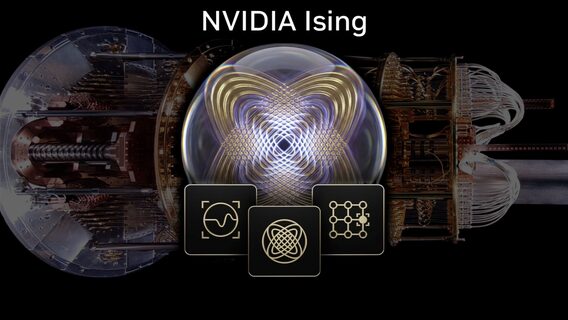
NVIDIA has unveiled Ising, its latest open AI models designed to make quantum computers more useful and faster with fundamentally new capabilities.
NVIDIA already offers an open-source development platform for quantum computing called CUDA-Q. The platform is “qubit-agnostic” and works seamlessly with different types of quantum processors (QPUs) and qubit modalities.
NVIDIA today announced Ising, its first family of open quantum AI models. The new model is designed to help researchers and enterprises build quantum processors that are not only powerful but also suitable for running real-world applications, including artificial intelligence, writes WccfTech.
However, the main bottleneck in quantum computing is currently related to the calibration of quantum processors and the correction of quantum errors. Qubits are unstable and prone to numerous errors. Today, quantum processors make errors once in a thousand operations, but in order for quantum computers to become practical, this figure must be reduced to once in a trillion operations. NVIDIA claims that artificial intelligence is the key to removing this obstacle and preparing quantum processors for large-scale and reliable computing.
Ising includes two advanced models with the possibility of personalization:
Ising Calibration: A visual-language model that can rapidly interpret and respond to data from quantum processors. This allows AI agents to automate the process of continuous calibration, reducing the time required from days to hours.
Ising Decoding: Two versions of the model based on 3D convolutional neural networks, optimized for speed or accuracy, performing real-time decoding for quantum error correction.
Ising Decoding models are up to 2.5 times faster and 3 times more accurate than pyMatching, the current open-source industry standard.
According to NVIDIA, these Ising models offer 2.5x higher performance and 3x higher accuracy in the decoding process, which is a crucial step required for quantum error correction.
Also interesting is the fact that Ising calibration is 15 times smaller than alternatives, while Ising decoding requires 10 times less data for training.
NVIDIA confirms that its open Ising AI models are now being used by leading researchers, academic institutions, and enterprises. Again, this is just one step ahead in the era of quantum computing.