“50% of our unit’s fighters are former SZChshnyky.” Interview with the commander of the NC13 NRK shock company, Mykola “Makar” Zinkevich
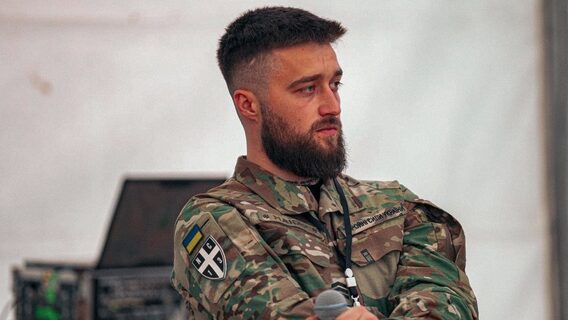
During the security conference, we managed to talk to Mykola «Makar» Zinkevich, commander of the NC13 assault rifle company (3rd OSH Brigade). We learned what kind of people become operators of ground robotic systems, what tasks they are already capable of performing (taking prisoners, holding positions), and whether robots with artificial intelligence will replace infantrymen and assault troops in the near future.
During the security conference, we managed to talk to Mykola «Makar» Zinkevich, commander of the NC13 assault rifle company (3rd OSH Brigade). We learned what kind of people become operators of ground robotic systems, what tasks they are already capable of performing (taking prisoners, holding positions), and whether robots with artificial intelligence will replace infantrymen and assault troops in the near future.
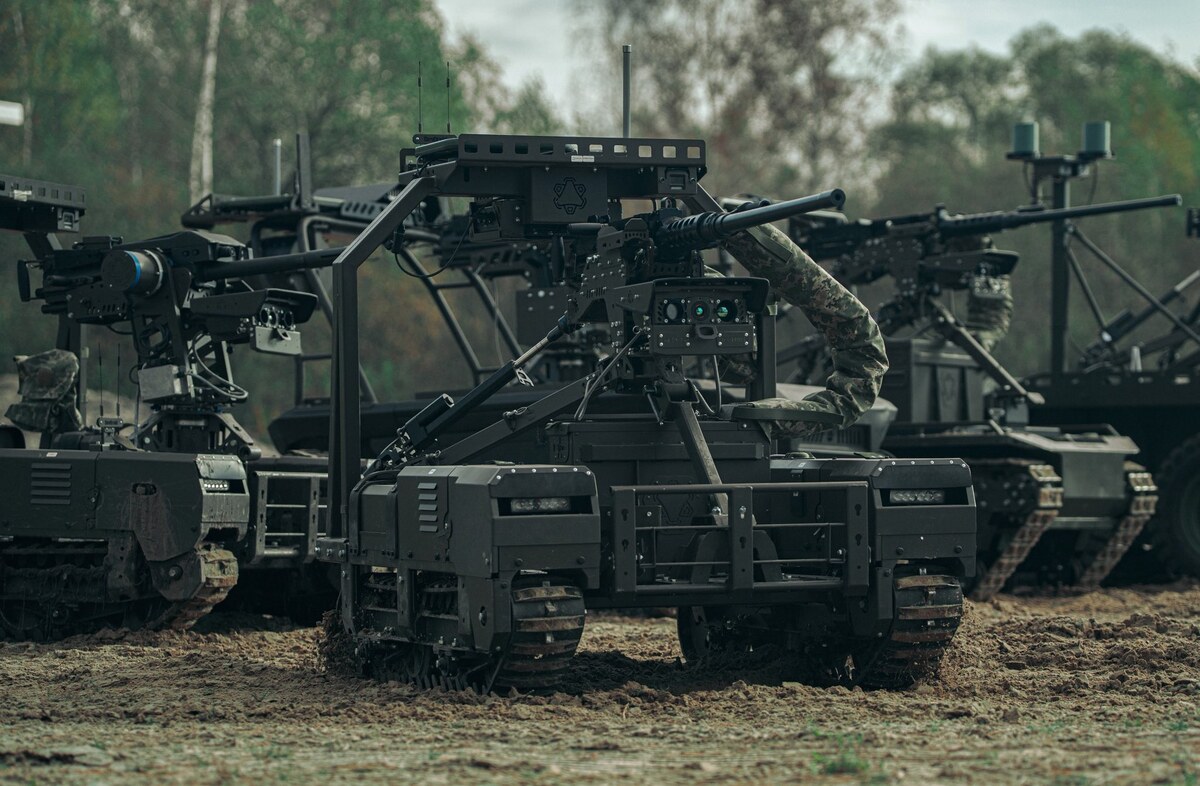
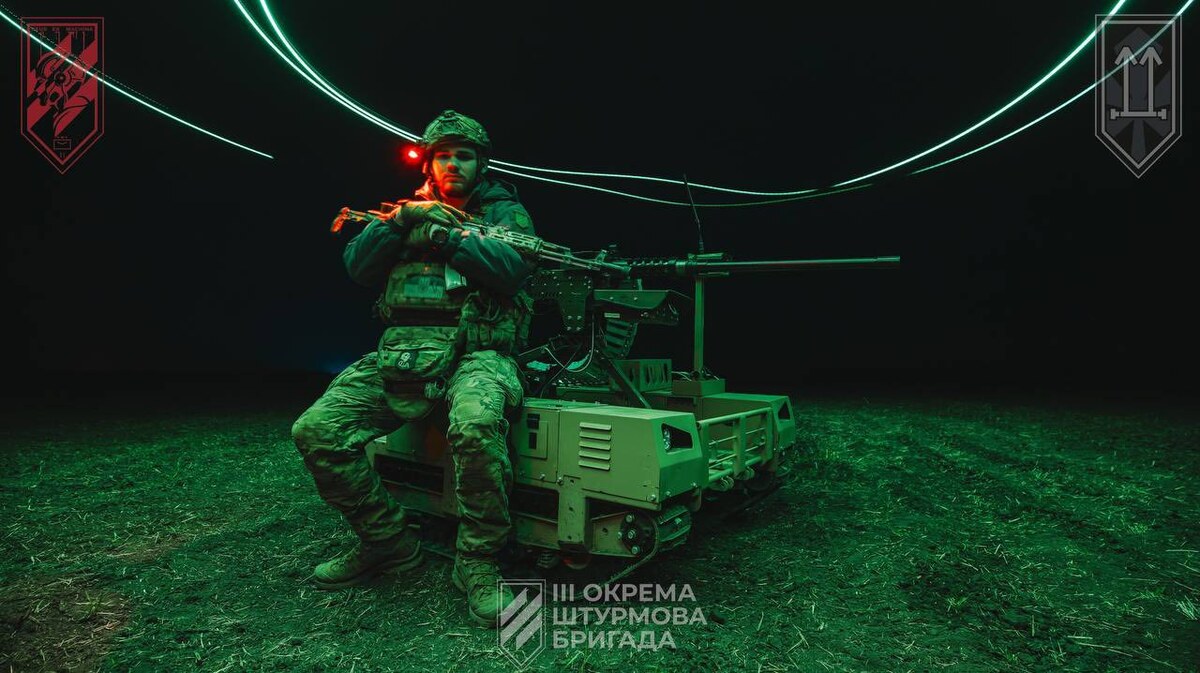
The Third Separate Assault Brigade within the Third Army Corps created a company of NC13 ground-based robotic assault systems only in August of this year. The unit’s main tasks were special operations, sabotage, bombing of dugouts, and ambushes. It should be noted that it was NC13 that was the first in the world to use drones to capture an enemy position and take prisoners.
«Makar», the unit commander, participated in the battles for Avdiivka: his brigade held back the Russians on one of the flanks so that other units of the Armed Forces of Ukraine could withdraw.
The dev.ua publication recorded a blitz interview with Mykola Zinkevych during a security forum for youth. It well reveals the topic: how and by whom (with what) Ukraine will conduct combat operations in the 25-kilometer kill zone on the contact line with the enemy in 2026.
— During your speech, you said that half of your unit is made up of those who return to the SZCH. The rest are mostly young servicemen (and there is also a small part of old fighters). I have a question: how are the SZCH who returned on their own motivated? Why did they want to join your unit on their own?
— Those who left on their own, they have some level of motivation if they came to us. That is, it is easier to work with such SZCH. You simply explain to them the vectors of the direction of movement of the unit, the order in it, discipline and everything. And you instill them in the team.
But we also get SZCH, who, for example, were discovered somewhere by the VSP, the police and sent to the procurement centers… And from there, the fighters also get to us. These people are mostly without any motivation at all.
You see, for example, there is a guy who went to the North-Eastern Front because he didn’t have a very adequate command. Now he’s with us, and he’s been there for two or three months, and he’s happy, glad that he’s fighting with us, fulfilling his combat missions, receiving financial support, and he’s normally being let go on vacation. He’s also starting to feel calmer, he’s getting motivated, he feels that he’s needed here.
He feels that no one wants to send him straight to the landing and kill him, wipe him out in assaults, they want to train him first. We have a training course for people who came from the North-Eastern Front, after they get into our company. They go through a training course for a month and a half.
These skills are added to those they already had as part of the military training they received in other units.
Our entire command of the NRK shock company is young guys. They are 23, 25, 26, 27 years old, but these are guys who were previously stormtroopers, at a young age.
And this, you could say, is a sergeant/officer staff that is already managing the unit using completely different methods than what is written in books, than it was 3, 4, 5, 10 years ago. These are new approaches, new methods of motivating personnel, new standards that are being formed. And when a person gets, so to speak, from a bad environment to an adequate one, he is ready to perform the tasks assigned to him.
And at many moments , such people have a very strong motivation because they are not abandoned, but want to be taught, taken into their team, taken into their family.
— Of course. You also said that 40% of the unit is young people in your team. How and where do you look for them?
— With young people, everything is happening more in the format of live communication with public organizations. Yes, we have organizations such as Centuria, of various kinds in our brigade. We communicate with people, show them what we have, what we are fighting with now, what technologies there are. Also, the media resource actively helps us, we actively develop our unit’s media centers and carry out recruitment and agitation of personnel. And also in our brigade, in the corps, there are such things as attack aircraft week, technology week, killhouse, FPV school, NRK school. Young people come there, they can try it, see if they like it, if they want to get involved in it in their service.
Photo from Mykola Zinkevich’s Facebook page
— This fall, as you know, some men under the age of 22 were allowed to leave the country. How did this affect you, our mobilization resource?
— I think that out of the 40% I mentioned, half are young people aged 18–20.
— So this is actually a risk group?
— Yes. And this is probably the most motivated staff, who are eager to do something right away. We slow them down a little, promise them that they need time, they need experience, they need to work a little, because they are the kind of people who ALREADY want it.
Youth and technology are such a symbiosis. It is very easy to combine, and if the vector is directed correctly, it will develop very dynamically. I can speak again for my unit: the entire management of my company of shock NRK NS-13 is young people aged 20–25. But it is young people who developed these technologies, who built them, built the tactics of their application, built the methodology, introduced these skills to the systemic level.
— I will clarify the question regarding the departure of young people: do you feel that there are fewer such people (under 22 years old)?
— Actually, I will say this, I don’t have time to follow everything that is happening at these different political and legislative levels. Because we are completely immersed in the performance of combat missions and in the development of units, and the development of the brigade, and the corps. Personally, I didn’t feel it, but in general, I think that recruiting has slowed down a bit because of this.
But on the other hand, conscious youth, especially conscious ones, will not go anywhere. I think there are many young people who are not even 18 yet, but they have already made some decisions for themselves that they will connect their lives with the army and with service.
— You said that logistics in the affected area are already being carried out half by NRCs and half by drones. And how do NRCs perform the task in terms of small arms, that is, to what extent are they already capable of waging war?
— Let me go back to logistics for a moment. I mentioned a figure of 50% (of the tasks performed by the NRC — ed.), but this 50% could be 40 tons of cargo per week. This is a colossal figure!
And if we are talking about the use of IEDs as weapons, then this is the direction of my company’s work. That is, these are sabotage tasks behind enemy lines, the elimination of shelters, support for assault operations and support for defensive operations. We are actively developing this area.
And in fact, in 2026 you will see a huge number of successful, large-scale operations using purely robotic systems.
We have already proven their applicability. We captured the enemy with the help of robotic complexes. We replaced infantry with machine-gun IRCs in positions for a month and a half. We blew up logistical routes behind enemy lines, delivering three aerial bombs there to the IRC.
Therefore, we worked it all out, built this tactic, and now Andriy Evgeniyovich Biletsky has given us the opportunity to develop a separate company of shock NRKs as part of the 3rd assault brigade.
At the beginning of the 26th year, we are preparing a number of large-scale operations, with which we will finally convince everyone that the NRC shock troops have not only the right to life, but also the right to be a systemic tool for conducting combat.
And, in particular, other brigades also actively use NRK. If you look, the 93rd actively uses machine gun NRK during assault operations. The 5th Assault: recently there was material on how they destroyed the enemy’s BMP or MTLB. These are no longer isolated cases, this is already a system.
— We often meet manufacturers of the same strike drones at exhibitions. And, in principle, if you look even at exhibitions: there are always a lot of drones, and drones, as a rule, are from only a few companies. Do you have enough resources, specifically in the combat units that are being supplied to you now?
— To be honest, there is not enough. Some of it comes through the state sector, some comes through orders directly from the brigade, some thanks to volunteers. There is probably a shortage of shock NRC units on the market. There is not a very large selection. But, probably, this is due to the fact that this topic has been irrelevant for a long time.
As we can see, there are already many logistics NRCs on the market. Why are there so many of them? Because for more than a year and a half, many teams have been effectively using these means for logistics, which is why this market is developing.
If we now start to use shock NRCs on a larger scale and more actively, then more interesting robots will appear on the market and this trend will increase. And in order to move in tandem with manufacturers, to campaign and promote this topic more, we also hold various events. We held a shock NRC forum, a crash range of shock NRCs with manufacturers: we gave them the opportunity to put themselves in the operator’s shoes, to control remotely from the dugout. Many manufacturers began to modernize their equipment after that.
So yes, there is a lack of NRC, but we are working on it.
— How many NRCs are needed in total, in pieces?
— There won’t be many robots. There will always be few of them. But again, logistics. This is the simplest example that can be given. One battalion as a whole carries an average of up to 1,000 kilograms per night.
If we take 800 kilograms of cargo and give it to the infantry (to carry on their backs), then we would have to give 20 kilograms to each soldier. It turns out that we save the lives of 41–42 infantrymen per night.
If we talk about shock-absorbing IEDs, then, for example, the M2 Browning machine gun crew is 3–4 people. We are replacing the work of 3–4 people on the battlefield.
It’s simple math, so we need a lot. The more we have, the more we’ll replace.
— Regarding the autonomy of the NRC, is the use of artificial intelligence mainstream in your country?
— Our unit is partly autonomy haters. We are not against artificial intelligence helping us to guide, helping to patrol the sector, but we are against it being able to make its own decisions, if we are talking about strike IRCs, and independently control the vehicle on the battlefield — that is, for it to drive with the help of AI from point A to point B. In my opinion, and in the opinion of my unit, this is an unnecessary thing, since this is a battlefield, and IRCs are a tool that simply replaces a person there, that is, replaces his hands.
There is a weapon, there is a person. A person holds a weapon with his hands. And, in fact, the NRC replaces these hands in order not to substitute the fighter. But we consider it unnecessary to give the work autonomy.
— By the way, your colleague from Achilles said during his speech that in 2026 he will try to transfer drone operators to the rear, to Kyiv conditionally, and leave engineers on the battlefield. Is this a realistic idea and does such a distance make sense?
— Quite real, maybe even more.
— Is it possible, for example, to attract operators and pilots from other countries to fly drones on the battlefield?
«Anything is possible, anything is possible. In fact, I think what my colleague said is that they’re already trying it, they’re scaling it up. It’s a perfectly normal practice.»
— So is this the future or is it already happening now?
— I think this is not the future, this is already the present.
— No one from other countries is in charge yet?
— I think, from other countries — definitely not, but it is definitely an opportunity to take operators to a distance. An operator is first and foremost a specialist, a professional. The representative of «Achilles» (Yuriy Fedorchenko, commander of the 429th separate unmanned systems regiment — ed.) correctly noted that a pilot is a professional in his field. Let’s remember how long it takes to train an F-16 pilot, how long it takes to train a professional tanker, a professional water mechanic of armored vehicles, and so on.
Photo from Mykola Zinkevich’s Facebook page
All this takes time. And each trip is an experience that he accumulates. And this experience is unique. And we have no right to allow ourselves to lose such specialists. It is better to accumulate their experience, and then they can transfer it to other operators, scale it up.
We need to educate professionals of modern, new, technological warfare. And protect them. Therefore, taking them beyond the boundaries of defeat, into civilian cities, is a completely cool and positive practice, in my opinion. This needs to be implemented.
— Last question. I listened to your discussion on the panel: there is already a kill zone 25 km long. There are many drones in it, many IRCs, fiber optics and other means of destruction. But inside there are still people — infantrymen. Who should they be?
«They’re not people, they’re titans.»
«Where can we get such titans? Or should we also replace them with robots?»
— You won’t completely replace them with robots, because where there are a lot of infantrymen, this territory will be considered ours. You can’t cancel that here. You can’t take an infantryman off the battlefield, but I believe that up to 80% of his tasks can be removed thanks to various technological processes.
— So the infantryman will risk his life less?
— If we remove 80% of the tasks from it and take them to technological processes, then, probably, yes. But the enemy will also focus on it with the same percentage of technology. Therefore, the question here is, with an asterisk.
But I will say, I was an infantryman and an assault rifleman in 2022–2023 and early 2024, when the active military who fought in 2015–2017 said: «Guys, it was easier in our time! How do you even fight?»
And now I look at the infantrymen, the stormtroopers, the conditions in which they are fighting now, and I understand that from 2024 to 2025 the front has completely changed.
And I don’t understand how much strength, encouragement, moral will, and titanic spirit it takes to continue to know what awaits you and to fight in such conditions. This deserves very, very much respect and support.
And I believe that an infantryman with an assault rifle is the main thing in the Ukrainian army. And everything that surrounds them should work for them. Everything — completely. That is, all technologies, all processes, all developments — everything should be aimed at helping the Ukrainian infantryman survive.
Атлас зброї: Україні передали шведські танки Stridsvagn 122. Які ще танки отримали захисники та від кого
Швеція передала Україні 10 танків Stridsvagn 122 з українськими екіпажами, навченими у Швеції, пише «Європейська правда», посилаючись на пресслужбу Збройних сил Швеції.
Раніше ми збирали, які ще танки Україні вже передали інші країни.
(текст від 29 липня 2022)
Німеччина передасть Україні 14 наземних безпілотників THeMIS. Що це за машини та як вони працюють
Німеччина передасть Україні 14 наземних безпілотників THeMIS. Імовірно, 7 таких транспортних засобів прибудуть до України до кінця цього року, вони призначені для евакуації поранених. Інші очікуються у 2023 році — їх будуть використовувати для очищення доріг. Нагадуємо, що це за зброя і що вона вміє.
Атлас зброї: Німеччина передає захисникам чергові MARS II. Які ще РСЗВ отримала Україна від західних партнерів та як вони працюють
Федеральне міністерство оборони Німеччини повідомило у Twitter, що у найближчі кілька тижнів Україні будуть передані чергові системи залпового вогню MARS II.
Раніше ми розповідали про те, які РСЗВ партнери надіслали на допомогу українським воїнам. Нагадуємо про це знову.
(Текст від 26 липня)
«У кращому разі це кінець 1990-х». NYT описав, чому російські ракети неточні, хто постачає мікрочипи ворогу та які системи озброєння може повторити навіть студент
Дослідники, які вивчали електроніку в новітніх російських крилатих ракетах та ударних гелікоптерах, були здивовані, виявивши технологію десятилітньої давності, використану в попередніх моделях, пише The New York Times. Розповідаємо, які висновки зробили американські дослідники стосовно зброї ворога.