Хочете будувати кар’єру в Data Science та AI? Vodafone Big Data Lab відкриває новий набір —>
Наталя ХандусенкоAI Eng
20 March 2025, 13:13
2025-03-20
All about NVIDIA GTC 2025: the most powerful chips for AI, new software for developers, the world's first base model for humanoid robots, cooperation with Disney and General Motors
In San Jose, California, Nvidia held its annual GTC 2025 conference, during which the company’s CEO Jensen Huang introduced Dynamo software for developers and AI factories, powerful AI chips, the world’s first base model for humanoid robots Isaac GR00T N1, and more.
In San Jose, California, Nvidia held its annual GTC 2025 conference, during which the company’s CEO Jensen Huang introduced Dynamo software for developers and AI factories, powerful AI chips, the world’s first base model for humanoid robots Isaac GR00T N1, and more.
NVIDIA Dynamo for AI Developers
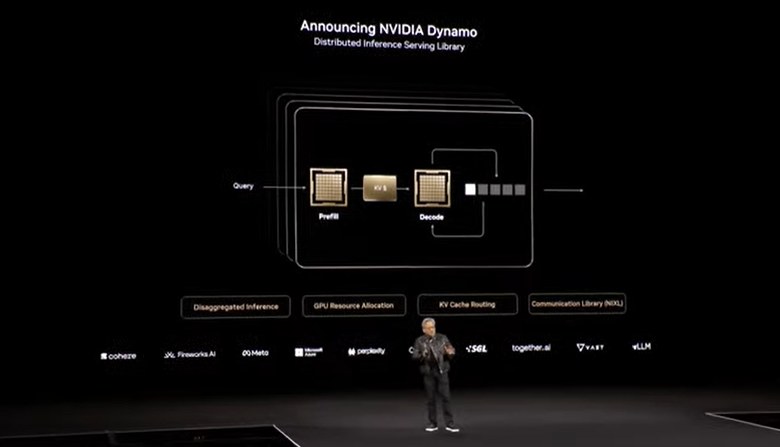
Nvidia Dynamo is open source software that can effectively increase performance and simplify scaling of advanced LLM reasoning while reducing the cost of token generation. It is not just software for independent AI developers, but a solution that AI factories need.
Dynamo accelerates data transfer between GPUs in multi-node systems and separates the pre-fill and output decoding phases, allowing both phases to be optimized to ensure the most efficient allocation of GPU compute resources.
In addition, Nvidia Dynamo offers the following features:
Up to 2x throughput improvement through disaggregated service;
3x improvement in time to first request with KV-aware routing;
40% TTFT improvement due to offloading system memory for KV cache.
The company claims to have used Dynamo to generate 30x more tokens on GPUs when running the DeepSeek-R1 model on a large GB200 NVL72 rack cluster and to double the performance of the Hopper GPUs serving the Llama models.
Blackwell Ultra and Vera Rubin AI chips
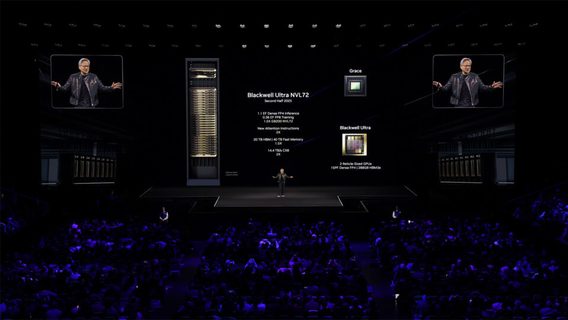
The Blackwell Ultra family of chips will be introduced in the second half of this year. Vera Rubin, the next-generation GPU, is expected in 2026, CNBC writes .
The Vera Rubin system, named after astronomer Vera Rubin, consists of two main components: a central processing unit called Vera and a newly designed graphics processor called Rubin.
Vera’s custom design will be twice as fast as the processor used in last year’s Grace Blackwell chips, the company said.
Combined with Vera, Rubin can handle 50 petaflops. That’s more than double the company’s current Blackwell chips. Rubin can also support up to 288 gigabytes of fast memory, one of the key features AI developers are looking for.
Nvidia also announced new versions of its Blackwell chip family, which it called Blackwell Ultra .
This chip will be able to produce more tokens per second, meaning it can generate more content in the same amount of time as its predecessor, the company said.
Nvidia says this means cloud providers can use Blackwell Ultra to offer a first-class AI service for time-sensitive applications, allowing them to generate 50 times more revenue from the new chips than the Hopper generation, which was released in 2023.
The Blackwell Ultra will come in a dual Nvidia Arm processor version called the GB300 and a GPU-only version called the B300. It will also be available in eight GPU versions in a single blade server and in a rack version with 72 Blackwell chips.
Recall that the company also introduced the world’s smallest desktop supercomputers on the Blackwell Ultra platform — NVIDIA DGX.
Isaac GR00T N1 — the world’s first basic model for humanoid robotics
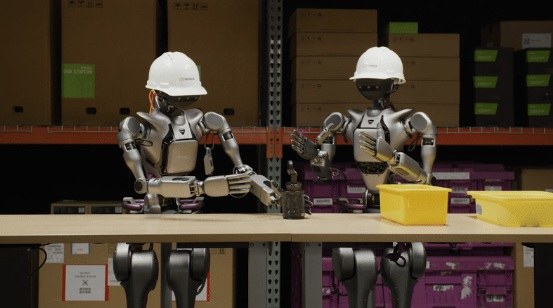
Nvidia has announced the Isaac GR00T N1, the first open, fully customizable base model for generalized humanoid thinking and skills. The GR00T N1 is the first in a family of fully customizable models that Nvidia plans to release to robotics developers around the world.
The GR00T N1 base model has a dual-system architecture inspired by human cognition. «System 1» is a fast-thinking model that reflects human reflexes and intuition. «System 2» is a slow-thinking model for deliberate, methodical decision-making.
Based on a vision language model, System 2 reasoned about the environment and received instructions to plan actions. System 1 then translated those plans into precise, continuous robot movements. It trained on human demonstration data and vast amounts of synthetic data generated by NVIDIA.
During his talk, Huang demonstrated the 1X humanoid robot, which autonomously performs household cleaning tasks using a «post-learning policy» built on the GR00T N1. The robot’s autonomous capabilities are the result of a collaboration between 1X and Nvidia in the field of AI training.
Nvidia says the GR00T N1 can easily generalize common tasks (such as grasping, moving objects with one or both hands, and transferring objects from one hand to the other) or perform multi-step tasks that require extended context and a combination of common skills. Additional developers with early access to the GR00T N1 include Agility Robotics, Boston Dynamics, Mentee Robotics, and Neura Robotics.
Nvidia teams up with Disney and Google DeepMind AI in AI Robotics project
Nvidia announced a collaboration with Disney Research and Google’s DeepMind AI lab to develop Newton, described as an open-source physics engine that allows robots to learn to solve complex tasks with greater accuracy.
Built on NVIDIA’s Warp framework, Newton will be optimized for robot training and compatible with simulation frameworks such as Google DeepMind’s MuJoCo and NVIDIA Isaac Lab. In addition, the three companies plan to enable Newton to use Disney’s physics engine.
Google DeepMind and NVIDIA are collaborating on the development of MuJoCo-Warp, which is expected to accelerate robotics machine learning workloads by more than 70 times and will be available to developers through Google DeepMind’s open-source MJX library, as well as through Newton.
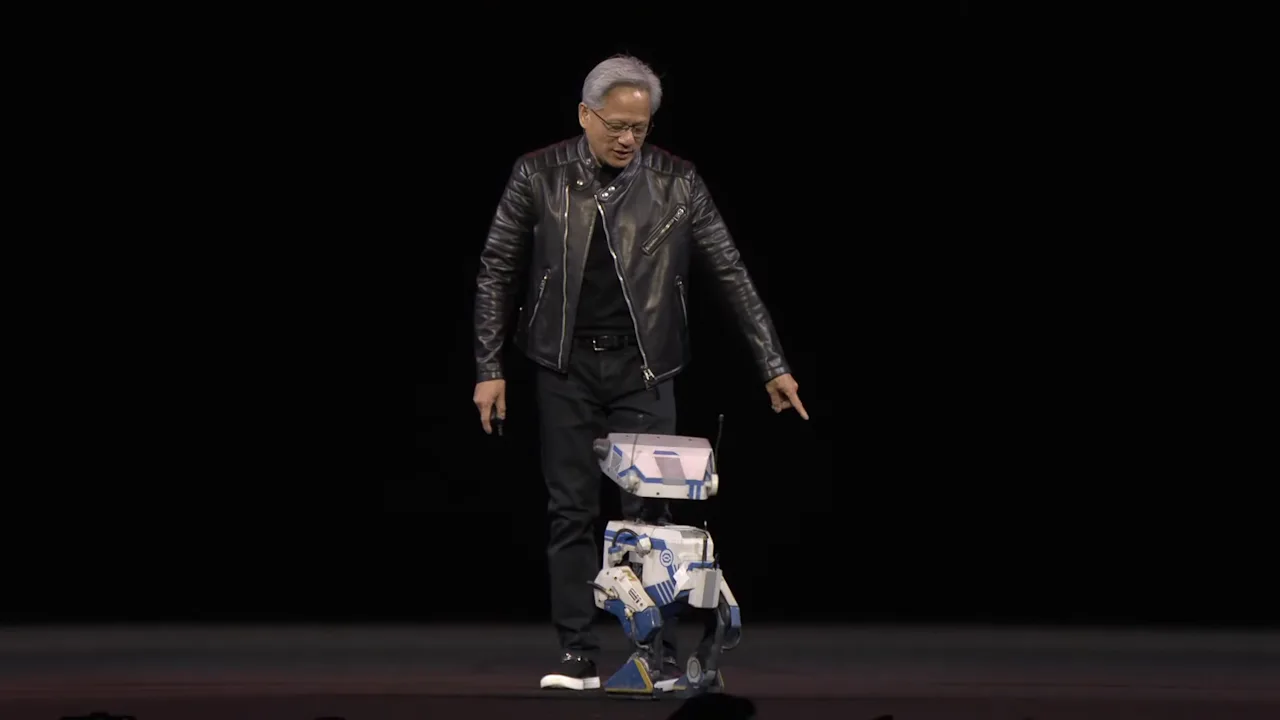
Disney Research will be one of the first partners to use Newton. The Mouse House plans to use the AI-powered technology to enhance its robotic character platform, which powers next-generation entertainment robots, such as the Star Wars-inspired «BDX» droids that joined Huang on stage during his performance.
General Motors and NVIDIA collaborate on artificial intelligence
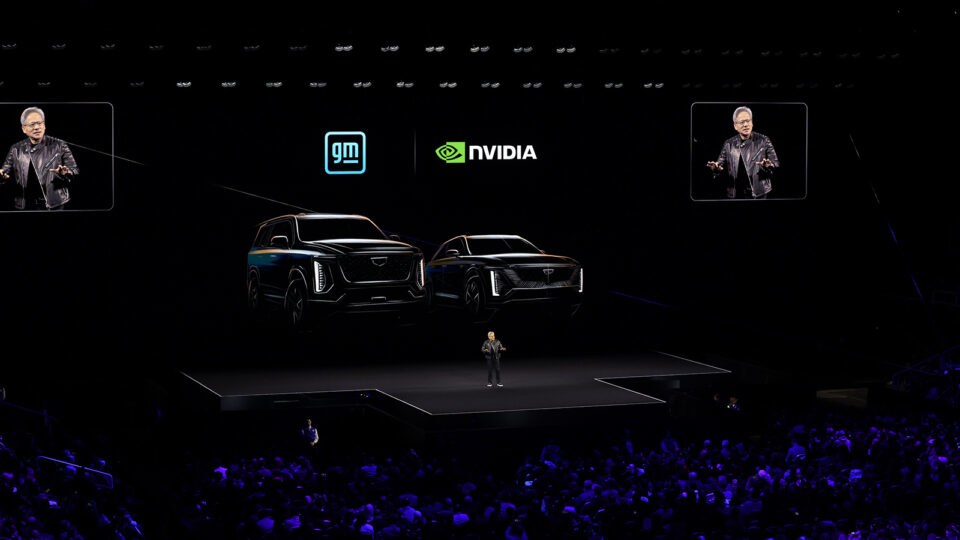
GM, the largest U.S. automaker, is leveraging NVIDIA AI, simulation, and accelerated computing to develop next-generation cars, factories, and robots. The company also announced NVIDIA Halos, a comprehensive safety system that combines NVIDIA’s line of automotive safety hardware and software solutions with leading-edge AI research in audio and video safety.
«The era of physical AI has arrived, and together with GM, we are transforming transportation, from cars to the factories where they are made,» said Jensen Huang.