Хочете будувати кар’єру в Data Science та AI? Vodafone Big Data Lab відкриває новий набір —>
Наталя ХандусенкоAI Eng
6 March 2026, 16:31
2026-03-06
Nvidia says it no longer plans to invest in OpenAI and Anthropic
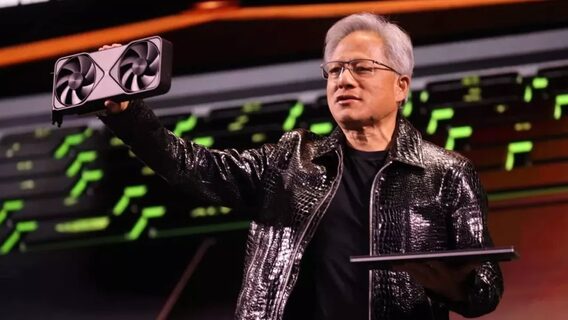
Nvidia's latest statements suggest that the company's financially strong partnerships with leading AI developers have entered a new phase. During a conference call with Morgan Stanley, CEO Jensen Huang noted that previous investments in OpenAI and Anthropic will likely be the company's last. He explained this by saying that the upcoming IPOs of these startups are a natural conclusion to such deals.
Nvidia's latest statements suggest that the company's financially strong partnerships with leading AI developers have entered a new phase. During a conference call with Morgan Stanley, CEO Jensen Huang noted that previous investments in OpenAI and Anthropic will likely be the company's last. He explained this by saying that the upcoming IPOs of these startups are a natural conclusion to such deals.
Jensen Huang’s explanation was succinct, but its implications are far-reaching. Nvidia, whose products have become indispensable to the infrastructure of generative AI, finds itself in a unique position: the company is both a key hardware supplier and a shareholder for the very software developers who build products based on its chips. This model, which used to be mutually beneficial, now looks increasingly complex and confusing.
By the time Nvidia finalized its stake in OpenAI’s latest $110 billion funding round last week, its actual investment had shrunk to about $30 billion. Analysts saw the reduction less as a financial constraint than as a signal of waning interest. Concerns that AI startups and their suppliers were artificially inflating each other’s valuations have fueled broader discussions about an investment bubble across the industry.
If Nvidia's ties with OpenAI have become opaque, its relationship with Anthropic has been downright strained. In November, the chipmaker invested about $10 billion in model developer Claude, deepening a partnership that was then positioned as a multi-cloud collaboration with Google and Microsoft.
But just two months later, Anthropic CEO Dario Amodei spoke at the World Economic Forum in Davos, Switzerland, with a scathing critique of U.S. chipmakers for selling high-performance AI systems to Chinese customers. He compared such deals to “selling nuclear weapons to North Korea,” a remark that many took as a veiled rebuke to Nvidia itself.
Since then, the fallout has escalated. The Trump administration has blacklisted Anthropic as a “supply chain risk,” barring federal agencies and defense contractors from using its models—though the issue appears to still be under discussion behind the scenes. The move was in response to the company’s refusal to allow its AI systems to be used for autonomous weapons or domestic surveillance.
Then OpenAI announced a new partnership with the Pentagon, a deal that Amodei publicly called “false,” claiming that OpenAI had exaggerated the scope of the military collaboration. The public backlash was immediate and ironic: According to Sensor Tower, Anthropic’s Claude app shot to number one on Apple’s free apps chart, displacing ChatGPT , after months of not even making it into the top 100.
Huang’s comment, made in San Francisco at a conference this week—that once OpenAI and Anthropic go public, new investment opportunities will virtually disappear—fits into a convenient narrative of “natural progression.” But the norms of late-stage investing in Silicon Valley suggest otherwise: companies often continue to invest in startups right up until the initial public offering (IPO).
This discrepancy has led some observers to see Nvidia’s recent caution as a pragmatic retreat rather than a matter of procedural timing. With geopolitical pressures mounting, regulatory scrutiny tightening, and valuations of AI companies soaring into the hundreds of billions of dollars, the world’s most valuable semiconductor company has likely decided that its hardware (and software) advantages are more than enough leverage.
Як нейромережі бачать вільну та незалежну Україну? Тест dev.ua
Нейронні мережі для генерації зображень бачать світ по-своєму, їхню логіку зрозуміти часом зовсім неможливо. Але таки хочеться. На честь Дня Незалежності України редакція dev.ua вирішила провести невеликий експеримент.
Ми задали чотирьом різним нейронним мережам п’ять однакових запитів: «прапор України», «День Незалежності України», «український Крим», «перемога України» та «українці». Отриманими результатами ми ділимося з вами нижче.
У TikTok тепер можна генерувати фон за допомогою нейромережі. Ми протестували її та ділимося результатами
У TikTok з’явилася нова функція «Розумний фон». З її допомогою як фон для тіктоків можна підставляти згенеровані нейромережею зображення. Редакція dev.ua протестувала цю технологію і ділиться своїми враженнями.