Хочете будувати кар’єру в Data Science та AI? Vodafone Big Data Lab відкриває новий набір —>
Олександр КузьменкоAI Eng
10 February 2025, 17:59
2025-02-10
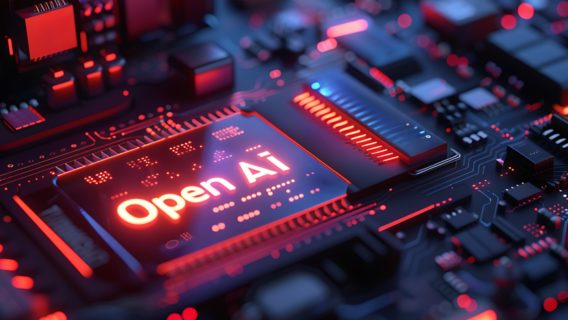
OpenAI completes development of its first proprietary chip and prepares to send it into production
OpenAI will complete the development of its first in-house artificial intelligence chip in the next few months. The company plans to send it to Taiwan Semiconductor Manufacturing soon, but mass production will not begin until 2026.
OpenAI will complete the development of its first in-house artificial intelligence chip in the next few months. The company plans to send it to Taiwan Semiconductor Manufacturing soon, but mass production will not begin until 2026.
The process of sending the first design through a chip manufacturing facility is called «taping out.» It typically costs tens of millions of dollars, and it will take about six months to produce a finished chip, unless OpenAI pays significantly more for expedited production. There is no guarantee that the chip will work after the first taping, and if it fails, the company will have to diagnose the problem and repeat the taping phase.
OpenAI reportedly sees the training chip as a strategic tool to strengthen the company’s negotiating leverage with other chip suppliers. After the first chip, OpenAI engineers plan to develop increasingly advanced processors with broader capabilities with each new iteration.
If the first version is successful, it would allow ChatGPT to begin mass production of its first AI chip and possibly test an alternative to Nvidia chips later this year. OpenAI’s plan to submit its design to TSMC this year shows that the startup has made rapid progress in developing its first project, which can take other chipmakers years.
According to industry sources familiar with chip development budgets for an ambitious, large-scale program, a single version of the chip could cost $500 million. That cost could double if the necessary software and peripherals need to be built around it.
Generative AI model makers like OpenAI, Google, and Meta have demonstrated that more chips clustered together in data centers make the models smarter. As a result, they need as many of these chips as possible.
OpenAI’s own AI chip, while capable of both training and running AI models, will initially be deployed on a limited scale, primarily for running AI models, the sources said. The chip will have a limited role in the company’s infrastructure.
To deploy a program as comprehensive as Google or Amazon, OpenAI would need to hire hundreds of engineers. TSMC is manufacturing OpenAI’s AI chip using its advanced 3-nanometer process. The chip uses a common architecture with high-bandwidth memory (HBM), which Nvidia also uses for its chips, the sources said.
OpenAI previously aired its first ad during the Super Bowl, the final game of the professional American football season, which is watched by over 100 million viewers each year. In its ad, OpenAI placed AI on a par with humanity’s most significant inventions.
Як нейромережі бачать вільну та незалежну Україну? Тест dev.ua
Нейронні мережі для генерації зображень бачать світ по-своєму, їхню логіку зрозуміти часом зовсім неможливо. Але таки хочеться. На честь Дня Незалежності України редакція dev.ua вирішила провести невеликий експеримент.
Ми задали чотирьом різним нейронним мережам п’ять однакових запитів: «прапор України», «День Незалежності України», «український Крим», «перемога України» та «українці». Отриманими результатами ми ділимося з вами нижче.
У TikTok тепер можна генерувати фон за допомогою нейромережі. Ми протестували її та ділимося результатами
У TikTok з’явилася нова функція «Розумний фон». З її допомогою як фон для тіктоків можна підставляти згенеровані нейромережею зображення. Редакція dev.ua протестувала цю технологію і ділиться своїми враженнями.