Олександр КузьменкоAI Eng
30 July 2026, 10:55
2026-07-30
OpenAI and Alibaba release new voice AI models for developers
American OpenAI and Chinese Alibaba have simultaneously announced the release of new artificial intelligence models designed for voice processing and generation. The updates include solutions for instant speech-to-text conversion during live conversations, as well as full-fledged models for direct dialogues between the user and AI.
American OpenAI and Chinese Alibaba have simultaneously announced the release of new artificial intelligence models designed for voice processing and generation. The updates include solutions for instant speech-to-text conversion during live conversations, as well as full-fledged models for direct dialogues between the user and AI.
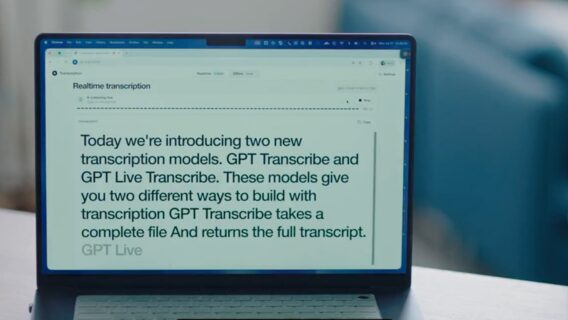
OpenAI has expanded its API with two new transcription tools, GPT-Live-Transcribe and GPT-Transcribe. The former is designed for real-time tasks with minimal latency, while the latter is focused on processing ready-made audio files in batch mode. The main innovation of both models is the ability to take into account arbitrary recording context (industry terminology, special keywords, expected languages, and pre-transcribed lines).
According to OpenAI, context support increased semantic accuracy from 38,5% to 44,6% for GPT-Live-Transcribe and from 41,6% to 45,2% for GPT-Transcribe. In tests on real audio recordings, GPT-Live-Transcribe’s error rate dropped to 9,60% (versus 11,65% for GPT-Realtime-Whisper), and GPT-Transcribe showed an error rate of 8,98% compared to 15,21% for Whisper-1. According to Artificial Analysis, GPT-Transcribe’s error rate was even lower at 3,31%, and the cost of use is $4.50 per 1,000 minutes.
We’re introducing two new transcription models in the API:
• GPT-Live-Transcribe: built for low-latency live transcription. • GPT-Transcribe: optimized for asynchronous transcription of completed audio files and batch workloads.
At the same time, Alibaba introduced the Qwen-Audio-3.0-Realtime Plus and Flash models, focused on direct speech-to-speech interaction. They support full-duplex mode, allowing the user to interrupt the AI interlocutor right during the speech, and also allow you to call external functions and use your own cloned voices.
According to the Speech-to-Speech Index from Artificial Analysis, the Qwen-Audio-3.0-Realtime Plus model took first place with a score of 84,1%, ahead of the GPT-Realtime-2.1 High model from OpenAI, which scored 79,1%. The Chinese model outperformed its competitor in tests of logical thinking and conversation dynamics. However, the weak point of Alibaba’s development remains latency: the time to the first audio signal is about 4 seconds compared to 1.14 seconds in the OpenAI analogue.
Earlier, DeepL’s chief scientific officer Stefan Mesken said that artificial intelligence in voice translation overcomes the «uncanny valley» stage and reaches the level of natural communication with the preservation of emotions and intonations. Thanks to new technologies, people will be able to freely speak their native language without barriers using smart glasses or phones.
Як нейромережі бачать вільну та незалежну Україну? Тест dev.ua
Нейронні мережі для генерації зображень бачать світ по-своєму, їхню логіку зрозуміти часом зовсім неможливо. Але таки хочеться. На честь Дня Незалежності України редакція dev.ua вирішила провести невеликий експеримент.
Ми задали чотирьом різним нейронним мережам п’ять однакових запитів: «прапор України», «День Незалежності України», «український Крим», «перемога України» та «українці». Отриманими результатами ми ділимося з вами нижче.
У TikTok тепер можна генерувати фон за допомогою нейромережі. Ми протестували її та ділимося результатами
У TikTok з’явилася нова функція «Розумний фон». З її допомогою як фон для тіктоків можна підставляти згенеровані нейромережею зображення. Редакція dev.ua протестувала цю технологію і ділиться своїми враженнями.