Хочете будувати кар’єру в Data Science та AI? Vodafone Big Data Lab відкриває новий набір —>
Ігор Вишневський AI Eng
27 June 2026, 10:10
2026-06-27
OpenAI has released three new models of the GPT-5.6 series, with the flagship Sol at the helm. However, they are currently being tested by clients close to the Trump administration.
OpenAI has unveiled three new models, including its flagship Sol, but they are currently in «limited preview» due to new requirements from the Trump administration.
OpenAI has unveiled three new models, including its flagship Sol, but they are currently in «limited preview» due to new requirements from the Trump administration.
As OpenAI reported on its official website, the flagship model Sol, as well as Luna and Terra, are part of the GPT‑5.6 series.
«Terra is a balanced model for everyday work, and Luna is a fast and affordable model. Terra has competitive performance compared to GPT‑5.5, but at half the price, while Luna offers powerful capabilities at the lowest price,» the company announced.
Meanwhile, GPT‑5.6 Sol was announced with «the most robust security suite to date.» The company said it has strengthened protections against high-risk activities, sensitive cyber requests, and repeated abuse, and has spent weeks searching for vulnerabilities, stress-testing the system, and protecting it from real-world attacks.
«We believe in broad availability and plan to make GPT-5.6 Sol, Terra, and Luna publicly available in the coming weeks. As part of our ongoing collaboration with the US government, we have been providing them with a preview of our plans and the capabilities of the models prior to launch. At their request, we are starting with a limited preview for a small group of trusted partners, whose participation has been notified to the government, before releasing them for wider use,» OpenAI explained.
Features and specifications
GPT-5.6 Sol is described by the company itself as their strongest model to date. To back up these claims, the company shared a set of benchmarks showing improved agent capabilities in coding, biology, and cybersecurity.
OpenAI explained that in GPT-5.6 they «introduced a new way of thinking to give Sol as much time as possible for deep thinking.» In addition, when using this model, a new mode is introduced that goes beyond the capabilities of a single agent, using subagents to speed up complex work.
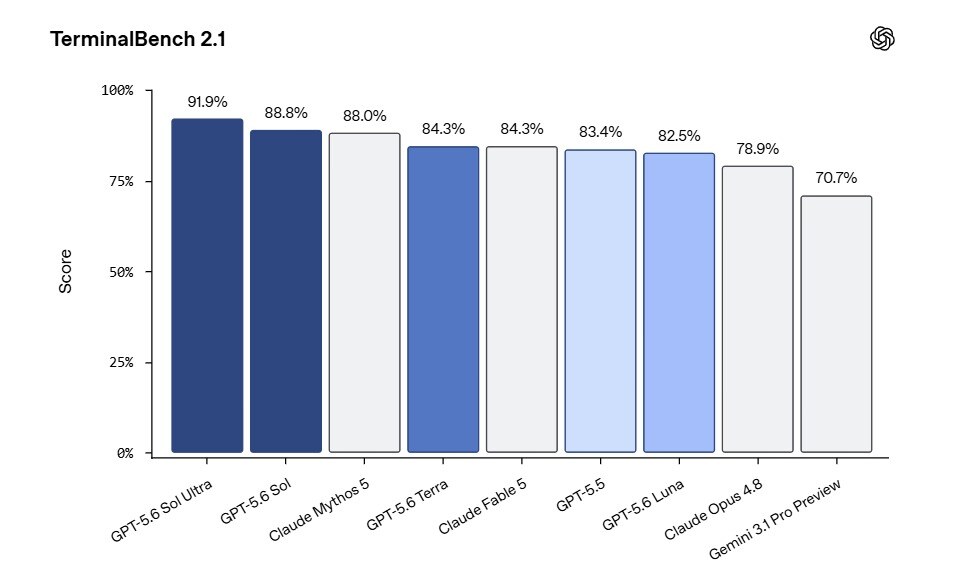
Encoding capabilities with GPT‑5.6 Sol are demonstrated using the Terminal‑Bench 2.1 benchmark.
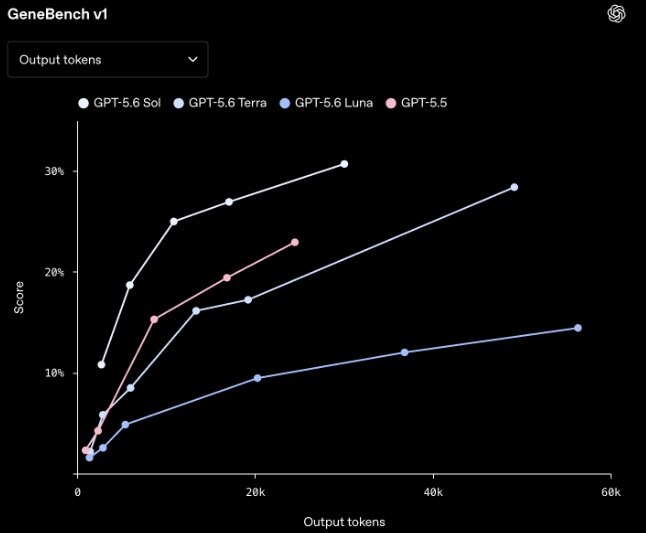
GPT-5.6 Sol also shows significant improvements in biology performance. On GeneBench v1, which evaluates long-term genomic and quantitative biological analyses, it achieves better results than GPT-5.5 while using fewer tokens.
The company also reiterated that GPT‑5.6 Sol is their most powerful cybersecurity model, rivaling Anthropic’s Mythos in performance while using only about 1/3 of the original tokens.
They also add that benchmark thresholds cannot cover all ways in which a model can be used or combined with other tools.
Interestingly, GPT-5.6 models are trained to deny unauthorized cyber assistance, including when users try to hide their intentions or jailbreak the model. «These model-level safeguards establish a first line of defense around what the model should and should not help with,» the release states.
Prices
It is reported that during the preview, GPT‑5.6 models will initially be available via API and Codex to a select group of trusted partners and organizations.
The difference in the cost of using the three GPT‑5.6 class models is as follows: Sol — $5 input / $30 output; Terra — $2.50 input / $15 output; and Luna — $1 input / $6 output.
Prehistory
Recall that the Trump Administration previously introduced a rule requiring AI companies to release their models in a test period with limited access to a number of users designated by the US government. In particular, the Trump administration asked OpenAI to delay the release of GPT-5.6 on the condition that the government itself decides who will get access first.
Meanwhile, OpenAI’s main competitor, Anthropic, was forced to urgently block access to its flagship AI models, Fable 5 and Mythos 5, more than a month ago at the request of the US government. The government issued a corresponding export control order, citing national security issues.