Mathematics of Attrition: Why the Enemy's Bet on a Missile Deficit Worked and How to Return Kyiv from the Conditional 2022
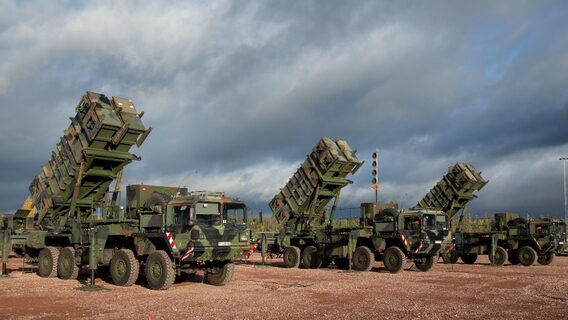
The recent combined attacks on the Ukrainian capital have clearly highlighted a catastrophic trend that can no longer be ignored. The Russian military has figured out the main vulnerability of our air defense system — the physical shortage of PAC-2/PAC-3 anti-ballistic missiles.
The recent combined attacks on the Ukrainian capital have clearly highlighted a catastrophic trend that can no longer be ignored. The Russian military has figured out the main vulnerability of our air defense system — the physical shortage of PAC-2/PAC-3 anti-ballistic missiles.
The picture looks contrasting: while mobile fire groups and electronic warfare units successfully eliminate more than 90% of the Shaheds, and classic anti-aircraft missile systems hold their own against cruise missiles, heavy ballistics (Iskander-M, supersonic Zircons) are increasingly breaking through the dome over Kyiv. Patriot anti-missiles are simply physically insufficient. The capital has once again found itself in a critically vulnerable state of the 2022 model.
What does this mean in terms of military technology and the global military-industrial complex? Let’s look at the numbers, algorithms, and alternatives.
Crisis of global production vs speed of use
Cruel mathematics from analysts and the Ministry of Defense shows: the entire Western world today produces fewer Patriot anti-missiles per month than Russia produces for Ukraine over the same period.
The current maximum production capacity of the state-of-the-art PAC-3 MSE missiles is about 52 units per month .
As for the Russians, according to the GUR data, which NV refers to, within a month their industry is capable of producing: up to 60 units of Iskander-M and up to 10 Iskander-K. As well as up to 5 units of «Onyxes» and up to 3 «Zircons».
Now let’s calculate the intensity of the shelling: in just the last four massive attacks on Kyiv, the enemy launched 114 ballistic and 24 supersonic/anti-ship missiles. The physics of interception is such that to guarantee the destruction of one high-speed ballistic target, the Patriot complex must launch two anti-missiles.
Mathematics is playing against us — the global military-industrial complex is simply not keeping up with the pace of this war.
«Emergency Military Loan»: A Software Approach to Hardware
To break this strict calculation, the Ministry of Defense of Ukraine and the Ministry of Digital Affairs, headed by Mykhailo Fedorov, are currently conducting emergency negotiations with almost 40 partner countries. Our state is offering its allies an unusual financial and logistical track.
The gist of the idea: Give us the Patriot missiles from your combat stockpiles right now, «off the wheels.»
«We have already contracted and continue to contract for Patriot missiles, deliveries of which will begin next year. Our appeal to our partners is to transfer the missiles from their stocks now, and later replace them at the expense of our future deliveries,» writes Defense Minister Mikhail Fedorov.
Allied security guarantee: Ukraine has already signed and secured long-term contracts for hundreds of new missiles (including with support from Germany and a $1 billion European loan). As soon as these new missiles roll off the assembly lines in 2027–2028, they will not go to Ukraine, but immediately to the warehouses of those countries that took the risk and lent us their ammunition today.
The main paradox is that there are missiles in the world. They lie in the launch containers of NATO countries as an inviolable reserve (NR) in case of hypothetical future conflicts. However, as President Volodymyr Zelensky noted, «while Patriot missiles are gathering dust in the warehouses of allies, this only encourages Russia to hit residential buildings.»
But the Western military bureaucracy continues to function according to outdated peacetime algorithms. Any delay in scaling up supply mechanisms translates into human lives and destroyed infrastructure in Kyiv.
Global Missile Market: What, besides Patriot, is capable of shooting down ballistic missiles?
If US stocks are depleted, can Ukraine diversify its purchases of similar medium- and long-range systems? The miltech world in this segment is extremely narrow, and there are few real alternatives.
SAMP/T and Aster 30 missiles: European hope in the medium term
The Franco-Italian SAMP/T air defense system is often called the European «twin» of the Patriot. The complex is based on a fully digital architecture, has a modern all-round radar and high mobility. However, there are nuances with its integration.
As Yuriy Ignat, a former spokesman for the Air Force of the Armed Forces of Ukraine, noted on the air of Radio NV, SAMP/T has been operating in Ukraine for a long time and has demonstrated success against aircraft, but the ballistic modification we have has not yet been used. According to him, ballistics interception is an extremely complex technology: «The radar must bring the anti-missile and ballistic missile together at one point in the sky, at breakneck speeds.» Few manufacturers in the world have achieved such technologies.
The hope for Ukraine is a new modification of the complex — SAMP/T NG (New Technology) with Aster 30 Block 1 NT missiles, capable of effectively eliminating ballistic threats. France has already made a decision to transfer the updated systems (in general, there were plans for 8 complexes with 6 launchers each). However, as the Armed Forces of Ukraine emphasize, the process of manufacturing such high-tech things is long, so this is a medium-term perspective that will not solve the crisis «here and now.»
David’s Sling: Israeli standard with political bloc
A joint development of the Israeli Rafael and the American Raytheon — the David’s Sling air defense system — is one of the world leaders in missile defense. The complex uses Stunner missiles (export name SkyCeptor) with dual-channel guidance (radar + thermal imager), which makes it invulnerable to Russian electronic warfare.
Moreover, the system is more cost-effective: a Stunner missile costs about $700,000 — $1 million, while a PAC-3 MSE for Patriot starts at $4-5 million. Israel recently made a historic deal, selling this complex abroad for the first time to Finland for €317 million to strengthen NATO’s eastern flank.
However, this track is currently closed for Ukraine. Firstly, Jerusalem maintains a strict political embargo on the supply of lethal weapons due to its own security risks. Secondly, due to the colossal shortage of production capacities and the queue of customers, we cannot count on these complexes in the foreseeable future.
Where is NASAMS in this scheme?
There is often confusion in the Ukrainian information space when NASAMS is offered as an alternative to Patriot. This is a technological error.
NASAMS is the «workhorse» of our air defense, but it is NOT capable of shooting down ballistics. The complex was developed for adapted aircraft missiles (AIM-120 AMRAAM) to destroy cruise missiles, helicopters and UAVs. Even the newest AMRAAM-ER (extended range) missile does not have a kinetic interceptor (hit-to-kill) necessary to destroy the thick-walled warhead of the «Dagger».
The main value of NASAMS for Kyiv is the technological offload of Patriot. NASAMS takes on 100% of cruise missiles of the X-101 or Caliber type, allowing Patriot not to waste its extremely expensive and scarce PAC-3 anti-missiles on aerodynamic targets, but to save them purely for ballistic strikes. Purchasing more NASAMS is a great step to strengthen the second echelon of defense, but it will not save the capital if the Patriot batteries run out of «cartridges».
Verdict
The Western world must finally get rid of the illusion of security and realize: keeping anti-missiles «in case of World War III» in warehouses in Germany or the USA is a strategic mistake. The Third World Technological War is already underway in real time in the skies over Kyiv.
If partners do not open their arsenals for an emergency military loan right now, tomorrow no production facilities of the Western military-industrial complex will have time to compensate for the milestone passed, when the most effective anti-missile systems on the planet will remain in Ukraine without a single charge.