Хочете будувати кар’єру в Data Science та AI? Vodafone Big Data Lab відкриває новий набір —>
Олег ОнопрієнкоAI Eng
24 June 2026, 09:00
2026-06-24
PayPal billionaire, secret service money and AI training grounds. Who is Palantir and how their algorithms ended up in the Armed Forces of Ukraine?
Founded by PayPal and Stanford alumni, Palantir has become the leading provider of AI solutions for the Ukrainian army and government. Their platforms help plan routes to bypass enemy air defenses, analyze the results of air strikes, and optimize regional reconstruction. We tell you how Palantir's digital ecosystem works, what it is already being used for attacks on the Russian Federation and Iran, and what hidden threats cooperation with the developer poses.
Founded by PayPal and Stanford alumni, Palantir has become the leading provider of AI solutions for the Ukrainian army and government. Their platforms help plan routes to bypass enemy air defenses, analyze the results of air strikes, and optimize regional reconstruction. We tell you how Palantir's digital ecosystem works, what it is already being used for attacks on the Russian Federation and Iran, and what hidden threats cooperation with the developer poses.
Who is behind Palantir?
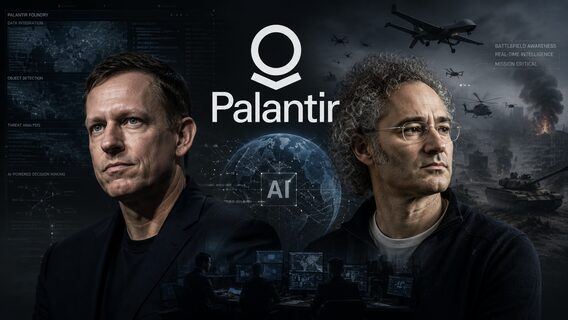
Palantir was founded in 2003 in California by PayPal and Stanford alumni who wanted to bring anti-financial fraud algorithms to the national security arena. The most prominent figures among the founders are entrepreneur and investor Peter Thiel and current CEO Alex Karp, who set the company not only a business course, but also a fairly rigid political and ideological framework.
Peter Thiel, co-founder of PayPal and one of the most influential technology investors in the United States, was Palantir’s first major private backer and a key architect of its early ties to U.S. intelligence. It was Thiel who brought In-Q-Tel, a CIA venture capital fund, into the company, whose investment not only provided the money but also opened the door to real-world intelligence missions, on which the Gotham platform was honed. Close contact with the intelligence community transformed Palantir into something much more than a startup. The company began to be perceived as a technological extension of the American Deep State.
Donald Trump and Peter Thiel
Alex Karp took over Palantir in 2005 and remains its CEO, a public figure with an inner ideologue. He has been a vocal commentator on the war in Ukraine, openly supports a tough stance against authoritarian regimes, and positions Palantir as a company that will become a technological tool for democratic states in new wars. However, it was during his tenure that the company signed some of its most controversial contracts, from ICE to predictive policing projects in Europe, which has led to the current wave of criticism surrounding the brand.
From Silicon Valley to Kyiv
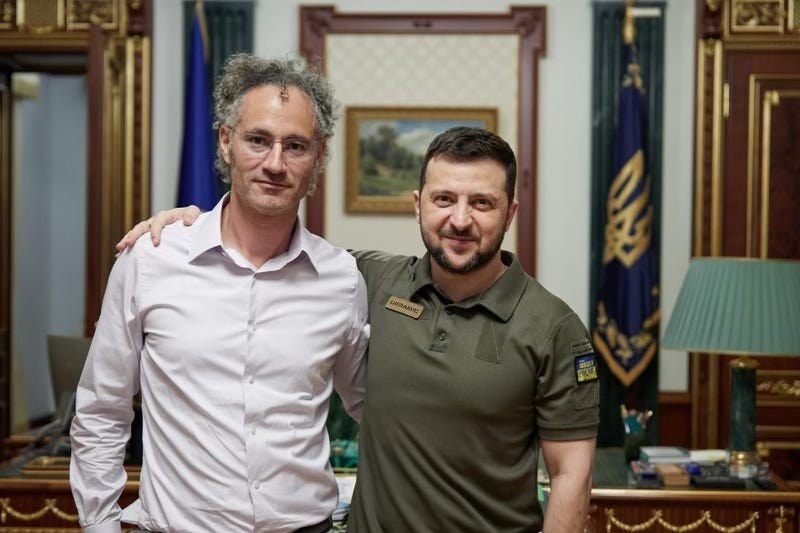
Since the first year of the full-scale invasion, Palantir has become one of the key technology partners in the war. Karp became the first head of Big Tech companies to visit Ukraine in June 2022. Within a year and a half, Palantir’s data analysis and artificial intelligence platforms had already been integrated into six ministries of Ukraine.
Subsequently, Ukraine began using Palantir software to consolidate intelligence, analyze air strikes, and plan strikes on Russian targets, which was officially confirmed by both Ukrainian officials and the company itself.
At the combat level, at least three areas are key: analysis of air attacks, work with intelligence, and planning deep strike operations. According to Defense Minister Mikhail Fedorov, together with Palantir, they “created a system that analyzes air attacks in detail,” implemented AI solutions for processing large amounts of intelligence, and integrated technologies into planning strikes in the deep rear of the Russian Federation.
“Today, technology, AI, data analysis, and the mathematics of war directly affect the outcome on the battlefield,” he added, adding that Ukraine’s task is to “strengthen its partnership with Palantir in AI solutions and defense tech projects that provide a technological advantage.” — Mykhailo Fedorov
Alex Karp with Volodymyr Zelensky
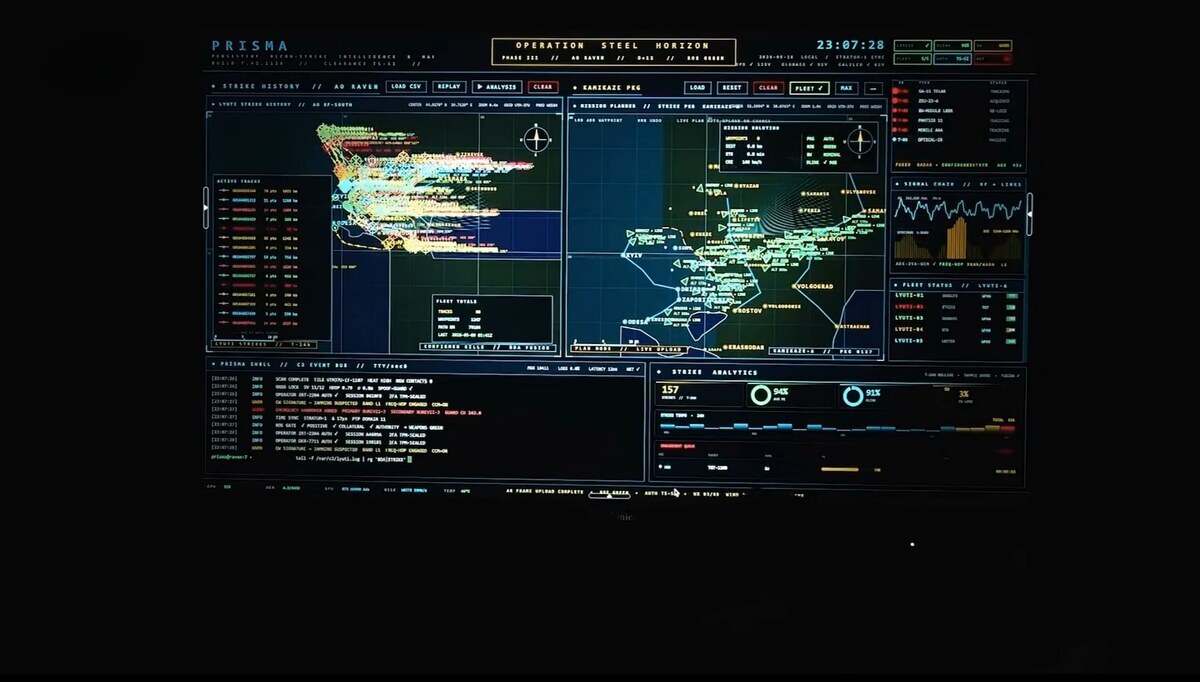
Palantir helped launch the PRISMA system for the Defense Ministry’s GUR to plan long-range drone strikes on targets deep inside Russia. According to the description, PRISMA collects satellite imagery, radar and radio reconnaissance data, drone telemetry, and sensor data into a single interface, forming a real-time tactical picture.
The system analyzes where the Russians shot down previous drones, where radars and air defenses were operating, which routes have already been “lit up,” and on this basis suggests alternative trajectories for subsequent strikes, effectively telling operators where it is best to launch new waves of UAVs. CNN describes PRISMA as an “operations center” for simultaneously controlling a large number of drones during active missions.
A shot with the PRISMA system from a CNN report
Brave1 Dataroom, a joint project of the Ministry of Defense, the Armed Forces of Ukraine, the Research Institute of Military Intelligence, the Brave1 cluster, and Palantir. This is a secure environment for training and testing AI combat models on real data from the front: from attack routes and profiles to the parameters of enemy drones and air defenses.
Developers who have passed the test receive access to validation datasets collected by the state through Dataroom, and can use them to build algorithms for detecting and intercepting aerial targets, primarily shaheed-like drones. Palantir itself provides a platform for integrating, normalizing, and anonymizing this data, which is already being used by Ukrainian companies' models.
Palantir's role in civil and semi-civil projects is no less significant. The Ministry of Digital Transformation and the company signed a memorandum that envisages the use of its software to assess damage to buildings and infrastructure and optimize reconstruction. In cooperation with the Ministry of Community and Territorial Development, Palantir Foundry is used to digitize regional resilience plans : the system builds damage maps based on satellite data and state registers, models territorial development scenarios, and helps identify "bottlenecks" in energy, heat supply, and basic services.
The goal is to digitize both the plans themselves and their implementation so that the state and donors can see which solutions have the maximum effect for protecting critical infrastructure and restoring communities.
Separate projects relate to humanitarian demining (a joint initiative of the Ministry of Economy and Palantir using AI to prioritize sites), as well as support for the education system — the Ministry of Education and Science uses Palantir tools free of charge within the framework of a separate memorandum.
How Palantir helped bomb Iran
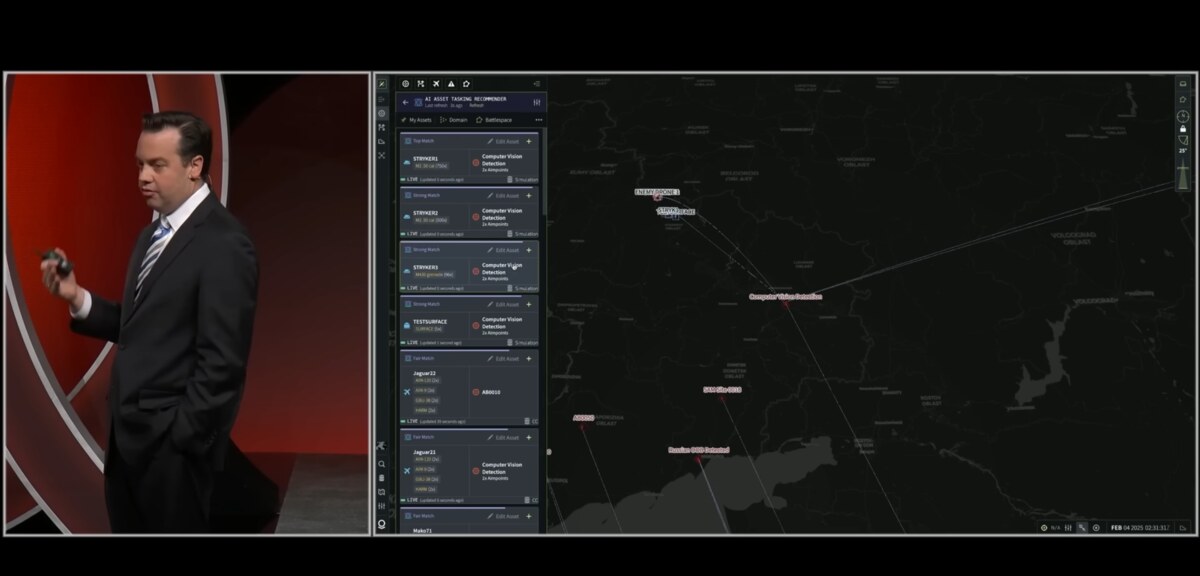
To understand what Palantir is ideally aiming for in Ukraine, it’s worth looking at the Maven Smart System (MSS), a new battlefield operating system that the U.S. Department of War is deploying across all branches of the military. Essentially, it’s Palantir’s military “superstructure,” which collects data from satellites, drones, radar, intercepted communications, and other sensors and displays it all on a single, shared map for commanders.
While analysts previously manually reviewed videos, reports, and maps in dozens of tables and presentations, now the system itself "digests" the flow of information, highlights suspicious objects, groups them into lists of targets, and suggests action options.
Demonstration of Maven Smart System during operations in Ukraine
The principle of Maven's operation is often explained through the so-called OODA loop: observe - understand - decide - act. Sensors provide observations, the Palantir software platform combines everything into a single picture and classifies objects, and AI modules suggest to commanders who and what should be hit first, for example, which missile battery, which communication node or which ammunition depot. A person still presses the final "approval button", but a significant part of the work, from finding targets to selecting means of destruction, already takes place inside the software system.
In the US war against Iran, Maven was used as a primary targeting tool. According to official figures, the system helped plan more than 13,000 strikes in 38 days.
AI in exchange for data. What Ukraine risks
Palantir in Ukraine is not just another “digital partner” for defense and reconstruction, but a private conduit for the American state into our most sensitive data and infrastructure, which carries corresponding risks.
The German Bundeswehr Cyber Center has warned national manufacturers and intelligence agencies about the risks of dependence on American infrastructure and the possible loss of control over AI models if critical algorithms are developed in an environment controlled by a foreign vendor.
In December 2025, after a seven-year period of lobbying and testing, the Swiss Army officially abandoned the use of Palantir software, citing risks to data sovereignty. An internal 20-page report concluded that even if the servers were located in Switzerland, it was not technically possible to exclude access to sensitive information by US intelligence agencies due to US laws, including the CLOUD Act.
Digital sovereignty: How the struggle for data control has become a full-fledged geopolitical confrontation
Ukraine, unlike Switzerland, is in a completely different security situation and is objectively more dependent on US military and technological support, so its room for maneuver is much narrower. Nevertheless, the Swiss case demonstrates that a country with high cybersecurity standards, not at war and with a wider choice of suppliers, considers Palantir's architectural risks to outweigh the potential benefits.
A separate plane is the company's history in the context of human rights and mass surveillance. Palantir has long cooperated with the US Immigration Service, the newly created Trump police force for "catching" migrants ICE, and a number of law enforcement agencies. Amnesty International and a number of human rights organizations have documented cases where Palantir technologies played a key role in ICE raids accompanied by human rights violations, and have urged investors to consider these risks.
In Europe, the company has been criticized for its participation in predictive policing projects, where software is used to predict crime based on large amounts of personal data; human rights activists warn that this can lead to discriminatory practices and opaque decisions regarding specific people.
Overall, the partnership with Palantir gives Ukraine a tangible tactical and organizational advantage: systems like PRISMA, air attack analysis, and Brave1 Dataroom really enhance our ability to plan strikes. Previously, a burning Moscow and the isolation of Crimea were only dreams - now they have become an everyday reality.
At the same time, the European controversy surrounding Palantir and criticism of its work with ICE and the police show that issues of data sovereignty, algorithm transparency, and human rights cannot be postponed “for later.” As the Ukrainian military is already saying .