The world's first edible robots clean the water, then become food for the fish they help
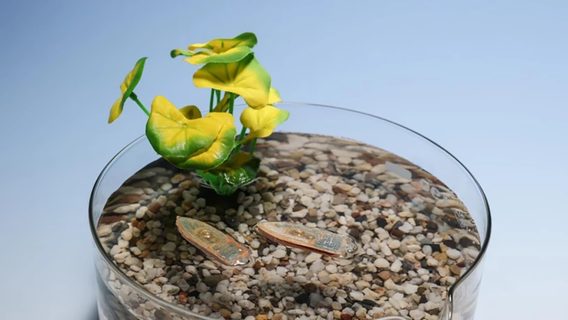
Swiss scientists have developed tiny aquatic robots that look like motorboats that monitor water quality and are safe for fish.


Swiss scientists have developed tiny aquatic robots that look like motorboats that monitor water quality and are safe for fish.
Swiss scientists have developed tiny aquatic robots that look like motorboats that monitor water quality and are safe for fish.
The robots were created by a team at the Swiss EPFL led by Professor Dario Floreano and graduate student Shuhang Zhang, reports Interesting Engineering. Each tiny boat-shaped robot is just 5 centimeters long and weighs about 1.43 grams. Despite their size, they accelerate to speeds that are three times their body length per second.
The tiny robots are made from crushed fish food pellets, molded and freeze-dried. Inside the “boat” is a small chamber containing a harmless mixture of citric acid and baking soda. This chamber is sealed with a gel plug and has a reservoir filled with non-toxic propylene glycol.
The robot slowly sucks in moisture through a semi-permeable plug. When the water comes into contact with the powder inside, a chemical reaction occurs, releasing carbon dioxide. The gas then pushes the glycol out through a tiny back hole.
The displaced glycol changes the surface tension of the water using a natural propulsion trick known as the Marangoni effect , which is commonly used by insects such as water striders. As a result, the robot glides gently forward without any batteries or motors.
Researchers plan to release these tiny bots into ponds, lakes or other bodies of water, where they will drift and collect valuable data. Equipped with sensors, the robots can measure water temperature, pH levels or the presence of pollutants, and transmit the information wirelessly or store it for later retrieval.
Over time, the bodies of these tiny robots absorb water, soften, and eventually sink. At that point, they become part of the food chain. Fish and other aquatic animals can safely eat the bots thanks to their completely edible, non-toxic composition.
There is also potential for another application: using bots to distribute medicated feed to fish farms. Even if the bot is not eaten, all of its components decompose completely, leaving nothing harmful behind.
The only problem that remains is the sensors themselves. If the bots' bodies disappear without a trace, making the electronics similarly biodegradable, or even edible, is the next big challenge.
"Replacing e-waste with biodegradable materials is the subject of intense study, but edible materials with targeted nutritional properties and functions have been largely ignored, opening up a world of possibilities for human and animal health," Floreano said.