Retail Loyalty Platforms: 5 Solutions to Compare in 2026
A plastic card with a 3% discount no longer holds anyone back. The buyer has applications from five or six networks on his phone, and they all offer approximately the same thing. The winner is the one who knows more about the client and is able to make him an offer at the right moment: not a general promotion for everyone, but a coupon for the category that the person buys every week.
A plastic card with a 3% discount no longer holds anyone back. The buyer has applications from five or six networks on his phone, and they all offer approximately the same thing. The winner is the one who knows more about the client and is able to make him an offer at the right moment: not a general promotion for everyone, but a coupon for the category that the person buys every week.
Therefore, choosing software becomes a strategic decision, not the purchase of “another CRM.” When a chain chooses a loyalty management system , it actually decides how it will collect data about customers, how quickly marketing will launch promotions, and how much each new mechanic will cost.
We have collected five platforms that are most frequently searched for by Ukrainian networks: three Ukrainian and two international. This is not a ranking from best to worst. Each solution is strong in its own scenario, and below we explain in which one.
How we selected platforms
We looked at what really affects the launch and operation of the program in a network of 20–200 stores:
Mechanics. Bonuses, discounts, cashback, statuses, personal coupons, trigger promotions.
Channels. Branded mobile app, chatbots, push, SMS, email.
Integrations. Connection with cash register software and accounting system (1C, BAS, SAP, Microsoft Dynamics) without replacing what is already working.
Analytics. RFM segmentation, churn forecast, evaluation of campaign effectiveness.
Payment model and local support. How transparent is the price and is there a team that speaks the client's language and knows Ukrainian cash registers?
Data is taken from the official pages of vendors and profiles on Capterra as of November 2026. We mark the results figures provided by the vendors themselves as declared by the vendor.
Ukrainian platforms
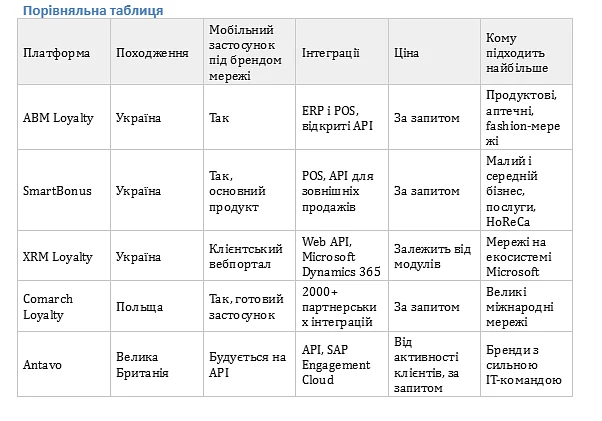
ABM Loyalty
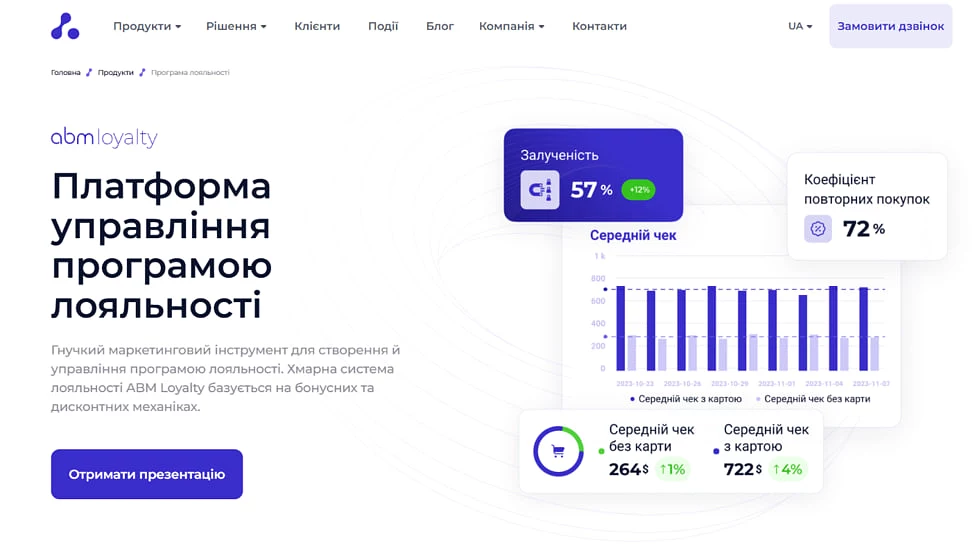
ABM Loyalty from ABM Cloud is a cloud-based system for networks that combines customer CRM, a promotion builder, communication channels, and analytics. The program has been used by over 500 companies, including Lotok, Lafar, VkusMart, and Intertop Kazakhstan.
What can he do:
buyer profile with purchase history, segmentation and NPS;
bonus and discount mechanics, coupons only for program participants with expiration date and group settings;
triggers for registration, specific purchase, product return, birthday;
channels: branded mobile application, chatbots, personal account, push, SMS, email;
Integrations . The system connects to existing ERP and cash registers without replacing them. Among the supported systems, the supplier names SAP, Microsoft Dynamics 365, Oracle, Navision, Odoo, and popular cash register software.
Results (declared by the provider). In the Lotok network, the program was launched in 3 months, the average check increased by 26%. In Intertop Kazakhstan, turnover increased by 30% after the launch.
Limitations . The price is not published, the cost is calculated after consultation. Analytics works well when the customer base is clean: if you have been collecting questionnaires with errors for years, you will first have to put the data in order.
Who is it for : Chains that need a full cycle (from CRM to a branded application) and want to keep their existing accounting system. Especially suitable if the chain already works with other ABM modules, such as inventory or assortment management.
SmartBonus
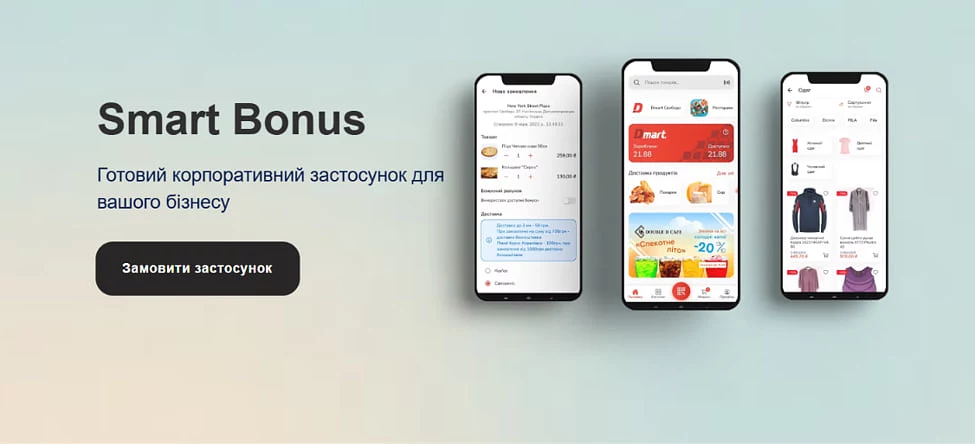
SmartBonus is a Ukrainian platform, the main product of which is a ready-made corporate application for iOS and Android under the client's brand. The company's offices operate in Kyiv, Dnipro and Lviv.
What can he do:
multi-level bonus programs, coupons, gift certificates;
push notifications and chat with customers in the application;
online ordering, booking, payment and delivery;
referral rewards and customer segmentation.
Results (claimed by the supplier) : +25% to the average check thanks to the loyalty program.
Limitations . The platform is designed for use as the main channel. For a large network with tens of thousands of transactions per day, it is worth separately checking the depth of analytics and integration scenarios with the accounting system.
Who is it suitable for : coffee shops, restaurants, salons, gas stations, small retail chains that need to quickly get their own application with bonuses and online ordering.
XRM Loyalty
XRM Loyalty is developed by E-consulting, a Ukrainian company that has been operating since 2001. The solution is built on Microsoft Dynamics 365 and is positioned as a comprehensive CRM for retail.
What can he do:
single customer profile, segmentation, analytics in Power BI;
a loyalty mechanic designer that works with marketing without programmers;
bonuses, points, statuses, challenges and gamification;
omnichannel communications and real-time antifraud;
optional contact center.
Clients and results (declared by the supplier). Central Department Store Kyiv, MOYO, ZARINA, Carlo Pazolini. MOYO's client base grew by 50%.
Limitations . The logic of the solution is tied to the Microsoft ecosystem. If the network does not work on it, you will have to estimate the costs of Dynamics licenses and support along with the loyalty program itself.
Who is it for: large chains that already use Microsoft Dynamics and want to build loyalty into their existing CRM architecture.
International platforms
Comarch Loyalty
Comarch is a Polish technology company that has been building loyalty programs for major brands for over 25 years. According to the company, the platform operates programs with over 713 million active members in 50+ countries.
What can he do:
a single profile and balance of the buyer across stores, brands, countries and franchises;
AI-selection of an offer (coupon, cashback or points) for a specific basket at the checkout;
ready-made mobile application and templates for launch.
Clients : Auchan Retail (about 1.5 million transactions per day), Alshaya Group.
Limitations: The solution is designed for enterprise scale. For a chain of 30 stores, such an implementation would likely be prohibitive in terms of cost and time.
Who is it suitable for: large chains and holdings with several brands or countries of presence.
Antavo
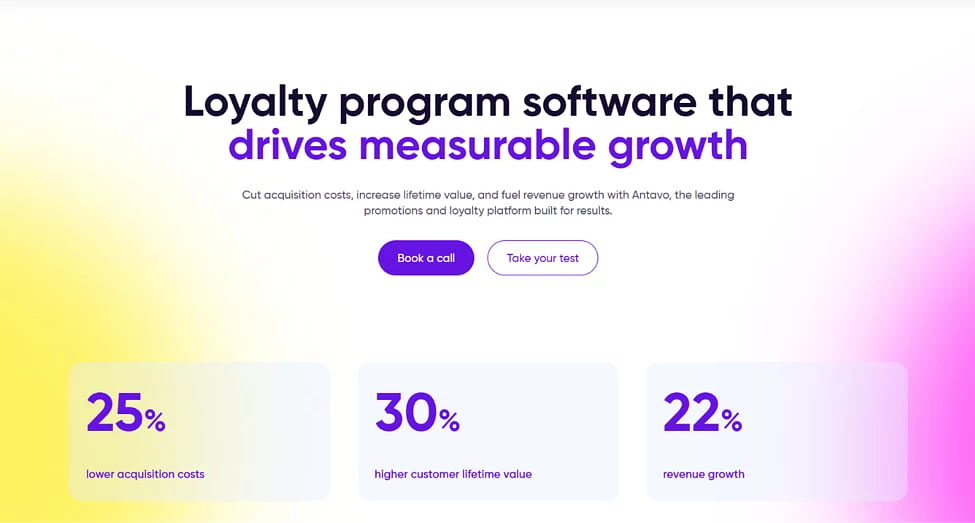
Antavo is a British company founded in 2012 that develops AI Loyalty Cloud. The platform works on the principle of no-code for marketing and API for developers. Among the company's clients are KFC, BMW, Flying Tiger Copenhagen.
What can he do:
points, statuses, paid and “emotional” loyalty programs;
Payment model . The price is individual. Tariffs depend on customer activity, and inactive participants, according to the pricing overview, are not taken into account.
Limitations . The platform is API-centric: the application and website for buyers are usually built by the brand team or an integrator. Local support and integration with Ukrainian POS software must be specified separately.
Who is it for : brands with their own IT team who are building complex omnichannel programs and want a flexible engine instead of a ready-made product.
What mechanics work in 2026
The platform itself does not retain customers. It is the mechanics who run on it that retain them. This is what is currently giving the greatest effect in grocery, pharmacy, and fashion retail.
Personal coupons instead of general discounts. A 10% discount on everything trains the buyer to wait for a promotion. A coupon for a favorite category that is valid for three days brings a person back to the store and does not eat into the margin on goods that they would have bought anyway.
Statuses with real value. A silver or gold level works when it gives something tangible: more cashback, early access to sales, free shipping. If the difference between the levels is 0.5% bonuses, the buyer simply does not notice it.
Trigger scenarios. Welcome bonus after registration, reminder after 30 days without purchases, offer after returning the product. These campaigns are set up once, and then they work automatically.
Recovering dormant customers. RFM analysis shows who used to buy frequently and then disappeared. It is usually cheaper to bring back such a customer than to attract a new one, so it is worth making a separate offer for them.
The app as the main channel. Push notifications are free, unlike SMS, and the app allows you to show your bonus balance, e-card, and personal offers in one place.
Mistakes that make a loyalty program unprofitable
Launch without a goal. If no one has defined what indicator should increase, it is impossible to understand after a year whether the program worked.
Same offers for everyone. The chain gives out bonuses to those who would have come without them, and offers nothing to those who are about to go to a competitor.
Bonuses that cannot be spent. Complicated cancellation rules annoy customers more than their absence.
The cash register lives separately from the application. The cashier does not see the customer's status, bonuses are accrued with a delay, and the buyer receives errors in the application.
Five questions to ask a supplier before signing a contract
How long will it take to integrate with our cash register and accounting? Ask to name a network with the same cash register system where the solution is already working.
Who sets up a new promotion? If every mechanic requires a programmer, marketing will take weeks to launch campaigns.
What will happen to the data if we leave? Specify the format for uploading the customer database and bonus history.
How is the cost calculated? By the number of participants, stores, transactions or modules. Calculate the price over a three-year horizon, taking into account the growth of the base.
How will the platform prove its effectiveness? A good provider will help you set up a comparison of program participants and non-participants based on average check and purchase frequency.
Calculation example
Let's take a chain of 40 stores with an average check of 400 UAH and 6,000 checks per day. If 45% of checks are made with a loyalty card, and personal coupons raise the participant's check by 10%, the chain receives an additional 108,000 UAH of turnover daily: 6,000 × 0.45 × 400 × 0.1. This is over 39 million UAH per year. This figure is the upper limit of how much it makes sense to spend on the platform, team, and bonus budget.
What does the cost of the loyalty program consist of?
None of the five platforms publish a fixed price, so you will have to compare calculations to suit your scale. The budget usually includes four parts: implementation and integration with the cash register and accounting, monthly payment for the platform, communication channels (SMS costs money, push is free) and the bonus fund itself, i.e. discounts and points that the network gives to customers.
The bonus fund is often the largest item. Therefore, a platform with good analytics can pay for itself faster than a cheaper one: it shows which promotions increase sales and which simply give discounts to regular customers.
What to choose?
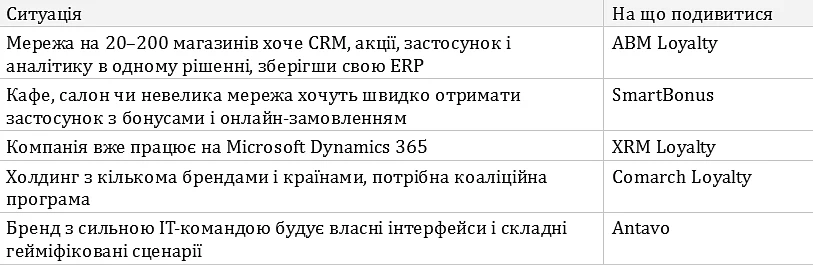
There is no universally best loyalty platform. For a small business, the speed of launch and a ready-made application will be crucial, for a medium-sized network, communication with the cash register, accounting and analytics, for a holding company, scalability and work with several brands.
Before choosing, formulate what exactly should change in a year: frequency of visits, average check, share of repeat purchases. Then ask two or three suppliers to show how their system measures these indicators on your data. This way, you will compare not presentations, but real effects.