
AI agents in engineering processes: what it really looks like
While most companies are debating whether to implement AI in development, some already have six months of statistics. WhiteBIT is one such case.


While most companies are debating whether to implement AI in development, some already have six months of statistics. WhiteBIT is one such case.

While most companies are debating whether to implement AI in development, some already have six months of statistics. WhiteBIT is one such case.
AI tools for developers are no longer an experiment. Copilot, Cursor, agent pipelines are all part of everyday work in many teams. But there is a big difference between «we connected AI» and «we changed processes for it».
WhiteBIT, a Ukrainian crypto exchange with an audience of over 8 million users, went through this process and shared the results. Spoiler: throughput tripled. But what’s more interesting is how exactly they did it and where they initially went wrong.
Fintech development is not a startup where you can «swish and see.» Every change goes through several layers of verification, and rightly so: the price of a mistake is high.
But there is a nuance: a significant part of engineering time is spent not on complex solutions, but on mechanical work. Creating a branch, configuring an endpoint, adhering to conventions, adding logging, writing basic tests — all this is necessary, but does not require deep expertise. This is the «first draft», which eats up hours before the real work begins.
It was this «tax» that the team wanted to remove — so that engineers would spend their time on things that really require their judgment.
Before talking about tools, let’s talk about the approach. WhiteBIT immediately formulated a rule that they never deviated from: the agent speeds up execution, the person makes the decision.
This means that the AI did not get access to the «hard» parts of the work — architectural decisions, threat analysis, edge case assessment. Instead, the agent took on the first draft of clearly defined tasks: PR with UI changes, API, feature flag, and basic tests.
All existing gates remained in place: individual review, team review, CI/CD, production approval for risky changes.
The team measured the result through DORA metrics — not «how much code was written,» but how much value was delivered and how consistently.
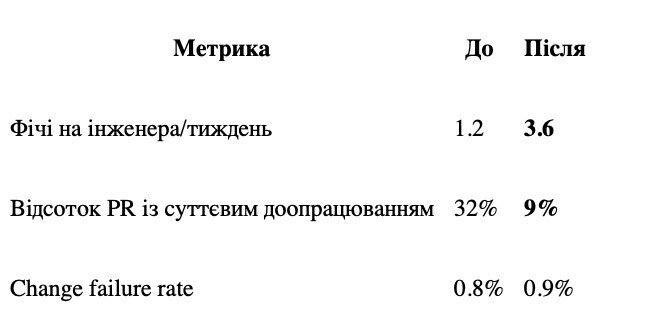
Throughput has tripled. Reliability has not dropped. Change failure rate has remained virtually unchanged, which in the context of ×3 performance is a separate achievement.
32% of PRs needed rework — that’s a lot. The team analyzed the reasons and found out: most of the problems were not in the model, but in the system around it.
The main ones are: the agent invented APIs and methods that did not exist; unclear specifications led to incorrect UX; the task swelled beyond the scope. Fixing these problems — through stricter requirements for the task description, scope restrictions, and a forced «plan first» step — reduced the rework rate from 32% to 9% in five months.
That is, the main tool for improvement is not a model upgrade, but a better engineering discipline around it.
Clear delegation standards, clear lines of responsibility, traceability, observability, and auditability have turned AI agents into a reliable engineering tool.
This change also shapes the profile of the kind of people the team wants to see in them: developers who combine technical depth, responsibility, decision-making maturity, and a hands-on approach to using AI. If you’re interested in working on products where quality, security, and modern engineering approaches are important, check out Career opportunities at WhiteBIT .
The real value isn’t just speed. It’s the ability to automate mechanical work, reduce cognitive load, and allow developers to focus on solutions that really matter—while maintaining the same level of security for products that create real value.








Comment hidden for violating commenting rules.
Comment hidden for violating commenting rules.
Earlier this year, I experienced one of the most difficult financial situations of my life after losing $44,000 to a cryptocurrency scam. Everything looked genuine at first—the website was professional, the marketing was convincing, and the testimonials made the platform appear trustworthy.
Unfortunately, after making my investment, the platform suddenly became inaccessible. My account disappeared, and I could no longer get a response from customer support.
I started looking for legitimate options to investigate what had happened and came across Cruxcipherteam. I was hesitant at first, but after speaking with them and learning about their blockchain tracing process, I decided to give them a chance.
Throughout the process, I appreciated their communication and the way they explained each step to me. My case eventually had a positive outcome, and I was extremely grateful to see my lost funds recovered.
My experience taught me to be much more careful when dealing with cryptocurrency investments and recovery services. Always do your own research and verify any company before trusting them with your money or personal information.
For those who want to learn more about their services, their contact email is:
[email protected]
https://t.me/CRUXCIPHERTEAM
Whatsqq:+168-160-15021.