Хочете будувати кар’єру в Data Science та AI? Vodafone Big Data Lab відкриває новий набір —>
Ігор Вишневський Crypto
27 January 2026, 09:00
2026-01-27
How a scandalous Moldovan oligarch became Putin's bottomless crypto wallet, and the A7A5 cryptocurrency helps the Russian Federation circumvent sanctions. What is known about this
Since the beginning of the full-scale war, the topic of Russia circumventing Western sanctions has not lost its relevance, and the «tougher» the sanctions become, the more ingenious the ways to circumvent them are. The word «tougher» had to be put in quotes right away, because the concepts of «toughness» and «Western sanctions» do not go well together in the same sentence — especially for Ukrainians, who are already tired of trolling Western (in)decision to act. Nevertheless, if Russia were to sit idly by and not take any steps in response, these sanctions would have a much more critical effect on the aggressor country. Unfortunately, it is not sitting like that, and the sluggish Western bureaucracy does not have time to react to this properly.
Since the beginning of the full-scale war, the topic of Russia circumventing Western sanctions has not lost its relevance, and the «tougher» the sanctions become, the more ingenious the ways to circumvent them are. The word «tougher» had to be put in quotes right away, because the concepts of «toughness» and «Western sanctions» do not go well together in the same sentence — especially for Ukrainians, who are already tired of trolling Western (in)decision to act. Nevertheless, if Russia were to sit idly by and not take any steps in response, these sanctions would have a much more critical effect on the aggressor country. Unfortunately, it is not sitting like that, and the sluggish Western bureaucracy does not have time to react to this properly.
Among all the effective means of circumventing sanctions, cryptocurrency is worth mentioning separately. Especially in a specific context — after all, recently the media reported that the ruble stablecoin A7A5 overtook USDT and USDC in growth, and its transaction volume reached $100 billion. This insignificant result was achieved in less than a year since the stablecoin was launched. But its story is even more interesting. How the cryptocurrency launched in Kyrgyzstan became a multi-billion dollar loophole for the Russian regime, and what does the odious oligarch from Moldova, Ilan Shor, have to do with it? About this in our material.
«The Magic of a Name.» Why Ilan from Moldova Launched A7A5 in Kyrgyzstan
The name Ilan, consonant with the most odious representative of the technological world, Elon Musk, already evokes a certain negativity by its very sound — unfortunately, Musk himself contributed to this, regularly producing scandalous statements on topics sensitive to Ukrainians. Moldovan Ilan is far from as rich and influential as the American Elon, but his contribution to supporting Russian aggression around the world is much more obvious, systematic and eloquent.
First of all, it is worth saying that Ilan Shor has significant political experience in destabilizing the situation in Moldova in favor of pro-Russian forces — he was the leader of the now banned pro-Russian Shor party, and in 2023 he was sentenced in absentia there to 15 years in prison. Among his subversive political activities, Shor was also accused of illegally withdrawing over a billion dollars from the Moldovan banking system.
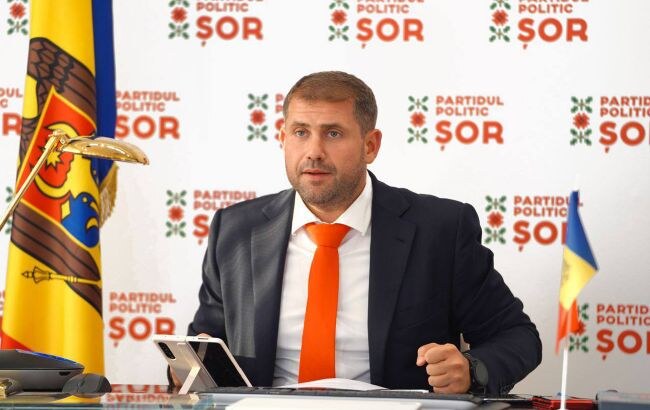
Ilan Shor
Shor left Moldova back in 2019, spending the next few years in Israel. Then he moved to Russia and even received Russian citizenship. By the way, Shor has been married to Russian pop singer Jasmine for almost 15 years and has two children with her. We hope that dev.ua readers will find the strength to live on with this information:).
So, whatever one may say, Ilan Shor has more than enough merits to Russia, and now there are even more — because the A7 company business he organized has become a huge platform for circumventing Western sanctions, in particular thanks to the A7A5 cryptocurrency.
Politically loyal to Russia, Kyrgyzstan, seems to have been chosen as a successful jurisdiction not by chance. Moreover, circumventing the sanctions imposed on Russia has become a de facto separate industry for the depressed Kyrgyz economy, and perhaps the most productive one — in 2025, the Kyrgyz economy was literally booming only due to the fact that the entire country became a «slot» for Russian purchases.
Actually, this was confirmed for Russian media by A7A5 director Leonid Shumakov, who called Kyrgyzstan «a friendly jurisdiction that is not so heavily subject to sanctions.» He noted that «this jurisdiction is very helpful in coping with the pressure that Russia is experiencing.» By the way, Shumakov, quoted here, was sanctioned by the United Kingdom last year precisely for his crypto activities.
Who else contributed to the success of the A7A5 stablecoin: what analysts and investigations say
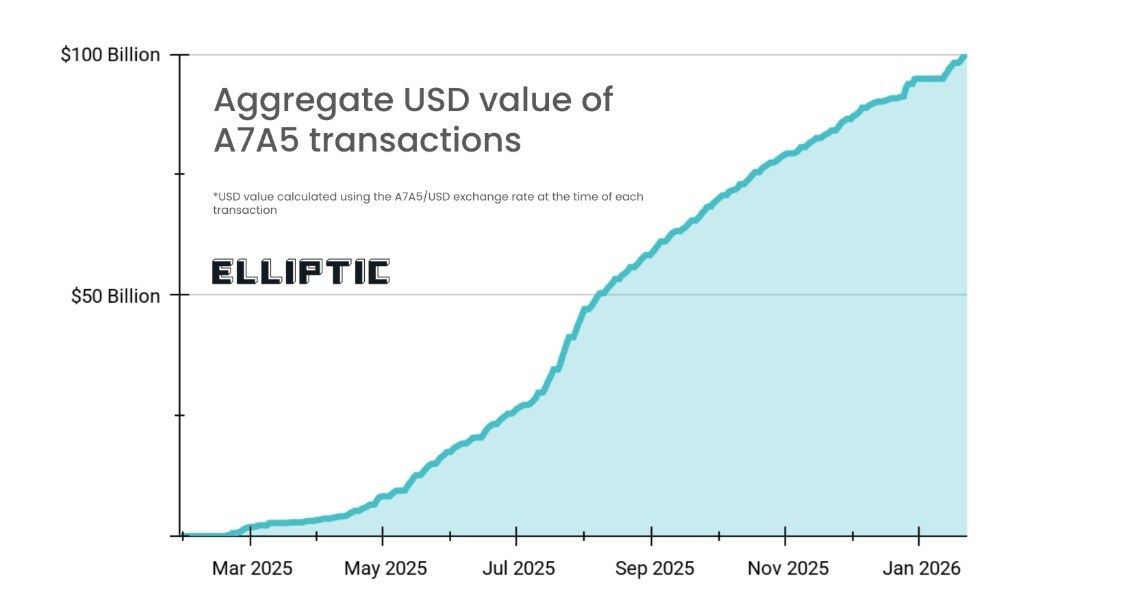
A few days ago, blockchain analytics firm Elliptic reported that A7A5, the world’s first stablecoin pegged to the Russian currency, had surpassed $100 billion in transactions.
Screenshot from Elliptic website
«A7A5 facilitates tax evasion by mitigating this specific risk and functioning as a ‘safe haven’ backed by the ruble. It allows Russian companies to access global USDT liquidity without the long-term risk of wallet freezes,» Elliptic says on its website.
The A7A5 crypto is used as a kind of «bridge» to USDT for Russian importers: for example, Russian users can purchase A7A5 via the Tron or Ethereum blockchains, and then exchange them for USDT (a stablecoin pegged to the dollar), subsequently withdrawing funds in the desired country or currency.
The main shareholder of A7, besides the odious Ilan Shor, is Promsvyazbank, a Russian state-owned bank that has been sanctioned for its role in servicing the defense sector of an aggressor country. It is the Russian state-owned bank that is the guarantor of A7A5 on the basis of ruble deposits held at PSB.
«Although USDT Tether has become the main crypto asset for circumventing sanctions imposed on Russia due to its price stability and liquidity, it can be confiscated by Western authorities. This was demonstrated by the seizure of USDT assets of the Russian cryptocurrency exchange Garantex by US government agencies in March 2025,» Elliptic reminds.
The lack of real influence on this cryptocurrency and the ineffectiveness of Western sanctions against it caused the A7A5 boom: to date, about 250,000 transactions have been made from 41,300 separate accounts, and the number of transactions increased significantly at the end of September 2025 due to the ability to purchase A7A5 using Promsvyazbank bank cards.
In one of the most comprehensive and high-profile investigations on the subject, the Financial Times reported that the Kremlin-backed cryptocurrency scam A7A5 appears to have succeeded in circumventing US sanctions. At least, the publication found that at least $6 billion in Russian money passed through the crypto between August and October 2025.
The publication recalls that in August last year, Washington added the Kyrgyzstan-based crypto exchange Grinex to its sanctions list, namely Grinex is a likely successor to the previously mentioned Garantex, but it seems that this did not help much.
The Financial Times also writes that the registered issuer of the coin is the Kyrgyz company Old Vector, which was also blacklisted by the US. But as we can see, despite all the sanctions not only from the US, but also from the European Union and the UK, things are going very well for the Russian cryptocurrency A7A5.
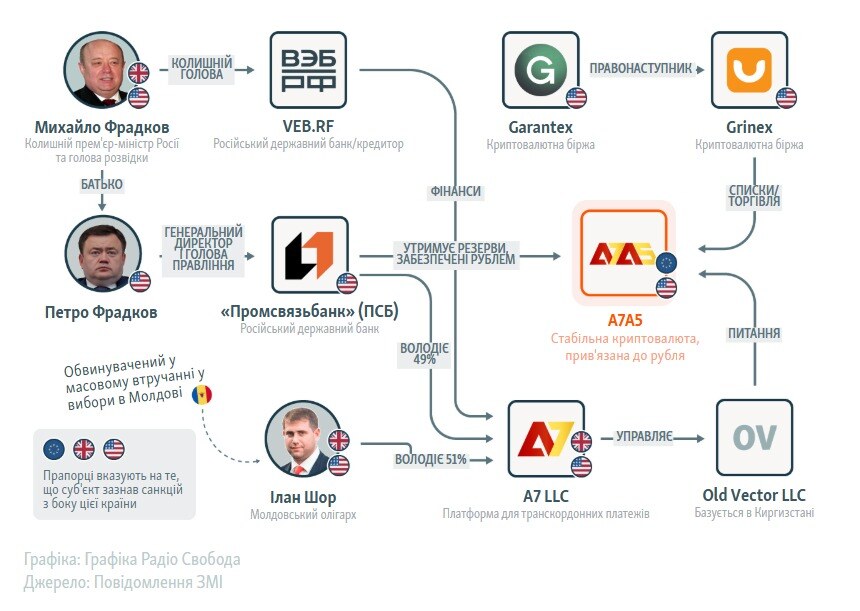
In December last year, Radio Liberty formed its vision of a scheme through which the Kremlin successfully uses cryptocurrency to finance its needs and circumvent sanctions.
Screenshot from the Radio Liberty website
The publication has collected facts proving that the A7A5 stablecoin is supported by a network of Russian state banks, and Promsvyazbank, controlled by the son of former intelligence chief Mikhail Fradkov, Petr Fradkov, provides ruble reserves for this token. The scheme also involves the aforementioned crypto exchanges Garantex and Grinex.
Interestingly, Radio Liberty journalists tried to find the office of the A7A5 cryptocurrency issuer, Old Vector, but a dilapidated house was found at the legal address. «When Radio Liberty journalists visited this house, which stands off a dirt road behind a rusty blue metal fence and concrete blocks, two boys who answered the door said they knew nothing about any company registered at that address. A neighbor from the house next door also said that a company with that name had never been here,» the publication wrote .
Chickens are counted in the fall
Last fall was in many ways a defining one for the A7A5 stablecoin, but it brought news that was completely opposite in tone. While in the Russian Federation A7A5 received official qualification as a digital financial asset, which strengthened its position as much as possible, the EU followed with previously promised sanctions.
«You can settle with digital currencies within the framework of foreign trade operations, while transactions using the CFA are carried out without paying VAT. To use A7A5 in settlements for foreign economic activity transactions, a Russian company must register on the Token platform as an investor, buy stablecoins there and make settlements with foreign partners. They, in turn, will receive tokens on one of the public blockchains — Tron or Ethereum,» the mechanism explains in a press release on this occasion.
Meanwhile, at the end of October last year, the EU announced the 19th package of sanctions against Russia, which included measures directly against the A7A5 cryptocurrency. «The EU is imposing full sanctions against the developer of the widely used ruble-backed stablecoin A7A5, the Kyrgyz issuer of this coin, and a large trading platform associated with it,» it said on this occasion, adding that the sanctions also targeted a cryptocurrency exchange in Paraguay, which played a key role in circumventing existing restrictions. Thus, EU operators were prohibited from providing crypto and fintech services that allow Russia to develop its own financial infrastructure.
On November 25, a ban on the A7A5 stablecoin went into effect, blocking transactions in the EU related to the asset. However, it is worth noting that European economies were unlikely to be the basis for Russia’s use of A7A5, so the impact of these sanctions is debatable.
In direct contact with Putin
Even if, after reading all of the above, someone still thinks that the sanctioned oligarch from Moldova, Ilan Shor, together with the A7A5 cryptocurrency he founded, is still somewhere on the margins of the political and economic life of the terrorist country, then these misconceptions will have to be dispelled. Thus, the Russian media has published a number of news reports about the fugitive oligarch’s direct contacts with the Russian dictator, including meetings at various events.
For example, Putin personally «blessed» the start of work of a so-called «Far Eastern International Financial and Settlement Center», opened on the basis of the office of the «Russian specialized fintech company A7».
«The new office will become a core competence center in the field of high-tech cross-border payments, resistant to Western sanctions, and should strengthen interaction with Asian countries, where up to 80% of foreign trade operations of Russian business are concentrated,» the press release on this occasion stated.
We see that behind the numerous veiled euphemisms of press releases, the essence is visible: the A7A5 cryptocurrency at the highest state level in Russia is intended to be one of the main payment instruments for circumventing sanctions, and this is not even particularly hidden. Given the rapid growth of operations in A7A5, these plans are being successfully implemented, and at the moment it is not even clear what could stand in their way.
The bodies of a Russian crypto investor and his wife were dismembered in the Emirates. He had previously disappeared with clients' money and presented himself to everyone as a friend of Durov
Billions in crypto are being stolen — it goes to missiles flying over Ukraine. How North Korean hackers are invisibly funding their country’s military programs