Хочете будувати кар’єру в Data Science та AI? Vodafone Big Data Lab відкриває новий набір —>
Марія БровінськаWeapon
11 January 2025, 11:11
2025-01-11
An OpenAI developer created an AI gun turret and paid for it with access to working systems. What happened?
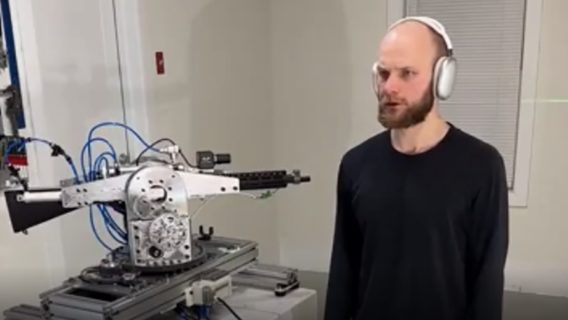
OpenAI has terminated its partnership with a developer who created a device that responded to ChatGPT requests to aim and fire an automatic rifle. The device went viral after a Reddit video showed its developer reading out firing commands, after which the rifle next to him quickly began aiming and firing at nearby walls.
OpenAI has terminated its partnership with a developer who created a device that responded to ChatGPT requests to aim and fire an automatic rifle. The device went viral after a Reddit video showed its developer reading out firing commands, after which the rifle next to him quickly began aiming and firing at nearby walls.
«ChatGPT, we are being attacked from the front left and the front right,» Gozmodo quotes the developer as saying. «Respond accordingly.»
The speed and accuracy with which the rifle responds is impressive, as it relies on OpenAI’s real-time API to interpret input and then return instructions that the device can understand. ChatGPT would only need a simple training session to receive a command like «turn left» and figure out how to translate it into machine-readable language.
In a statement to Futurism, OpenAI said it had reviewed the video and suspended the developer behind it. «We proactively identified this violation of our policies and notified the developer to cease this activity before we received your request,» the company said.
The potential for lethal weapon automation is one of the concerns expressed by critics of AI technology like that being developed by OpenAI.
The company’s multimodal models can interpret audio and visual data to understand a person’s surroundings and respond to queries about what they see. Autonomous drones are already being developed that can be used on the battlefield to detect and engage targets without human intervention. This is certainly a war crime and risks leading humans to become complacent, allowing artificial intelligence to make decisions and making it harder to hold anyone accountable.
This concern is not theoretical either. A recent Washington Post report found that Israel has already used AI to select targets for bombing, sometimes indiscriminately.
«Soldiers who were poorly trained in using the technology attacked human targets without confirming Lavender’s predictions at all,» the article says, citing a piece of AI software. «At certain points, the only confirmation needed was that the target was male.»
Advocates of AI on the battlefield say it will make soldiers safer by allowing them to stay away from the front lines and neutralize targets like missile depots or conduct reconnaissance from a distance. And drones with artificial intelligence could deliver precision strikes. But that depends on how they are used. Critics say the United States should do a better job of jamming enemy communications systems to make it harder for adversaries like Russia to launch their own drones or nuclear bombs.
OpenAI prohibits the use of its products to develop or use weapons or to «automate certain systems that could affect personal safety.»
But last year, the company announced a partnership with defense technology company Anduril, a maker of drones and AI-powered missiles, to create systems that can defend against drone attacks. The company says it will «rapidly synthesize time-sensitive data, reduce the burden on human operators, and improve situational awareness.»
It’s not hard to see why tech companies are interested in getting involved in the war effort. The United States spends nearly a trillion dollars on defense annually, and cutting that spending remains an unpopular idea. With President-elect Trump filling his cabinet with conservative tech figures like Elon Musk and David Sachs, a number of defense technology players are expected to gain significant advantages and potentially displace existing defense companies like Lockheed Martin.
While OpenAI prohibits its clients from using its AI to build weapons, there are a number of open-source models that could be used for the same purpose. Add to that the ability to 3D print weapon parts—which is what law enforcement believes the alleged UnitedHealthcare shooter, Luigi Mangione, did—and it becomes surprisingly easy to build a homemade autonomous killing machine from the comfort of your own home.
«It really works, it really exists.» The Commander of the Unmanned Systems Forces reported that Ukraine already has a laser weapon called the Trident, which can shoot down enemy aircraft and is being actively improved.
Як нейромережі бачать вільну та незалежну Україну? Тест dev.ua
Нейронні мережі для генерації зображень бачать світ по-своєму, їхню логіку зрозуміти часом зовсім неможливо. Але таки хочеться. На честь Дня Незалежності України редакція dev.ua вирішила провести невеликий експеримент.
Ми задали чотирьом різним нейронним мережам п’ять однакових запитів: «прапор України», «День Незалежності України», «український Крим», «перемога України» та «українці». Отриманими результатами ми ділимося з вами нижче.
У TikTok тепер можна генерувати фон за допомогою нейромережі. Ми протестували її та ділимося результатами
У TikTok з’явилася нова функція «Розумний фон». З її допомогою як фон для тіктоків можна підставляти згенеровані нейромережею зображення. Редакція dev.ua протестувала цю технологію і ділиться своїми враженнями.