Тарас КозаковІсторії
27 February 2026, 13:18
2026-02-27
Interview with tech businessman Ruslan Nonka: about business and hobbies that become a life's work
Ruslan Nonka is a successful Ukrainian entrepreneur who decided to conquer rather unusual niches. He decided to invest in books and padel courts. Ruslan created the Lobster publishing house, which translates science fiction from five languages - from Japanese to Chinese — and publishes historical literature about Africa, Latin America and Palestine. In parallel, he launched the Pax.com.ua platform for Ukrainian science fiction writers and opened a padel club in UNIT.City.
Ruslan Nonka is a successful Ukrainian entrepreneur who decided to conquer rather unusual niches. He decided to invest in books and padel courts. Ruslan created the Lobster publishing house, which translates science fiction from five languages - from Japanese to Chinese — and publishes historical literature about Africa, Latin America and Palestine. In parallel, he launched the Pax.com.ua platform for Ukrainian science fiction writers and opened a padel club in UNIT.City.
In this interview, Ruslan frankly talks about why publishing one book costs $10,000 and pays for itself in 3–4 years, how much Ukrainian authors earn (spoiler: $2,000–4,000 per book), how AI is changing the book industry, and why padel is not a fad, but a social movement with a promising future.
On the transition from gambling to new projects
— How did it happen that you switched from gambling to fantasy and padel?
— I love sports very much and try to do them all my life. Before I was 30, I tried a lot: football, the gym, swimming. But after 30, I got so bored with sports that it became uninteresting. At the same time, we all have sedentary jobs, and we need sports. I was looking for a long time for a game sport that would captivate me.
A friend recommended padel. I tried playing on the first padel court in the Respublika residential complex — I liked it. First, padel is not as traumatic as tennis. Second, there is an easy threshold for entry. I trained in tennis for half a year, but I was never able to play a full match. And here, five lessons — and you can already play 2×2. It’s fun and interesting.
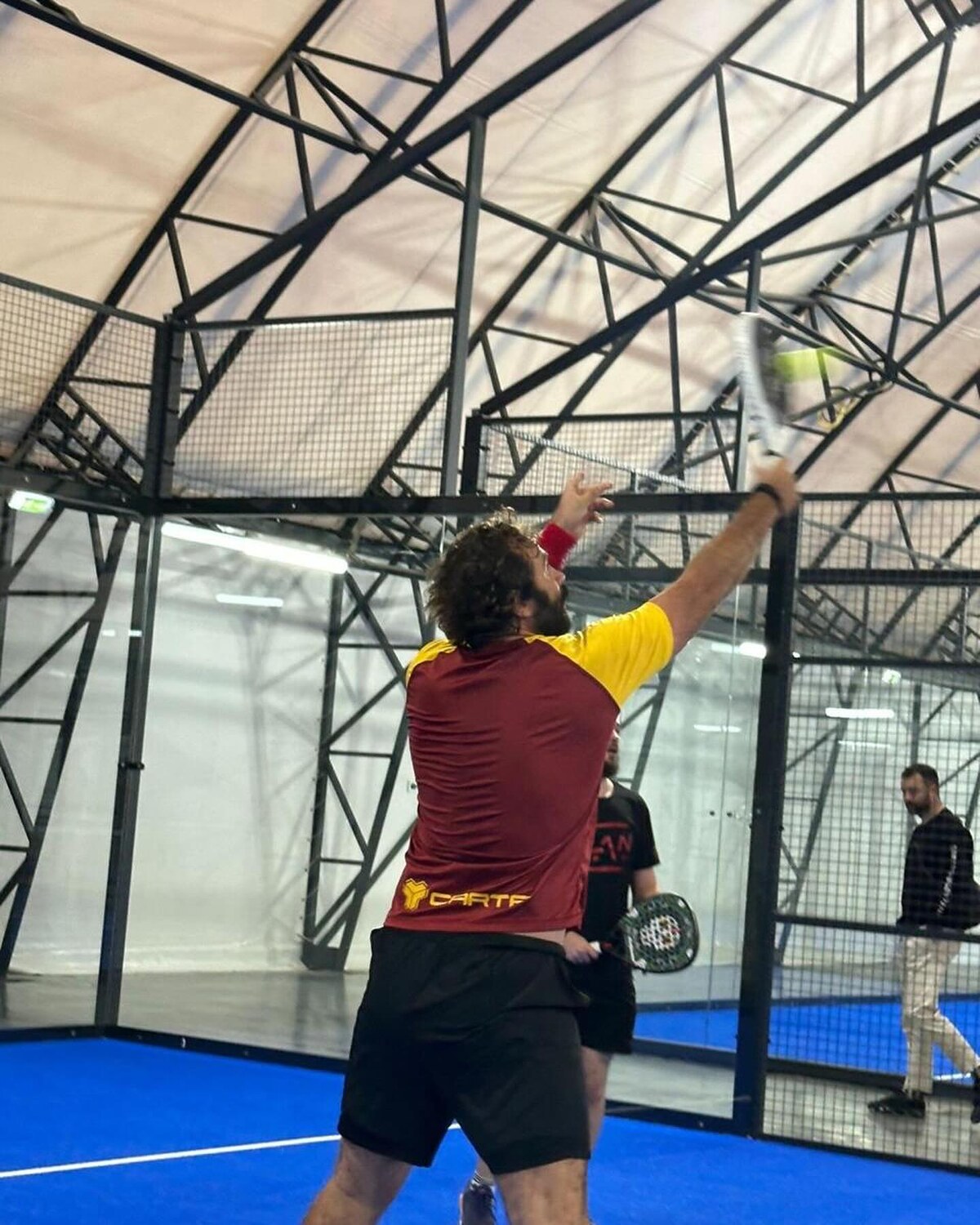
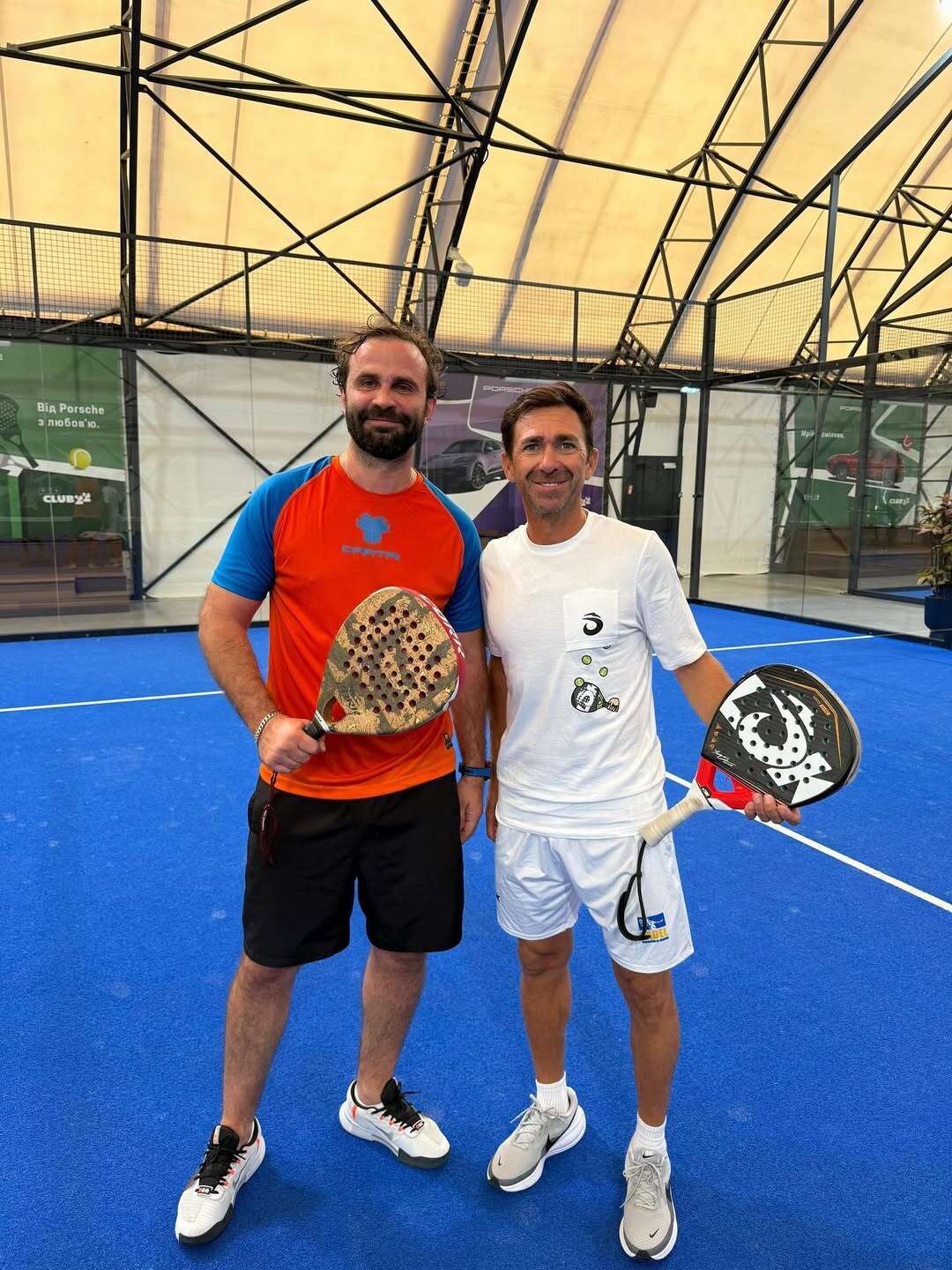
At that time, there were few halls, everything was constantly occupied. I thought: it would be cool to open a hall. Moreover, I always wanted to do what I liked. I found UNIT.City, they also wanted to open a padel court. We agreed on a partnership. We opened the first row of padel courts, now the second row is being completed — three more courts, a football field, a tennis court and a clubhouse.
As for gambling, I moved away from that area about a year ago. Now I mostly just do marketing consulting. Sometimes people come to me because marketing is my core expertise from my days in the advertising business, and that’s what I’m good at.
About the book business
— And tell me about the books.
— My first business was related to books — an online store with business literature. It didn’t last long, but I really love books. I love reading, I love books as an object.
A situation arose when I wanted to do something that resonated with my soul. I looked at the book market in Ukraine — it is very small. This is a willingness to take more risks and make investments. I identified two niches for myself: science fiction and history. Science fiction is not systematically published very much in Ukraine. With history — there is very little content.
One of the principles that is close to me in all projects is the principle of diversity. If it’s science fiction, we translate from five languages: English, Japanese, Chinese, German, French. I want to show the vision of the future of different parts of the world, different countries.
— How is the book business organized? Do you have a translation, printing house, bookstore?
— There is a group of people who select books. We look at awards, authors in different countries, look for annotations, feedback, read something. We contact the copyright holders — these are large companies. We buy the rights to publish the book. Then we do the translation — we have about 20 translators, all on contract. We type, design, make the covers ourselves and send them to the printing house.
The printing business is a separate business, not related to the book business. As a rule, none of the publishing houses has its own printing house.
We approach history books in even more detail. We have a scientific editor who reads the book, writes a review, then we discuss it and send it to print.
Publishing a book with marketing costs up to $10,000.
— How quickly does such an investment pay off?
— We are aiming for 3–4 years. A lot depends on the first print run. If the first print run is a success and you reprint it, you will earn more. The more popular the book, the more you earn.
Now we sell about 1200 books a month. This covers about 15% of our costs. This is not IT, unfortunately. The speed is not what I am used to.
— Do you have your own bookstore?
— Our name is Lobster, website lobster.net.ua. Distribution is set up for all major retailers. You can go to any store and find our literature. Online we are everywhere — Yakaboo, Megogo, Yabook. Offline, with the exception of one network, we work with everyone.
About AI in the book industry
— Today we discussed the topic — many people are talking about how AI books are being printed on Amazon. Have you seen this trend? Is it possible to make money on an AI book on Amazon?
— The book community is wary of AI. It is a direct competitor that can take jobs away from people. We are even forbidden in contracts to use AI to translate or narrate books. Only manually. The book industry is very conservative and traditional.
On the other hand, I personally welcome what is happening with AI — the democratization of access. People have been able to work with information much better. I myself use three different AIs, I teach how to write AI agents.
I think there’s no way out of this. We just need to come up with a form for it. We can’t just close our eyes and say that AI is bad. But AI shouldn’t completely replace humans either. We have to come up with something.
AI is a tool that opens up new opportunities and access to projects that previously could not be launched without millions of dollars. It will be difficult for the book industry, complicated, but some format will be developed.
About the Ukrainian science fiction market
— Have you estimated the size of the science fiction market in Ukraine?
— Three years ago, I did some serious research on the book market as a whole. Science fiction wasn’t counted separately — it’s very complicated. Each store defines fantasy differently. Some consider mysticism to be fantasy, some don’t. I think it’s about 10% of the market.
I’m not aiming for the market anymore, but for the circulation. I would like the average circulation of our books over the long term to be 5,000–7,000 books. Right now, a circulation of 10,000 is probably Dune when the film comes out, and Max Kidruk, who sells his books in large circulations. Everything else is a few thousand books, which is already considered good.
— What is the average check book?
— Somewhere around 550–600 hryvnias.
About the platform for Ukrainian authors
— How do you see the potential of Ukrainian science fiction writers? Are there any?
— Yes, in addition, I launched the Pax.com.ua platform — for authors who write science fiction and fantasy. I want to stimulate content creation here.
It’s been about a month since it was launched, now we’re finalizing it, changing the rating system a little. Ideally, we’d like to select and publish the best works on the platform. And then — for the rights to these works, animated series, film series, comics, to appear. So that it becomes a content creation factory.
We opened, we have about 30 more authors. I try to read one book a month from the platform. I’ve already seen a few good authors. I even liked a few people. We were thinking of publishing one, but we didn’t agree — it seems to be with another publishing house.
I definitely see the potential. Ideally, I would like us to not only publish these authors in Ukraine, but also continue them abroad — so that they are known about. So that they are translated into English, Polish, and other European languages.
— How much can an author earn if he writes a great book?
— If the author is not famous, the rights in Ukraine cost $500 and 7% royalties. Two, three, four thousand dollars. Writing books, you won’t be able to feed your family.
The content market in Ukraine is small. Many artists, musicians — in addition to performing, they have regular office jobs. I recently learned that many famous guys just go and work as managers in an office. The market is small, there is nowhere to turn.
It all depends on the economy. It’s all mathematically connected. Want more content? Put $100 million into the market, there will be more and better content. Very simple math.
«Do you expect it to be better? What’s the prognosis?»
— I really wanted to find some systemic changes in this project that I could make, but I don’t see them yet. I have my own path — I will slowly help develop Ukrainian-language content and content by Ukrainian authors at my level. I don’t know if this will result in a super-large-scale story. For now, I’m doing what I can.
About padel as a business
— Is padel a temporary fad or a long-term activity?
— Padel has a very specific niche. These are people who don’t want to bother with serious training, but want to stay in shape, spend their time usefully, hang out with friends. It’s a social movement.
I don’t see any other sport that would close this. Thanks to this, it will survive, it will retain its audience.
How much it will grow in Ukraine depends on several factors:
Infrastructure: there is very little of it. There are no children’s groups for padel lessons. There are probably seven halls in Kyiv and the surrounding area, of which four are within the city limits. Everything is always busy. And to build a hall in Kyiv is either a project as part of the infrastructure (like UNIT.City), or the land will cost very much, and it will be unprofitable.
Media coverage: how much coverage the sport will receive. If it becomes an Olympic sport or systematic world championships begin to be held, it will attract an audience.
In short: it will always occupy its niche, but how big it will be depends on various factors.
— Some say that padel is more economically profitable to develop than tennis — less costs, more profit.
— I don’t know much about tennis. We aim to pay off padel tennis in 3.5 years. Right now, each court is occupied 12 hours a day. 15 hours is the ceiling.
The economy has deteriorated a lot now, because there is no electricity — the generator is running. We have a large building, the generator eats up 60% of the profit. But this situation, I hope, will not always be like this.
The profitability of this business is quite good now.
— How much does an hour cost now?
— 1300 hryvnias. Actually like a court, but there is less space. Plus, you play the court alone or with two people, and a lot of padel is played 2×2. More people. I think we will raise prices even more at the distance. The market can definitely pay. I think we can charge 400 hryvnias per person.
— Who is a typical padel player in Ukraine, particularly in Kyiv?
— Mostly these are IT people: not only developers, but also management, people from various digital areas. There are also many self-employed entrepreneurs.
— Is padel only in Kyiv?
— No. There are already clubs in Odessa, Lviv, Ivano-Frankivsk, and I think even near Uzhhorod. Often it looks like this: the owner starts playing himself, gets interested, and decides to open a club.
— Do Ukrainian celebrities play padel?
— Yes. Andriy Shevchenko plays systematically and even opened a club with his partners. Some tennis players also play. And also — Oleksandr Usyk also plays padel.
— If I want to start playing, what do I need to buy?
— In a good way — nothing. Sports form and a desire to play. The club usually gives you a racket and everything you need.
— Are there padel tournaments in Ukraine?
— Yes, and a lot of them. Tournaments are held almost every day. For example, Club 22 regularly organizes tournaments, including women’s tournaments. My wife Anastasia runs the club directly and regularly holds women’s Sheplay tournaments. They are thematic, with a dress code, music, and are very atmospheric. So we invite all the girls!