Хочете будувати кар’єру в Data Science та AI? Vodafone Big Data Lab відкриває новий набір —>
Наталя ХандусенкоRobots
31 May 2025, 13:18
2025-05-31
Engineers have developed an artificial muscle for robots: it can automatically detect damage and self-repair
Scientists from around the world have already created stretchable electronics and mechanisms for robots that are soft and conformal. But these developments are unable to respond to damage and then initiate self-healing. To fill this gap, a team of engineers from the University of Nebraska, USA, has developed an intelligent artificial muscle.
Scientists from around the world have already created stretchable electronics and mechanisms for robots that are soft and conformal. But these developments are unable to respond to damage and then initiate self-healing. To fill this gap, a team of engineers from the University of Nebraska, USA, has developed an intelligent artificial muscle.
The team has developed an intelligent, self-healing artificial muscle with a multi-layered architecture that allows the system to detect and locate damage, and then initiate a self-healing mechanism — all without external intervention, reports Tech Xplore.
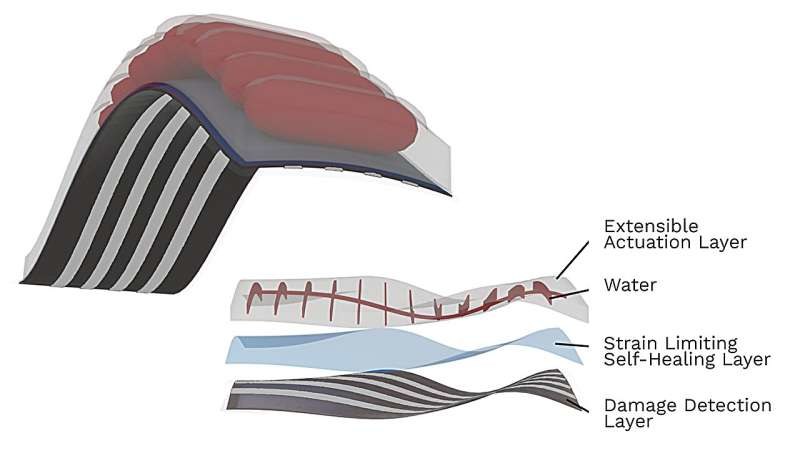
This "muscle" is the robot's actuator, which converts energy into physical movement. It has three layers:
the bottom layer — the damage detection layer — is a soft electronic shell consisting of microdroplets of liquid metal embedded in a silicone elastomer;
this shell is attached to a middle layer, a self-healing component, which is a rigid thermoplastic elastomer;
On top is the executive layer, which triggers the movement of the muscle under water pressure.
Source: Tech Xplore
To begin the process, the team induced five control currents through the underlying “skin” of the muscle, which is connected to a microcontroller and sensitive circuitry. Puncture or damage to this layer under pressure results in the formation of an electrical network between the traces. The system recognizes this electrical trace as evidence of damage and subsequently increases the current flowing through the newly formed electrical network.
This allows the network to function as a local Joule heater, converting the energy of the electrical current into heat around the site of injury. Within minutes, this heat melts and recycles the middle thermoplastic layer that seals the injury—the wound effectively heals itself.
The final step is to return the system to its original state by erasing the electrical trace of the damage to the underlying layer. To do this, engineers exploit the effects of electromigration, a process in which an electric current causes metal atoms to migrate.