Промо на dev.uaAI Eng
25 June 2026, 13:00
2026-06-25
How ScroogeFrog AI is fighting ad fraud in the age of AI bots
Digital advertising is approaching a critical point. Industry analysts predict that by 2026, global losses to advertisers due to ad fraud will exceed $120 billion. If a few years ago marketers struggled with primitive scripts and click farms, today artificial intelligence dictates the rules of the game. To stop this large-scale drain on budgets, the ScroogeFrog AI Antifraud team has developed a technology for deep traffic analysis, because standard methods of struggle are already powerless.
Digital advertising is approaching a critical point. Industry analysts predict that by 2026, global losses to advertisers due to ad fraud will exceed $120 billion. If a few years ago marketers struggled with primitive scripts and click farms, today artificial intelligence dictates the rules of the game. To stop this large-scale drain on budgets, the ScroogeFrog AI Antifraud team has developed a technology for deep traffic analysis, because standard methods of struggle are already powerless.
From simple clicks to human imitation: how the threat evolved
Bots now generate about 30% of all global web traffic. Modern AI bots don’t just blindly click on ads — they’ve mastered the art of masquerading as real people. They redirect connections through resident proxies, simulate human click latency, “read” pages, and even perform micro-conversions. As a result, businesses face a triple threat: a direct drain on budgets, completely distorted web analytics, and the inability to make informed strategic decisions based on data. At the same time, the most important promotion channels are hit.
A comprehensive market analysis demonstrates the following distribution of vulnerability of the main advertising channels:
Programmatic (~35%): Automated display ad buying is a prime target for fraudsters. The sheer number of intermediaries (SSPs, DSPs, ad exchanges) and the opacity of inventory make it easy for attackers to inject spam traffic, inject hidden iframes, and spoof premium publisher domains.
In-app / Connected TV (CTV) (~20%): Mobile apps and smart TVs are extremely vulnerable due to the nature of data transmission. Device ID spoofing, background loading of ads in invisible areas of the screen, and simulation of views on expensive video ad platforms are all prevalent here.
Paid Search (~15%): Search engine optimization suffers from click fraud, SERP scraping, and automated botnets designed to drain daily campaign budgets on the highest-converting keywords.
How bots adapt to your payment models
Marketers often think they have complete control over the situation by choosing proven, standard traffic purchasing models. However, in practice, the indicators in advertising offices under the influence of these algorithms easily turn into an illusion. Depending on how you pay for advertising, bots instantly adapt their strategies:
When working on the CPM (Cost Per Impression) model , scammers inflate views using pixel stuffing (hiding a banner in a 1×1 pixel) or ad stacking (stacking dozens of banners on top of each other). The advertiser pays for millions of impressions that no living person could physically see.
In the CPC (Cost Per Click) model, AI bots generate clicks with a precisely calibrated frequency so as not to arouse suspicion in the networks' basic filters. Traffic graphs crawl up beautifully, CTR looks perfect, but sales remain at zero.
Even the CPA (Cost Per Acquisition) model, considered the mainstay of performance marketing, is under threat. Smart algorithms have learned to fill out lead forms using stolen databases, register fake accounts, upload content, and add products to carts, forcing businesses to pay commissions for completely fictitious conversions.
You look at your dashboard and see a successful campaign with growing traffic, but the business is getting zero real ROI. Your money is simply disappearing as bots have learned to embed themselves into the real user journey.
Deformation of a complex Customer Journey
Such fraudulent schemes are incredibly difficult to detect due to the inherent complexity of the modern customer journey. A user rarely buys a product on the first click, usually going through a series of touchpoints:
Standard user interaction chain
1. First acquaintance:
Targeted advertising on social networks creates initial brand awareness.
2. Information search:
The user searches for information in a search engine to read reviews and learn more about the brand.
3. Building trust:
The client clicks on a referral link on an authoritative industry blog, which builds trust.
4. Completing the conversion:
The user returns via email promotional email and finalizes the order.
When marketers try to visualize this journey, their analytics begin to resemble a tangled detective story. To fairly distribute value across these channels, various attribution models (from First Click to AI-powered dynamic models) are used.
And this is where bots find a weak spot: using, for example, cookie stuffing, they forcibly intercept the Last Click attribution stage. As a result, they take credit and commission for an organic sale that was actually made by a real person. To stop this, we need a fundamentally new type of analytics.
Creating a Digital Impression: How to Assemble a Complete Visitor Dataset
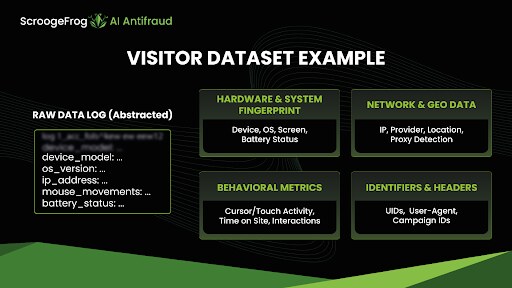
Since basic IP address checks are no longer enough to detect such cunning manipulations, a modern enterprise-level anti-fraud system is forced to collect and analyze a deep, multi-layered digital footprint — the Visitor Dataset. This analysis occurs simultaneously at three levels:
Network layer (HTTP headers): The system analyzes raw connection logs, checks IP routing data, and matches the declared browser parameters. Bots often get cut off by small discrepancies — for example, when a device claims to be a mobile browser but sends headers that are typical of server software.
System level (Browser JS events): Scripts query the hardware environment to check for real screen resolution, hardware acceleration via WebGL, number of processor cores, and battery health API. If a device pretends to be a flagship smartphone but cannot render basic system fonts, it is instantly marked as an emulator.
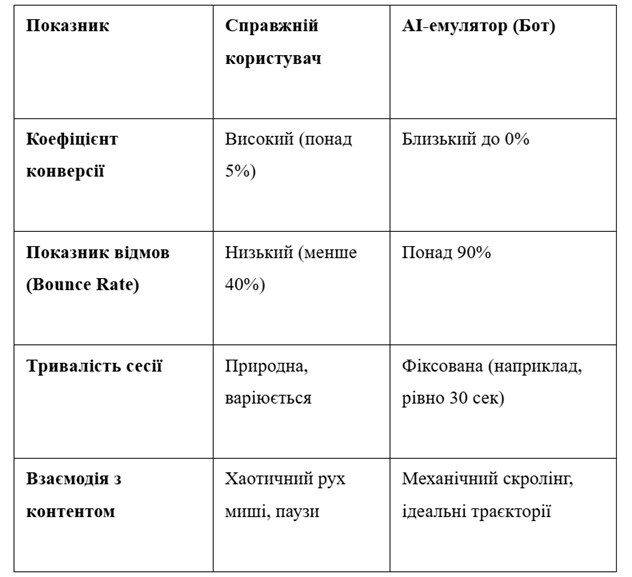
Behavioral biometrics: The most reliable line of defense. While artificial intelligence can fake headlines, it is extremely difficult to replicate the physical limitations of the human body. Bots move cursors along flawless mathematical lines, while humans micro-pause, miss targets, and flick their mouse unpredictably. Real users read content at different speeds, while robots scroll pages with perfect mechanical periodicity.
It is the deep segmentation of these markers that allows us to clearly see the gap between a live audience and automated software:
How ScroogeFrog is changing the rules of the game
The main problem with most “boxed” anti-fraud services is that they try to protect businesses with static rules. They apply the same templates to everyone, evaluating mobile games and complex B2B platforms on the same scale. However, modern AI bots easily bypass universal filters, adapting to a specific site.
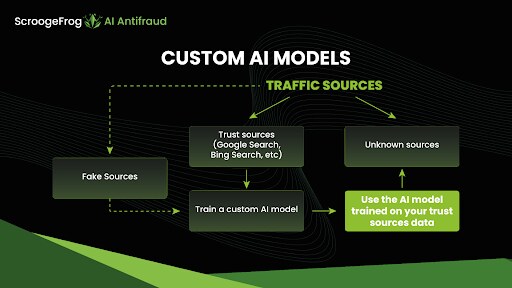
That is why ScroogeFrog AI Antifraud abandoned outdated dogmas in favor of training Custom AI Models, which are created individually for the unique traffic profile of each specific client.
The process of building protection begins with capturing data from guaranteed clean reference channels, the so-called Trust Sources (for example, direct brand search). Human behavior here becomes the basic mold of the norm. Then, terabytes of raw unstructured logs go through a strict data labeling pipeline, where each visit is labeled as human or bot. A custom algorithm is trained on these examples, which then analyzes the flow from unknown sources (Unknown Sources). Moreover, if the system finds new types of fraud on fake sites (Fake Sources), this data is automatically returned to the training cycle for dynamic recalculation of the entire model.
The analytical core of this system is based on three powerful machine learning algorithms:
Random Forest: Builds ensembles of decision trees, reliably blocking high-level structural fraud.
Gradient Boosting: Sequentially creates models where each subsequent one actively corrects the errors and "blind spots" of the previous one.
MLP (Multilayer Perceptron): A fully connected neural network that finds the deepest nonlinear relationships in user behavior.
However, as practice has shown, even the presence of such algorithms does not guarantee success if one critical mistake is made in the strategy for training them.
Experiment on real data: Why the algorithm should “know the enemy by face”
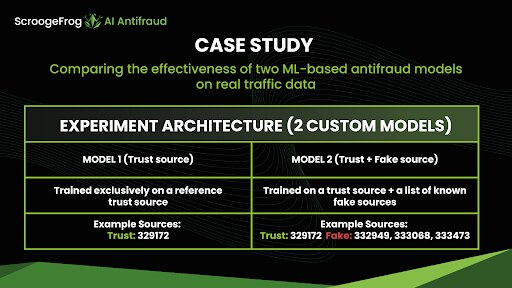
To prove the importance of proper AI training logic, we conducted an experiment on a real traffic dataset, pitting two different strategies head-to-head:
Model 1 was trained exclusively on the “ideal” behavior of people from clean sources. The logic: the system knows the norm, and anything that deviates from it is fraud.
Model 2 underwent comprehensive training: it was simultaneously shown both pure human traffic and patterns from the "blacklist" of real fraudulent botnets.
The experiment was conducted in two rounds, and its results were quite unexpected.
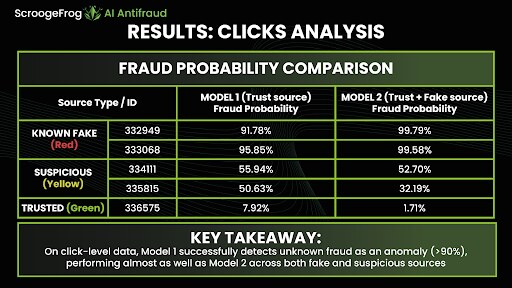
Round 1: Raw click filtering. At the stage of analyzing regular clicks, Model 1 performed excellently. Working in anomaly detection mode, it caught over 90% of unknown fraud simply as a behavioral deviation from the norm. It would seem that the theory was confirmed: showing AI examples of bots is not necessary. But this turned out to be an illusion.
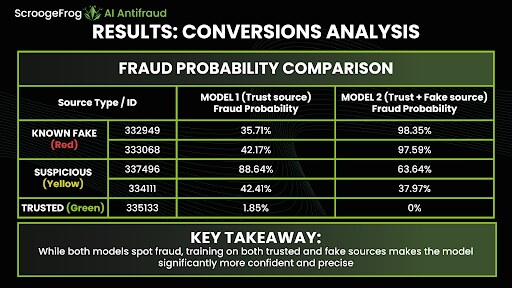
Round 2: Analysis at the target action (CPA) stage. When we moved to the moment of filling out forms and registrations, the situation turned around. Since modern bots simulate conversions filigree, Model 1 (which knew only “good” examples) began to hesitate. It assigned a low probability of fraud to obvious bots — only 35–42%. In addition, due to the too rigid template of the “ideal person”, it began to give a lot of false positives on live users, blocking real customers.
Instead, Model 2, trained on the stark contrast between the norm and real-world fraud mechanics, performed with surgical precision. It identified bots at the conversion stage with 97–98% confidence, while maintaining 0% false positives on clean traffic.
The key conclusion of the study: Trying to train AI only on good examples makes performance marketing defenseless. To build hermetic protection, algorithms are required to study the architecture of the fraud itself in detail. Only then can the system operate without errors.
The New Standard of Marketing: How to Take Back Control of Your Budget
The era of simple solutions in digital marketing is officially over. Naive attempts to save budgets by manually disabling sites or outdated IP address lists no longer work against artificial intelligence technologies.
The only way to stay effective and win this arms race is to implement deep, automated digital footprint analysis based on custom, two-way machine learning models. This approach allows businesses to:
Instantly cut off junk traffic before budgets are depleted.
Get transparent end-to-end analytics for objective evaluation of sales channels.
It is safe to scale advertising campaigns that are truly profitable.
Stop funding the shadow botnet market. If you want to know how much of your budget is currently spent on neural network conversion simulation and deploy robust enterprise-grade protection, contact the ScroogeFrog AI Antifraud team.
Як нейромережі бачать вільну та незалежну Україну? Тест dev.ua
Нейронні мережі для генерації зображень бачать світ по-своєму, їхню логіку зрозуміти часом зовсім неможливо. Але таки хочеться. На честь Дня Незалежності України редакція dev.ua вирішила провести невеликий експеримент.
Ми задали чотирьом різним нейронним мережам п’ять однакових запитів: «прапор України», «День Незалежності України», «український Крим», «перемога України» та «українці». Отриманими результатами ми ділимося з вами нижче.
У TikTok тепер можна генерувати фон за допомогою нейромережі. Ми протестували її та ділимося результатами
У TikTok з’явилася нова функція «Розумний фон». З її допомогою як фон для тіктоків можна підставляти згенеровані нейромережею зображення. Редакція dev.ua протестувала цю технологію і ділиться своїми враженнями.