Хочете будувати кар’єру в Data Science та AI? Vodafone Big Data Lab відкриває новий набір —>
Марія БровінськаGadgets
24 September 2026, 08:14
2026-09-24
Sharp is developing a universal satellite antenna that should reduce dependence on Starlink
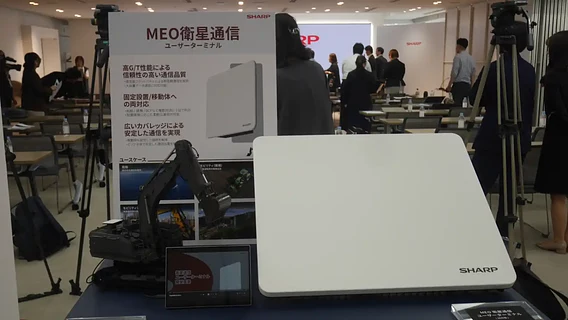
Japan’s Sharp is developing a compact satellite antenna that will be able to work with networks of different operators, rather than tying the user to a single provider like Starlink. The company plans to bring the first terminals with the new technology to the market in 2030, Nikkei Asia writes .
Japan’s Sharp is developing a compact satellite antenna that will be able to work with networks of different operators, rather than tying the user to a single provider like Starlink. The company plans to bring the first terminals with the new technology to the market in 2030, Nikkei Asia writes .
Sharp’s idea is to create a universal satellite terminal that can be used with various satellite networks. The company is considering its use in defense, remote control of construction equipment, unmanned driving and other tasks that require satellite communication with the transmission of significant amounts of data.
Today, satellite services often operate with their own specialized terminals. The most prominent example is Starlink: SpaceX itself develops the satellites, antennas, and user equipment for its network.
Sharp wants to make its terminal much more compact than traditional satellite dishes. To do this, the company is using technology that it previously developed for smartphones. The idea is for the device to be small and light enough to be installed, for example, on a boat or drone.
The development of universal antennas is supported by the Japanese government. The Ministry of Internal Affairs and Communications of Japan is collecting applications for compact and lightweight antennas, from which it plans to select two or three projects. Up to 7 billion yen — about $44 million — may be allocated for their implementation. State support will last a maximum of five years. Sharp has already submitted its application.
In parallel, the company is developing its satellite business together with partners. From 2027, Sharp plans to offer the services of Luxembourg operator SES in Japan. The companies announced the cooperation in June. By 2035, Sharp expects to receive about 100 billion yen, or about $630 million, in revenue from satellite services.
The company is also counting on foreign demand. Sharp links the prospects for universal terminals to growing geopolitical risks, which are causing countries to try not to depend on a single satellite communications provider.
One such project is the European IRIS² satellite system, and SES is part of the consortium responsible for its development and operation. Sharp CEO Shigeru Kobayashi told Nikkei Asia that the company can contribute to the project, partly because Sharp is not an American or Chinese company.
At the same time, another direction of satellite communication is already developing in Japan — direct connection of ordinary smartphones to satellites. Such services have been launched or are being prepared by the country’s largest mobile operators: NTT Docomo, KDDI, SoftBank and Rakuten. The latter is cooperating with the American AST SpaceMobile, which competes with Starlink.
But direct satellite communication with a smartphone has bandwidth limitations. It is primarily used for messaging and other tasks that do not require a large amount of data. Sharp hopes to occupy another niche — providing more stable high-speed communication for machinery, drones and autonomous vehicles.
According to Global Information, the global satellite communications market could grow to $223 billion by 2033. This is more than double the 2025 figure.
Satellite technology is one of Sharp’s new growth areas. The company is scaling back its liquid crystal display (LCD) business, which was previously one of its core businesses. Satellite terminals and AI servers are among five areas Sharp is focusing on. In fiscal 2030, the company expects to generate a combined 200-300 billion yen, or about $1.3-1.9 billion, from these new businesses.