Хочете будувати кар’єру в Data Science та AI? Vodafone Big Data Lab відкриває новий набір —>
Стас ЮрасовThat's Life
25 February 2026, 16:03
2026-02-25
"If an IT guy is scared on the street, or somewhere else, he can quickly call our group, they will pick him up and take him from point A to point B." Interview with Dmitry Strizhov, founder of SHERIFF
SHERIFF is a company that most people know as a security firm with yellow cars. But in recent years it has grown into something much more. It recently had its own SOC (Security Operations Center) for cybersecurity. This area in our country, frankly speaking, is still poorly developed. No more than 3% of Ukrainian companies are more or less engaged in cybersecurity.
SHERIFF is a company that most people know as a security firm with yellow cars. But in recent years it has grown into something much more. It recently had its own SOC (Security Operations Center) for cybersecurity. This area in our country, frankly speaking, is still poorly developed. No more than 3% of Ukrainian companies are more or less engaged in cybersecurity.
And the cases of attacks are very significant. As Strizhov recalls, last year one large Ukrainian construction network (he won’t say the name, but think about this information a little) paid hackers a million dollars in bitcoins to get their data back. So there’s plenty of work, but not enough specialists. SHERIFF started training them itself.
Another interesting direction of SHERIFF is the protection of enterprise facilities from FPV drones. An entire system has already been developed that not only warns of the approach of a UAV, but also attacks it.
As for Ukrainian IT people, the most common service among them, as it turned out, is a panic button. IT people are generally anxious by nature. But now, while moving around the city, they have more reasons for sudden panic. So they press a button on their smartphone — and a yellow car comes to them.
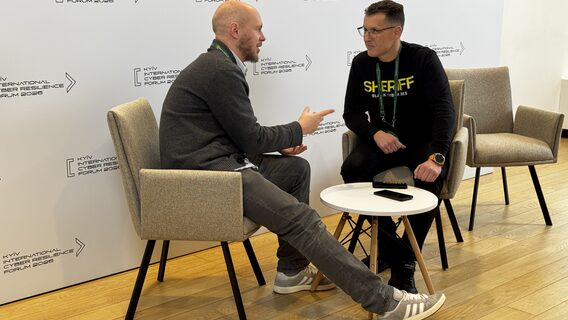
During the Kyiv International Cyber Resilience Forum 2026, a dev.ua journalist spoke with the company’s founder, Dmytro Stryzhov, about why 97% of Ukrainian businesses still ignore cybersecurity and how much this negligence can cost.
Why SHERIFF doesn’t manufacture equipment — and what is its strength then?
— If you don’t mind, I’ll start with such an interesting security segment as the car alarm market. In Ukraine, it still sells mainly Russian equipment — Pandora, Starline, and others. Do you plan to enter this market?
— No, and we won’t. We are not engaged in production and we won’t. Our strength is that we are security experts. We build a security dome. We come to the client — an individual or a business — we analyze where and how the person lives, what is valuable to them, the loss of which resources or people will stop the business. And based on this analysis, we form a solution.
Why build your own autobahn if you can buy a token and drive through? We don’t manufacture equipment either — Ajax has already built great equipment.
We will come to you and say: build this security line on Ajax, put a fire extinguisher in this corner, stick armored film on the glass. Install our panic button and tracking for your family, children, and top management so that they can call us wherever they are.
— Where is cybersecurity here?
— We already monitor your alarm system in your office, in your apartment, and your fire alarm system 24/7, and conduct analytical video surveillance. And we react if something happens.
And ultimately, we thought that the true strategic value of a business is not in the laptop that criminals can steal, but in the information stored on it.
If they assign you an ERP, if they assign you a warehouse base, you will have serious problems.
There have already been many examples at the state level and at the business level. And withdrawing funds from accounting computers is the lesser evil that can be.
A major Ukrainian company had its data encrypted last year and paid a million dollars in bitcoin to get it back. And a Range Rover factory in England was shut down for a month after the hack and lost billions of pounds.
That is, today the value is in the data, in the business processes, in the CRMs, in the customer databases that every business has. They need to be protected. That is why we created our Security Operations Center, the so-called SOC, with the help of which we monitor dangerous situations and respond to them.
By the way, in the area of car security, we have trackers that plug into the OBD connector. And we monitor the transport, react if necessary. But this is not a classic alarm. Now we put AJAX in some cars, but this is not against theft, but against the installation of wiretapping. If you have such an alarm, wiretapping is impossible.
Drone protection: monitoring, electronic warfare and drone interceptor
— FPV drones have already become a real threat, and not only on the front. Are you protecting against them?
— Yes, we are already closing this issue. The scheme is as follows: the monitoring system tracks the approach of the drone and triggers an alarm. People go to the bomb shelter. The EW system of directed action is automatically turned on — not some underground one, but a legal one that operates in the area of the drone’s approach. If the EW system does not work, an interceptor drone is raised and rams the target.
— Does this really work?
— It has already been done. Some enterprises in Ukraine are now equipped in this way. Buildings — not yet, but enterprises — yes.
Cybersecurity market in Ukraine and Europe
— How do you assess the cybersecurity market in Ukraine?
— It is very small and is just forming. Unfortunately, most Ukrainian companies turn to us after a hack, not before it. No more than 3% of Ukrainian companies are more or less involved in cybersecurity. So there is enough work on the market.
— And in Europe?
— The situation is different there. After the introduction of the NIS-2 directive, medium and large businesses are obliged to protect themselves. The directive requires having a cyber officer on staff and conducting quarterly pentesting of systems. If a company does not do this and a hack occurs, a fine of 2% of annual turnover and up to 10 million euros is imposed. Therefore, European companies take cybersecurity very seriously. Currently, there is a shortage of 100,000 specialists.
— Is there something similar in Ukraine?
— It appears. Last year, a law with similar requirements was adopted for state-owned companies. In December, the National Bank obliged about 900 financial companies to meet certain cybersecurity requirements by October of this year — SOC, audit, pentesting. Given our path to the EU, we will also reach NIS-2.
Three typical scenarios of cyberattacks on businesses
— What is most often stolen or broken into?
— There are three main scenarios.
The first is data destruction. These are usually organized groups operating within the structures of the Russian army. The goal is to stop, to harm.
The second is data encryption with a ransom demand. International hacker groups, including Russian ones. They sell your data to you. One large Ukrainian construction network paid a million dollars in bitcoins — and their data was returned to them. This was already 2025.
The third is phishing for an accounting computer. They gain access to the key to the bank account and simply withdraw funds to fake accounts.
Ajax, SHERIFF Base and tariffs
— How do you cooperate with Ajax?
— We are the general distributor of Ajax in Ukraine. SHERIFF installed the most Ajax in Ukraine. In total, about half a million Ajax devices have been installed in Ukraine, of which about 300,000 are connected to centralized surveillance consoles. Of these 300,000, more than 40,000 are on SHERIFF.
— If I don’t want to constantly pay significant amounts for security, is there a budget connection option?
— There is a SHERIFF Base service — from 65 hryvnias per month. We don’t monitor your alarms constantly, but if something happens — with one swipe in the application you send our crew. You pay only 500 hryvnias for the very fact of the departure, and only if it is needed.
What do IT companies order?
— What is popular among IT companies?
— Most often, there is an SOS emergency button on the employee’s phone.
If an IT professional feels scared on the street or anywhere else, he can quickly call our group, which will pick him up and take him from point A to point B: across Kyiv, between districts, from the city to the region. Top managers also order personal security.
Plans for 2025
— What are you planning to launch this year?
— Three big directions.
The first one is in March we are launching the international application Trасk me. This is tracking for the family: family members can see each other on the map, you can set geofences, and receive notifications. For example, if a child goes to training, you will receive a notification. Or you mark a dangerous area, and if your child is there, you will immediately know. It works all over the world via a mobile phone.
The second is the development of cybersecurity in EU countries and building our own team there.
The third is a social project: training veterans with amputees in the cybersecurity profession. The first group is 35 veterans. Now it will be a very large project — we want to give 2,000 veterans a profession in cybersecurity.
Cybersecurity allows you to work from home or anywhere in the world. We also have a focus on humanitarian demining and sapper training.
— Who are you looking for in the team now?
— SOC operators. They are hard to find, but we look for them and train them ourselves. Salaries are market-rate.
— How many IT specialists currently work at SHERIFF?
— I think about 70. Development, maintenance of internal systems and cybersecurity.