Хочете будувати кар’єру в Data Science та AI? Vodafone Big Data Lab відкриває новий набір —>
Наталя ХандусенкоAI Eng
10 September 2026, 16:32
2026-09-10
NASA and IBM created artificial intelligence to explore the Moon: how it works and why it's important
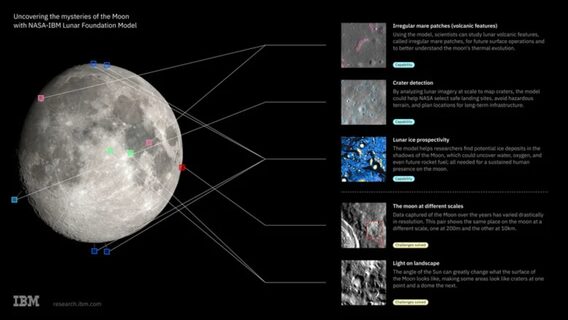
NASA and IBM have unveiled a new artificial intelligence model, the NASA-IBM Lunar Foundation Model, designed specifically for lunar exploration and will help scientists prepare for future Artemis lunar missions.
The model is now available for free download on the Hugging Face platform, so any researcher in the world can use it. The code is also available on GitHub.
What AI can do
The AI was developed to analyze complex images and data from lunar orbit, Engadget reports . The system's main tasks are:
Ice search — the smart assistant accurately identifies places on the lunar surface where frozen water may be hiding — which is critical for future lunar bases. During tests, the model was 23% more accurate than a similar system from Microsoft.
Crater recognition — the model identifies and classifies craters 19% better than existing counterparts, while consuming half the resources.
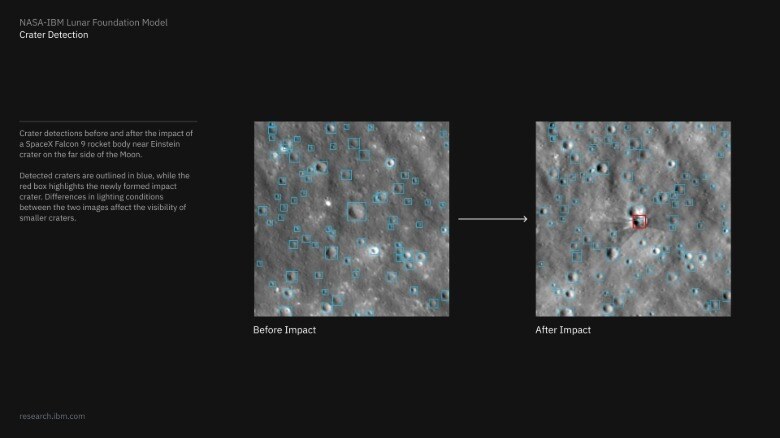
The system's operation has already been tested in practice: when the SpaceX Falcon 9 rocket booster crashed into the Moon on August 5, the AI unerringly found the crash site and identified a new crater on the first try, although it partially overlapped the old one.
What was the complexity of the development?
According to Dr. Juan Bernabe-Moreno of IBM Research, training AI to work with the Moon proved to be much more difficult than for Earth.
On Earth, the atmosphere scatters light, making shadows soft. On the Moon, there is no atmosphere, so shadows there are pitch black with sharp edges. This is why the same crater looks completely different in photographs at different times of day.
Typically, AI is trained by cutting out a piece of a photo and having the algorithm “repaint” it. However, with the Moon, this method failed, as most craters look almost the same from orbit.
To solve this problem, scientists divided the Earth's satellite into sectors — "like slices of an orange" — and trained the system on some slices and tested its performance on completely different ones.
A gift for scientists
Along with the model, NASA and IBM have made a giant database publicly available, containing tens of thousands of images and measurements from several spacecraft (USA and Japan).
All of this data has been perfectly organized and tied to a single coordinate grid for the first time in history—over 2 million points. Even if more advanced AI models emerge in the future, this created database will remain the foundation for lunar exploration for years to come.
Божество, зореліт, уламок планети: що людство знає про Місяць і як збирається туди повертатися
16 листопада 2022 року NASA успішно запустила місію Artemis 1 до Місяця. Ракета Space Launch System (SLS) і корабель Orion стартували о 8:47 за Києвом із космічного центру Кеннеді на мисі Канаверал. Задача корабля Orion — покрутитися навколо супутника Землі шість днів і повернутися на Землю, після чого можна запускати людей. Якщо все пройде успішно, уже за кілька років ми побачимо грандіозний камбек і реюньон людства на супутник Землі. Що ми знаємо про Місяць, чому так довго його ігнорували та як будемо повертатися — в оновленому завдяки успішному старту (нарешті!) суперексплейнері від dev.ua від 29 серпня 2022 року.
Як нейромережі бачать вільну та незалежну Україну? Тест dev.ua
Нейронні мережі для генерації зображень бачать світ по-своєму, їхню логіку зрозуміти часом зовсім неможливо. Але таки хочеться. На честь Дня Незалежності України редакція dev.ua вирішила провести невеликий експеримент.
Ми задали чотирьом різним нейронним мережам п’ять однакових запитів: «прапор України», «День Незалежності України», «український Крим», «перемога України» та «українці». Отриманими результатами ми ділимося з вами нижче.
Have important news to share? Message our Telegram bot
Key events and useful links in our Telegram channel