Наталя ХандусенкоAI Eng
9 July 2026, 09:52
2026-07-09
SpaceXAI has released Grok 4.5, which Elon Musk describes as an “Opus-class model”
SpaceXAI described its new Grok 4.5 model as a “workhorse” capable of handling all the typical tasks that the AI industry seeks to automate: writing code and creating applications, office and clerical work, research, copywriting, and other types of routine intellectual work.
SpaceXAI described its new Grok 4.5 model as a “workhorse” capable of handling all the typical tasks that the AI industry seeks to automate: writing code and creating applications, office and clerical work, research, copywriting, and other types of routine intellectual work.
Grok is expected to be able to do all of this at a lower cost, as SpaceXAI claims that their model has “twice the token efficiency” of other leading models. If proven in practice, such efficiency will be a huge advantage for SpaceXAI, as token costs are a growing concern among AI consumers, TechCrunch writes .
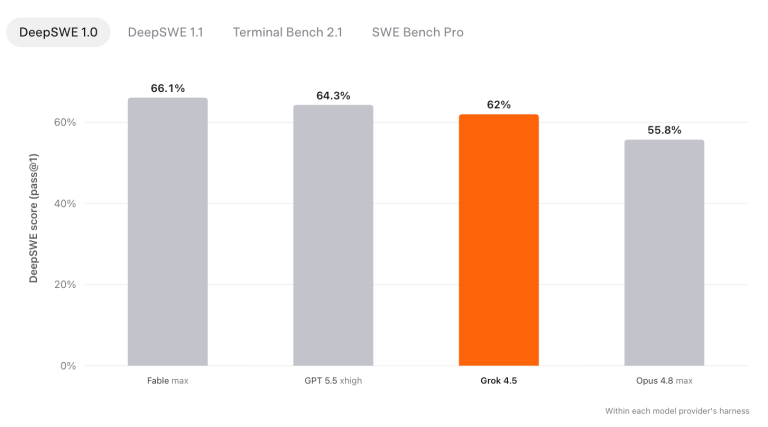
In a blog post, the company posted benchmarks that appeared to show Grok's competitiveness with other top-of-the-line models from SpaceXAI competitors, though it fell just short of best-in-class.
In a post on X, Elon Musk compared the new model to Opus, a large language model from Anthropic designed for intensive and complex tasks.
“Based on strong positive feedback from customers in our beta testing program, tomorrow (ed. — today, since the post was made on 8.07) SpaceXAI will make Grok 4.5 available to the general public. It is an Opus-class model, but faster, more token-efficient and cheaper,” Musk wrote in his post in X.
Musk later added, "Our internal assessment is that Grok 4.5 is roughly comparable to Opus 4.7, but significantly faster. The combination of functionality, higher speed, and lower cost is what makes it competitive."
SpaceXAI says its new model costs $2 per million input tokens and $6 per million output tokens. That’s a pretty competitive price if Grok’s capabilities live up to the company’s rhetoric.
In comparison, Opus 4.7 costs $5 per million input tokens and $25 per million output tokens. OpenAI offers tiered pricing for different versions of its models: Sol, its most expensive version, costs $5 per 1 million input tokens and $30 per 1 million output tokens, while the cheapest, Luna, costs $1 per 1 million input tokens and $6 per 1 million output tokens.
As a reminder, a new model from OpenAI was released today — GPT 5.6 . The release of this model was previously restricted by the Trump administration due to concerns about its security implications. OpenAI called it its “most powerful model to date.”
$131 million for Cybertruck and $4 million for Musk's security, colonies on Mars and warnings about Grok: strange details in SpaceX's presentation to investors
Як нейромережі бачать вільну та незалежну Україну? Тест dev.ua
Нейронні мережі для генерації зображень бачать світ по-своєму, їхню логіку зрозуміти часом зовсім неможливо. Але таки хочеться. На честь Дня Незалежності України редакція dev.ua вирішила провести невеликий експеримент.
Ми задали чотирьом різним нейронним мережам п’ять однакових запитів: «прапор України», «День Незалежності України», «український Крим», «перемога України» та «українці». Отриманими результатами ми ділимося з вами нижче.
У TikTok тепер можна генерувати фон за допомогою нейромережі. Ми протестували її та ділимося результатами
У TikTok з’явилася нова функція «Розумний фон». З її допомогою як фон для тіктоків можна підставляти згенеровані нейромережею зображення. Редакція dev.ua протестувала цю технологію і ділиться своїми враженнями.