Хочете будувати кар’єру в Data Science та AI? Vodafone Big Data Lab відкриває новий набір —>
Валентин ШнайдерAround IT
28 October 2025, 16:49
2025-10-28
The US has created microchips for nuclear reactors: sensors work at extreme temperatures and withstand radiation
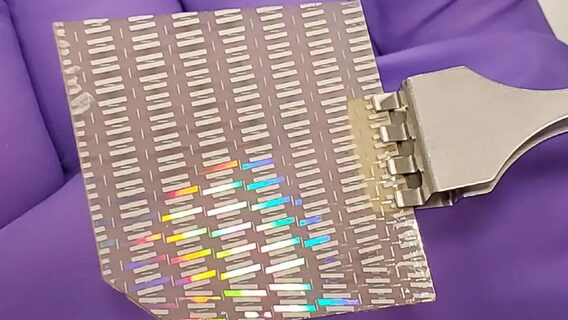
Engineers at the University of Maine have demonstrated microelectronic sensors that do not «burn out» under the influence of intense radiation and continue to work at temperatures up to 800 °C. The solution closes a key gap in measurement systems for new high-temperature reactors.
Engineers at the University of Maine have demonstrated microelectronic sensors that do not «burn out» under the influence of intense radiation and continue to work at temperatures up to 800 °C. The solution closes a key gap in measurement systems for new high-temperature reactors.
According to Interesting Engineering, the UMaine team spent two years testing the chip in a core-like environment. The prototype reads reactor power parameters without degradation for at least a week of continuous operation, and the sensors can withstand temperatures of 800 °C. The tests were conducted at the Ohio State University Nuclear Research Laboratory, part of the U.S. Department of Energy’s network of user research facilities.
Control in such conditions is critical: current industrial sensors for traditional nuclear power plants are not designed for the thermal and radiation loads of future plants. The new sensor measures temperature, power and other key parameters in real time, so engineers receive immediate feedback on the reactor’s condition, can detect deviations more quickly and reduce maintenance costs. Project leader Professor Mauricio Pereira da Cunha emphasizes: this is the first demonstration of a microchip capable of measuring reactor power at 800 °C — a temperature at which production analogues do not work.
In the next step, the researchers will integrate wireless mode: the chip will not require batteries, and power and data communication will be provided by an external polling signal. This will simplify installation and maintenance, especially where laying cables is dangerous or economically unprofitable.
Nuclear power generates about 20% of the U.S.'s electricity, and the transition to high-temperature reactors and microreactors requires new materials and electronics that can withstand both heat and radiation. The UMaine microchip removes a major barrier and paves the way for more precise control, increased efficiency, and extended maintenance intervals on future power units.