Реклама партнера — Название партнёра
UNIT.City — місце, де люди працюють... КРАЩЕ! Обирай свій простір просто зараз 👉

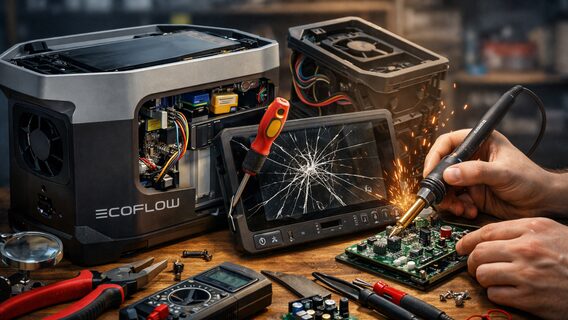
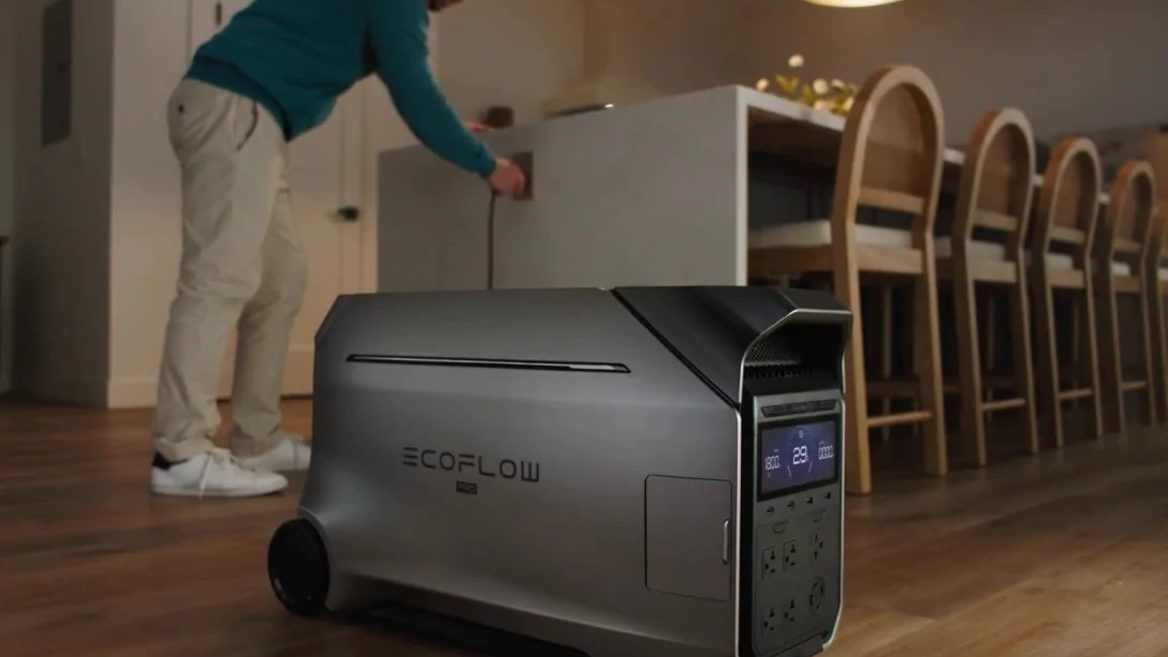
Ecoflow not working? You can wait weeks for repairs - there are currently huge queues. How to protect the station from breakdowns, what is and is not covered by the warranty and is it worth discharging devices to 0

Ukraine has seen a sharp increase in demand for repair and maintenance of portable charging stations. According to EcoFlow brand manager Serhiy Silin, after October 10, 2025, the number of service calls has increased dozens of times. This creates queues for repairs and affects the service times of official stations. Sales are also growing — September showed up to 3,000 stations sold per month, and in October-December 2025, sales exceeded 20,000 devices across the country.

dev.ua talked to experts — electronics repair service center master Maksym and EcoFlow brand manager Serhiy Silin — and found out what breakdowns occur most often, what to pay attention to when choosing a station, and how to safely operate batteries and inverters in real conditions.

Leave a comment
Ecoflow not working? You can wait weeks for repairs - there are currently huge queues. How to protect the station from breakdowns, what is and is not covered by the warranty and is it worth discharging devices to 0

Ukraine has seen a sharp increase in demand for repair and maintenance of portable charging stations. According to EcoFlow brand manager Serhiy Silin, after October 10, 2025, the number of service calls has increased dozens of times. This creates queues for repairs and affects the service times of official stations. Sales are also growing — September showed up to 3,000 stations sold per month, and in October-December 2025, sales exceeded 20,000 devices across the country.

dev.ua talked to experts — electronics repair service center master Maksym and EcoFlow brand manager Serhiy Silin — and found out what breakdowns occur most often, what to pay attention to when choosing a station, and how to safely operate batteries and inverters in real conditions.

Content
Disclaimer

Among Ukrainians, the most popular stations are Ecoflow, Bluetti, and Anker. We contacted representatives of each brand to find out how the stations are repaired, what problems consumers most often encounter, what cases are not covered by warranty, and whether there are official repair services in Ukraine. However, at the time of publication, we received answers only from Ecoflow.

How to choose a charging station that can cover your needs during blackouts

In order for the station to charge quickly and maintain the operation of the apartment during blackouts, you need to focus on the real power of the inverter and the type of battery. For domestic needs, it is optimal for the inverter to have a power of about 1–1.5 kW, which allows you to power a refrigerator, laptops and lighting. LiFePO₄ batteries are more resistant to deep discharges and frost, and fast charging depends on the current and voltage characteristics specified by the manufacturer.

«Pay attention to the input power from the network. For example, if the capacity of the stations is 2 kW, and the input power is 1 kW, expect that the station will charge in a little more than 2 hours. If the input is 2 kW, then a little more than an hour. The station charges more slowly up to 20 and after 80%. If your station is more than 3.6 or 4 kW, keep in mind that a standard outlet in the apartment can output approximately 2500-2800 W. This means that the charging time will be longer. If we are talking about Ecoflow stations, then all modern stations charge within an hour, except for stations over 2 kW,» says Sergey Silin.

So, it is worth paying attention to three factors:

  • Inverter power: minimum 1–1.5 kW to power a refrigerator, laptops, and lighting.

  • Battery type: LiFePO₄ are more stable to deep discharges and frost.

  • Fast charging: check the actual current and voltage specifications provided by the manufacturer.

What breaks most often in charging stations

The most common potentially vulnerable components are the battery and the inverter. Charge controllers and BMS, as well as mechanical elements such as connectors, buttons or displays, usually work stably if there is no external interference. Stations continue to function after 2–3 years of operation without replacing batteries or inverters.

It is worth noting: unofficial battery replacements are dangerous, and third-party interference can create risks, even if the station does not lock.

Often, consumers complain about difficulties with charging stations. The reason is in the settings that can be set in the application. In particular, the voltage parameters. Usually, such bugs can be fixed by completely discharging the battery, after which charging occurs without failures and surprises.

How often can you discharge a battery to 0% without harm?

Each station has a limit of charging cycles, indicated in the specifications. However, experts advise not to discharge the stations completely, but to leave at least 5-10% as a reserve.

Where to repair the station if it breaks down

Official EcoFlow service centers operate through a partner network, and repair times have increased due to queues that arose after the peak of demand.

The exclusive distributor «Ecoflow Ukraine» of course has its own office center. It is located in Kiev and repairs stations from all over Ukraine.

«Ecoflow Ukraine» has a warehouse and spare parts. The terms of repairs depend on the demand for goods on the market. In the usual period, the repair period was 2-3 days, now this process can take up to 3-4 weeks.

Stations from other manufacturers are repaired at network service centers for repairing electronics.

What is and is not covered by the warranty

The warranty does not cover external factors such as voltage fluctuations, generator power, or V2H/V2L use. Genuine battery modules are not sold separately, and there is no official battery pack replacement.

Manufacturing defects and malfunctions not related to user damage are warranty cases. This means — if the station does not turn on, does not charge / discharge correctly, has factory problems with the inverter, board or battery control — such problems are usually eliminated under warranty. Battery malfunctions that occurred through no fault of the user.

Warranty repair cases may include:

— malfunction of electronics inside the station;

— BMS (battery management system) defects;

internal short circuits or component failures that were not caused by damage to external parts

At the same time, battery degradation is not covered by the warranty. A complete discharge to 0% is not a warranty case and should be done with caution. In real conditions, when frequent power outages and frosts occur, LiFePO4 batteries show stability if they are not kept constantly outdoors. Long downtimes or power outages do not damage the station, provided that it is not connected to an unstable network.

Long power outages, voltage drops, generator connection, powering the house through the station (V2H/V2L) are not considered under warranty because it does not depend on the device.

«Voltage drops or connection from a generator or other external interference are the personal responsibility of the client. The station has certain protective functions against current drops, but when 500 volts or more appear in the network, no device will save it. Only special equipment at the entrance to the apartment or house,» Silin notes.

By the way, there is no official replacement of the battery module in case of breakage, and battery packs are not sold separately.

What is the most detrimental effect on the battery?

The greatest risk to the station is posed by external factors that the device cannot influence: voltage drops, generator connections, high voltages in the network. Frost affects the performance of batteries, especially if the station is often moved outdoors, but LiFePO₄ withstands short-term temperature fluctuations. Long shutdowns without load do not harm the battery if it is left in a safe state and not connected to the network.

Built-in protection features help with small surges, but with significant overloads, the device can be damaged.

Also, frequent blackouts, cold, and frequent full discharges certainly affect battery degradation. But station manufacturers have built several thousand charging cycles into the stations to 80% capacity.

According to Silin, the stations, like any electronic device, cannot operate in sub-zero temperatures, especially when charging. They can discharge and give off temperatures down to -20, depending on the manufacturer. In this case, the discharge will be faster, because the station will additionally take energy for heating and operation.

Long outages with complete downtime also cost devices. «If you don’t plan to use the station for a long time, it’s a good idea to charge it to 100% and discharge it to 50%. Then turn it off and do the same operation at least once a quarter,» Silin advises.

The most common breakdowns and maintenance

The most common potentially vulnerable components are the battery and the inverter. Charge controllers and BMS, as well as mechanical elements such as connectors, buttons or displays, usually work stably if there is no third-party interference. Stations after 2–3 years of operation continue to function without replacing batteries or inverters. Unofficial battery replacements are dangerous, and third-party interference can pose risks even if the station is not locked.

In Ukrainian realities, the PSDR board most often suffers. «It’s all because of the use of a plug-to-plug cable, when the reverse current kills the station. After all, it is not designed for the reverse current from the outlet (when the light appears),» explains Silin.

An iOS developer from Ajax Systems assembled his own charging station for UAH 21,000 and powered an apartment without electricity for 11 hours
An iOS developer from Ajax Systems assembled his own charging station for UAH 21,000 and powered an apartment without electricity for 11 hours
On the topic
An iOS developer from Ajax Systems assembled his own charging station for UAH 21,000 and powered an apartment without electricity for 11 hours
Without Bluetti and Ecoflow. The developer shared his own recipe for energy independence for $900. Here is the set of devices he uses
Without Bluetti and Ecoflow. The developer shared his own recipe for energy independence for $900. Here is the set of devices he uses
On the topic
Without Bluetti and Ecoflow. The developer shared his own recipe for energy independence for $900. Here is the set of devices he uses
"How long can you work without power on EcoFlow?" Aitovo residents share their experience and equipment setups in case of a blackout
«How long can you work without power on EcoFlow?» Aitovo residents share their experience and equipment setups in case of a blackout
On the topic
«How long can you work without power on EcoFlow?» Aitovo residents share their experience and equipment setups in case of a blackout
How the demand for the EcoFlow device in Ukraine has changed: from the ability to charge gadgets to a reserve of electricity in advance
How the demand for EcoFlow devices in Ukraine has changed: from the ability to charge gadgets to a reserve of electricity in advance
On the topic
How the demand for EcoFlow devices in Ukraine has changed: from the ability to charge gadgets to a reserve of electricity in advance
Read the country's main IT news in our Telegram
Read the country’s main IT news in our Telegram
On the topic
Read the country’s main IT news in our Telegram

Have important news to share? Message our Telegram bot

Key events and useful links in our Telegram channel

Discussion
No comments yet.