Наталя ХандусенкоІсторії
27 February 2026, 17:59
2026-02-27
A high school student founded an AI startup — a la Grammarly for programmers. Now 22, he has raised over $2 million in investment
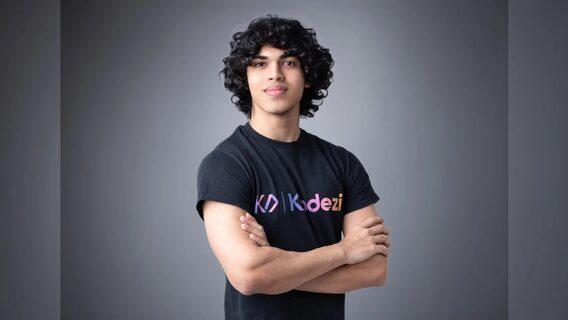
Ishrak Khan, a 22-year-old American, doesn't regret not going to college, as he has been running his own AI startup with over 35 employees for six years. He talked about how he built a company that has already raised $2.8 million in investment, with his first money raised while still in school, and shared his strategy for achieving his goal.
Ishrak Khan, a 22-year-old American, doesn't regret not going to college, as he has been running his own AI startup with over 35 employees for six years. He talked about how he built a company that has already raised $2.8 million in investment, with his first money raised while still in school, and shared his strategy for achieving his goal.
Ishrak Khan moved to the United States from Bangladesh with his parents in 2011. They bought him his first laptop, on which he began learning to program from YouTube videos.
The idea for the startup came to him in high school when he noticed his classmates constantly correcting code in computer science classes. Then he thought, why not create Grammarly for programmers, which would automatically correct coding errors.
"I spent a lot of time trying to figure out machine learning: how to make code correct itself and how to automate the whole process. It took me almost a year, but I was able to get it working in a prototype. That was the start of my company, which I now run full-time at the age of 22," Khan told Business Insider.
In the last grade, the student's project attracted the attention of his first investor. Although Khan did not receive funding, it gave him the impetus to transform his raw idea into a serious business. This is how the AI company Kodezi was born.
The next step was to find investment. The 17-year-old founder started sending emails to CEOs, startup founders, AI researchers, and venture capitalists. Over time, these emails turned into conversations about what I was building with some really big names.
First investment — $20,000
“I found an event called Orlando Synapse and wrote to them, ‘I’m a high school graduate and I don’t have $500 to put up a booth. Is there any way I can get in for free? This is what I’m building.’ Someone responded within hours, ‘Sure, here’s your free booth.’ I posted on LinkedIn about going to the event and that’s how I found one of my first angel investors. I got a $20,000 investment before I was 18.”
The biggest challenge was getting a “yes” from investors, because ChatGPT didn’t exist back then, and AI applications were still considered experimental.
It was difficult to convince investors to support an AI programming platform created by a teenager. The skepticism was not only about the technology, but also about whether the guy could implement the project at such a high level. Once generative AI became mainstream, the essence of what we were creating became much clearer.
By the age of 19, Khan had raised $800,000, then $2 million by the age of 22.
One of his strategies for achieving this was to learn to answer three questions investors asked:
What are you creating?
Why is this important?
Why would this be a company with a billion-dollar turnover?
It was also necessary to convince investors that he was the right person to do it.
"I overcame investor rejection by changing the format of the conversations: now I was not being interviewed, but rather I was interviewing them. I started trying to understand who they were, why they invested in such companies, and what their goal was. This helped me determine whether they were a good fit for me as a partner."
Whether to go to college is a question that has become a challenge
Another challenge was deciding whether to go to college or dedicate full-time work to his company at the age of 17.
Khan applied to 60 colleges, accepted more than a dozen of them, including Ivy League universities, but ultimately decided to drop out altogether.
“I realized that I would probably hate myself if I went to college. I would have lost the opportunities I had then, and I could have gone back to school at any time. If I had wanted to start an AI company after graduation, thousands of other people would have already done the same. While many of my friends were just preparing to graduate and then looking for a job, I had found my job now.”
Plans
Khan plans to continue to scale and grow his company.
When I turn 30, I see myself continuing to build my company.
"I want Kodezi to become the default system that companies rely on to keep their codebases working over time. If writing code is like building a car, then it takes a mechanic to maintain it. Our mission is to become an automated mechanic for software."
Як нейромережі бачать вільну та незалежну Україну? Тест dev.ua
Нейронні мережі для генерації зображень бачать світ по-своєму, їхню логіку зрозуміти часом зовсім неможливо. Але таки хочеться. На честь Дня Незалежності України редакція dev.ua вирішила провести невеликий експеримент.
Ми задали чотирьом різним нейронним мережам п’ять однакових запитів: «прапор України», «День Незалежності України», «український Крим», «перемога України» та «українці». Отриманими результатами ми ділимося з вами нижче.
У TikTok тепер можна генерувати фон за допомогою нейромережі. Ми протестували її та ділимося результатами
У TikTok з’явилася нова функція «Розумний фон». З її допомогою як фон для тіктоків можна підставляти згенеровані нейромережею зображення. Редакція dev.ua протестувала цю технологію і ділиться своїми враженнями.