Хочете будувати кар’єру в Data Science та AI? Vodafone Big Data Lab відкриває новий набір —>
Стас ЮрасовУвійти в ІТ
6 December 2024, 12:07
2024-12-06
From Ukrainian IT to an AI startup in San Francisco: how engineer Nikita Puzyrenko ended up at Tavus
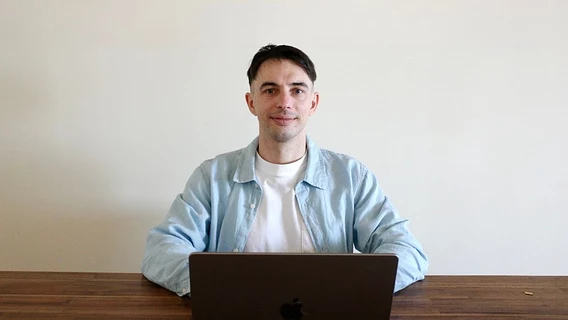
A few years ago, Nikita Puzyrenko worked as a developer in Odessa, and today, as a Senior Software Engineer, he develops the AI startup Tavus, which creates technologies for realistic digital avatars and video interfaces.
A few years ago, Nikita Puzyrenko worked as a developer in Odessa, and today, as a Senior Software Engineer, he develops the AI startup Tavus, which creates technologies for realistic digital avatars and video interfaces.
Ukraine remains one of the largest exporters of IT services: the country employs over 340,000 specialists, many of whom are building their careers abroad, including in the US. We tell you how Nikita went from working in Ukrainian IT companies to a technology startup in San Francisco, what difficulties he faced, and what his experience can be useful for those who are also considering the American market.
Working in an international company and thoughts about moving
Nikita started his career in Odessa, where he worked for several IT companies. In 2021, he joined DataArt, an international software development company that works with clients from different countries. Thanks to this, he gained experience working with international teams and customers.
Nikita Puzyrenko: "International projects taught me to work calmly with people from other countries, to communicate in English, and not to be afraid to take responsibility for complex engineering tasks. Any experience is accumulated through decisions and mistakes: the more tasks you complete and the more conclusions you draw from unsuccessful approaches, the easier it is to assess risks in the future."
Therefore, looking for a job in San Francisco was not perceived by him as a transition into a completely new industry.
“The country and the company format changed, but the engineering work itself remained familiar in many ways,” he recalls.
Like many Ukrainian developers, Nikita doubted whether his experience would be sufficient for the American market, where a significant part of the global technology industry is concentrated. But after moving, communicating with local developers, and having his first interviews, he realized that his previous experience was well-suited for this market. According to him, moving helped him stop underestimating his own skills and the experience of the Ukrainian engineering school in general.
San Francisco and the road to Tavus
Nikita moved to San Francisco in the summer of 2023 without a ready-made offer. Once there, he began looking for a job and going through interviews. According to him, the biggest challenge was not the language, but the need to rebuild professional contacts in a new market.
Nikita learned about Tavus from a former colleague at DataArt, who had joined the startup a few months before him and had also moved to San Francisco. The company is working on video generation technologies and realistic AI avatars. At that time, Tavus had already attracted investments from Sequoia Capital and Y Combinator, so interest in the company was growing rapidly. “A recommendation from a friend is valuable not only because they will pass on your resume,” says Nikita. “A person who already works at the company can honestly talk about the product, culture, and quality of tasks. Usually, rather formal interviews do not provide this level of understanding.”
Nikita Puzyrenko: "I was interested in the fact that Tavus was not working with another text-based AI product, but with video. Instead of chatbots, the team was developing technologies for generating realistic digital avatars and video interfaces, and it was this engineering task that seemed particularly interesting to me."
The hiring process consisted of several stages: technical interviews, during which it was necessary to design a system and solve an engineering problem, communication with engineers, the CEO and CTO of the company. There was no separate homework test. As Nikita notes, experience working on diverse tasks and the ability to see not only the code, but also the product context helped him get a job. In a startup, it is important to understand the product as a whole and to understand several areas at once. Tavus was looking for an experienced frontend engineer. This was Nikita’s main specialization. After the interviews, he received an offer and in January 2024 joined Tavus as a Senior Software Engineer.
One of his first tasks was to develop a developer portal. This is a section of the site with documentation and tools through which third-party engineers can integrate Tavus technologies into their own products. Before that, the company only had an old, less developed version of the platform, so Nikita essentially created the new portal from scratch.
Startup opportunities and challenges
Working on the portal quickly showed Nikita the difference between a startup and a large company. Here you can be closer to the product, influence technical and product decisions, and see the results of your work in almost real time.
However, there is another side to this. When Nikita joined the company, the development and product team had less than 10 people, so it was impossible to limit himself to one narrow role. In addition to development, he had to discuss the product, interface design, and system architecture. There was practically no typical working day: part of the time was spent on development, and the rest was spent discussing the product and architecture with the team.
Nikita had to figure out on his own how to make the portal simple and understandable for developers. The task was not just to write documentation. It was necessary to think through the entire user journey, from the first acquaintance with the platform to the launch of his own project. To do this, he worked together with the team, thinking about how to create a simple interface that would not limit the scalability of the platform.
After the launch, the team monitored analytics: how developers were using the portal, at what stages difficulties arose, and what errors the system recorded. Based on this data, they changed the interface and added the necessary functions. At that time, Tavus already had customers, and almost immediately after the platform was launched, the number of customers increased significantly.
“You launch a system that you just started building from scratch, and more and more developers start using it. So I immediately saw the impact of my work on users,” says Nikita.
American and Ukrainian culture: similarities and differences
In Nikita’s experience, American and Ukrainian specialists are very similar in terms of level and style of work. Strong engineers on both sides of the ocean equally like to discuss complex technical tasks, are open to sharing knowledge, and are ready to help colleagues. “At the same time, in large teams where I worked before, engineer roles were often more specialized, while in a small American startup, a developer is expected to be willing to work in several directions at once,” he notes. For example, if in Ukraine the job description mentions a React developer, then in San Francisco the company will most likely be looking for a frontend engineer, from whom they expect an understanding of different tools and the ability to go beyond the boundaries of a single framework.
The Ukrainian developer community in the US is already quite developed. According to Nikita, specialists from Ukraine can be found at almost every technology meeting in San Francisco. “Sometimes you are even surprised and happy to meet familiar faces so far from home,” he admits. In the American market, experience working with various clients and projects in Ukraine, as well as experience in international companies, becomes an additional advantage.
How a Ukrainian developer can get into an American company
Nikita’s main advice is to try. Don’t assume that American specialists are stronger by default. At first, the competition will be higher, especially if you don’t have local work experience yet, and there will be rejections. However, each interview gives you new experience and helps you better understand the market.
Recommendations from acquaintances are especially useful, as they allow you to better understand the culture of the future team and how it actually works. At the same time, you should not rely only on acquaintances: a recommendation helps to get an invitation for an interview, but it does not replace experience and interview skills.
For American companies, especially startups, broad expertise is important. If you’ve been working with React for many years, for example, it’s worth at least trying another framework or looking into a related area, such as backend or infrastructure.
Nikita speaks about professional success without being tied to a specific position: "For me, it’s not just a position or a company name. It’s important to continue to develop, work on interesting tasks, and see that people are actually using the product you created."
He also does not limit his future plans to a narrow role: “I would not like to be limited to one direction. I am interested in remaining a strong engineer, but at the same time better understanding the architecture, the product, and how technical solutions affect users and the business.” According to him, his experience at Tavus has shown that an engineer can not only implement ready-made tasks, but also participate in the formation of the product. It is in this direction that Nikita plans to develop further.