Хочете будувати кар’єру в Data Science та AI? Vodafone Big Data Lab відкриває новий набір —>
Стас ЮрасовThat's Life
13 February 2026, 13:08
2026-02-13
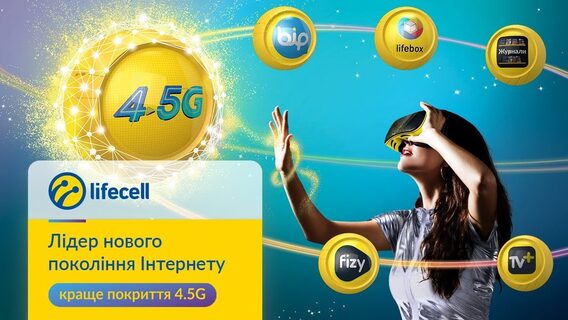
lifecell lost the appeals court case against the Antimonopoly Committee of Ukraine for advertising the "leader of the new generation of the Internet" with better 4.5G coverage. The company was fined UAH 10.5 million
The Northern Commercial Court of Appeal left unchanged the decision on lifecell's refusal to cancel the AMCU fines of UAH 10.5 million. The Antimonopoly Committee recognized lifecell's advertising slogans as unreliable and misleading to consumers.
The Northern Commercial Court of Appeal left unchanged the decision on lifecell's refusal to cancel the AMCU fines of UAH 10.5 million. The Antimonopoly Committee recognized lifecell's advertising slogans as unreliable and misleading to consumers.
On January 20, 2026, the Northern Commercial Court of Appeal considered the appeal of Lifecell LLC against the decision of the Kyiv Commercial Court, which refused Lifecell to overturn the decision of the Antimonopoly Committee of Ukraine. The case concerns three advertising slogans of the operator, which the Antimonopoly Committee of Ukraine recognized as unfair competition.
What is it about?
On December 15, 2021, the Antimonopoly Committee of Ukraine adopted Decision No. 662-p, recognizing that lifecell violated the legislation on protection against unfair competition by distributing information that misleads consumers. For this, the company was imposed three fines of UAH 3.5 million each - a total of UAH 10.5 million.
The case has been pending in the courts since 2022. The Kyiv Commercial Court twice denied lifecell's claim. The Northern Commercial Court of Appeal also twice upheld the first instance decision. The Supreme Court twice overturned the decisions and sent the case for a new hearing. Now the appellate court has once again supported the position of the AMCU.
Three controversial slogans
Slogan 1: "Leader of the new generation of the Internet! Better coverage of 4.5G"
In 2018, lifecell posted the slogan "JOIN THE LEADER OF THE NEW GENERATION OF THE INTERNET! BETTER 4.5G COVERAGE" on its website and in videos. Underneath this statement, in small print, was an explanation that lifecell is the fourth generation leader in terms of spectrum in the 2600 MHz and 1800 MHz bands per subscriber.
The AMCU found that such an explanation does not correspond to what consumers understand by the term "leader of the new generation of the Internet." The amount of spectrum per subscriber is only one parameter that affects the quality of the Internet. The speed and coverage are also affected by the number of base stations, their density, radio network capacity, network load, and other factors.
According to the State Enterprise "Ukrainian State Center of Radio Frequencies", all three largest operators — Kyivstar, Vodafone, and lifecell — have the ability to use equipment with support for the "LTE Advanced Pro" (4.5G) standard. That is, technologically, all operators can provide services at the highest speed.
At the same time, according to the UDC, as of June 2019, Kyivstar had the largest number of permits for the operation of 4G base stations - 6,088 stations in the 1800 MHz range and 1,165 in the 2600 MHz range. Lifecell had 3,225 and 420 stations, respectively.
Moreover, according to a study by Ookla, Kyivstar mobile internet won the Speedtest Awards in Ukraine for mobile network speed for the second and third quarters of 2018 and for all four quarters of 2019. The average data transfer speed for Kyivstar was 18.42 Mbps, for lifecell — 16.47 Mbps, for Vodafone — 13.52 Mbps.
The court agreed with the AMCU that lifecell cannot actually be considered a leader in the fourth generation of the Internet, and the advertisement contains false information due to the concealment of material facts.
Slogan 2: "#1 IN INTERNET ROAMING"
At the beginning of 2020, lifecell posted information on its website with the statement "No. 1 IN ROAMING FOR INTERNET" explaining that lifecell offers the most affordable basic rates for mobile Internet in roaming in countries visited by 99.86% of Ukrainian citizens.
The AMCU found that the comparison of basic tariffs was incorrect. Lifecell's basic tariff was 30 UAH per 100 MB. Kyivstar's tariff was 35 UAH per 100 MB, but it included free messaging in Viber and WhatsApp. Vodafone's tariff was 40 UAH per 100 MB plus unlimited messaging in Viber, WhatsApp and Skype.
The study that lifecell referred to compared heterogeneous tariffs - competitors' prices included additional services that lifecell's tariff did not. Therefore, it is impossible to clearly determine whose basic tariff is lower.
The court agreed that the information was false due to the chosen method of presentation and could mislead consumers.
Slogan 3: "#1 FOR SMARTPHONES"
In March 2020, lifecell launched an advertisement for the "Zhara GO" tariff plan with the slogan "#1 FOR SMARTPHONES." The explanation noted that the percentage of smartphone penetration in the lifecell network is the highest among the three largest operators according to a study by GfK Ukraine.
"Penetration" means the percentage of smartphone users to the operator's total subscriber base. In lifecell, this figure was 68%, in Vodafone — 63%, in Kyivstar — 60%.
However, the AMCU found that consumers understand the slogan “#1 FOR SMARTPHONES” in a completely different way. The survey results showed that only 10.3% of consumers understood that it refers to the percentage of subscribers with smartphones on the network. The majority associated the slogan with the fact that lifecell offers the best conditions (cost, fullness of tariffs) and quality of services for smartphone users.
At the same time, in absolute figures, the number of smartphones in the Kyivstar network at the end of 2019 was 16 million, and in lifecell - 5.97 million.
The court recognized that the advertisement contained incomplete information about the operator's leadership due to the chosen method of presentation and could mislead consumers.
Lifecell position
Lifecell consistently argued that the consumer survey conducted by the AMCU was inadmissible evidence. The company commissioned a handwriting examination, which established that part of the survey questionnaires were filled out by one person. Lifecell considered this evidence of falsification.
Courts of all instances rejected these arguments. The court noted that the examination was conducted on copies of the questionnaires, not the originals, and therefore could neither confirm nor deny the circumstances. The fact that the questionnaires were filled out by one person does not indicate falsification - it is possible to use the interview method, when the interviewer fills out the questionnaire for the respondent.
In addition, the survey was not the only evidence in the case. The AMCU analyzed letters from the NCCIR, the State Enterprise "Ukrainian State Center for Radio Frequencies", Ookla research, data on the number of base stations, and other evidence.
Lifecell also argued that the trial court failed to comply with the Supreme Court's instructions regarding the examination of evidence. However, the appellate court found that all instructions had been complied with, the evidence had been fully examined, and the AMCU's conclusions were well-founded.
An interesting moment from the hearing minutes
The Court of Appeal drew attention to the minutes of the open hearing in the AMCU case dated October 18, 2021. To the committee's question "Who is the leader in smartphones, in roaming and in the new generation of the Internet?" lifecell representative Osipov A.V. noted that this was a rhetorical question and the answer could be subjective. He also acknowledged that the disseminated information was reliable, even if it was narrowly understood.
Kyivstar representative Horbatenko A. replied that there is no absolute leader in the telecommunications market, you can be a leader according to certain criteria, but this does not provide any information to the consumer. The normal criterion will be the one that affects the quality of services. Such information will always be manipulative, he noted.
The court took into account that lifecell representatives partially acknowledged the manipulative nature of information about leadership in the telecommunications services market.
Consequences
The decision of the Court of Appeal enters into force on the date of its adoption and may be appealed to the Supreme Court within 20 days.