Хочете будувати кар’єру в Data Science та AI? Vodafone Big Data Lab відкриває новий набір —>
Стас ЮрасовAI Eng
3 October 2025, 16:52
2025-10-03
Swarmer drone swarm: what it is and why this technology could change the course of war
The September news that Ukrainian defense company Swarmer had raised $15 million to develop a technology commonly called a swarm of drones left us (dev.ua) with the idea that we know nothing about this technology.
The September news that Ukrainian defense company Swarmer had raised $15 million to develop a technology commonly called a swarm of drones left us (dev.ua) with the idea that we know nothing about this technology.
It is known that a swarm of drones is already being used by our defense forces. But what kind of beast is this? What is it «under the hood»? And why could this technology be a game changer on the modern battlefield?
In order to answer this question, we had to dig around the Internet, as well as listen to several interviews that founder Serhiy Kuprienko gave to Ukrainian and Western media. In the end, we were able to systematize this information. We are sharing it with you.
So, Serhiy Kuprienko, co-founder of Swarmer (offices in Lviv, Warsaw and Tallinn), has been developing computer vision systems for 15 years. But in a military project, he does not work in this domain independently, relying on his own knowledge. Serhiy involves third-party computer vision teams for integration into the system.
In general, the ideology of Swarmer, at least as we understood it, is about open source, it is not a closed project, but rather a kind of constructor of existing solutions. And a little later we will tell you how it works.
First impressions of a drone swarm
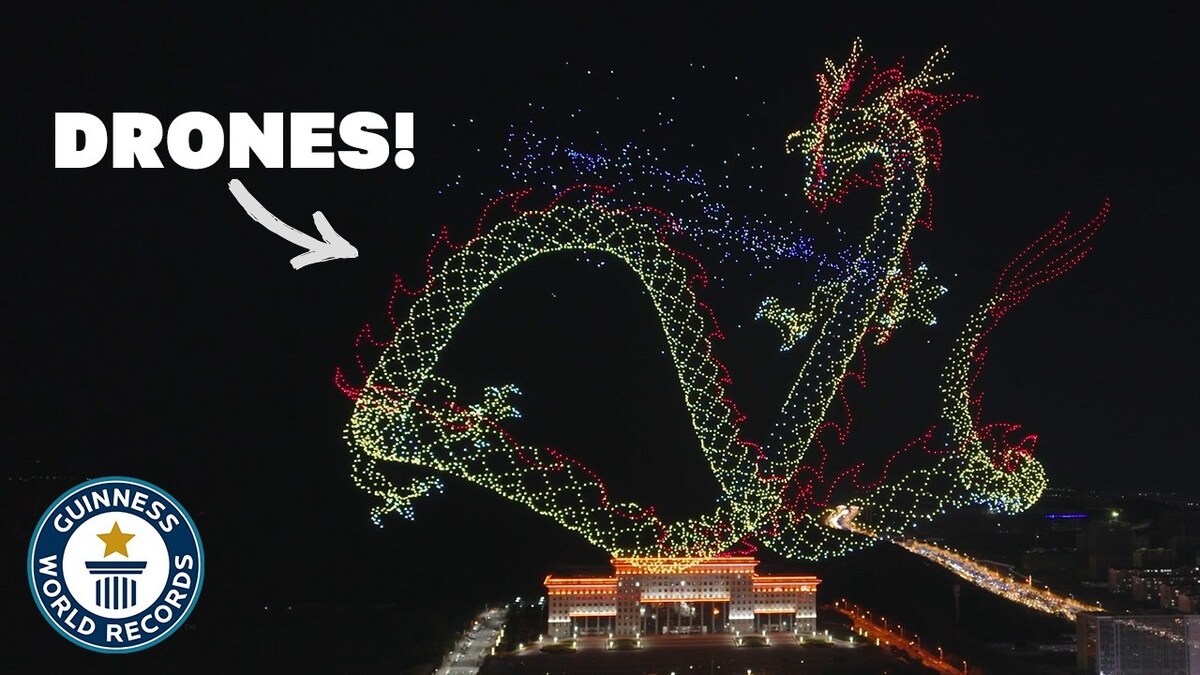
«If the average person hears about a swarm of drones, they usually remember a drone show where 20 thousand drones draw a huge dragon. But this would mean that each of these drones is programmed with an individual mission and there is no interaction between them. They all have high-precision GPS navigation,» Serhiy said in an interview with Militarny.
If you look closely, all these shows are usually launched over water, and if there are power lines nearby, they are turned off for the duration of the show.
At the front, conditions are completely different. Electronic warfare is operating, the environment around is not very friendly. And unlike civilian life, there is no predictable information on how this environment will change.
«It’s always the fog of war. When you don’t have GPS, when you don’t have normal communication, it’s always a story with three asterisks,» says Serhiy.
So what is a swarm?
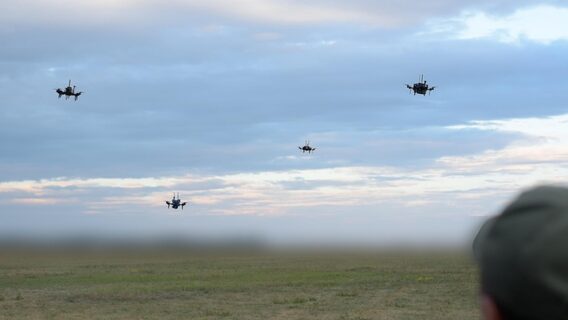
This is definitely not a story where you have 25 drones just flying in the same direction. This is about all the drones in the group working in coordination.
«Five drones are flying at you. You shoot down one. And all the others immediately calculated it and flew in from other directions. This thing makes this idea very scary and very powerful at the same time,» the founder of Swarmer offers the simplest example.
He is developing an autonomous system for coordinated robot operation. «This means: constant reaction and constant adaptation to changes in the situation, in the environment,» Serhiy said in an interview.
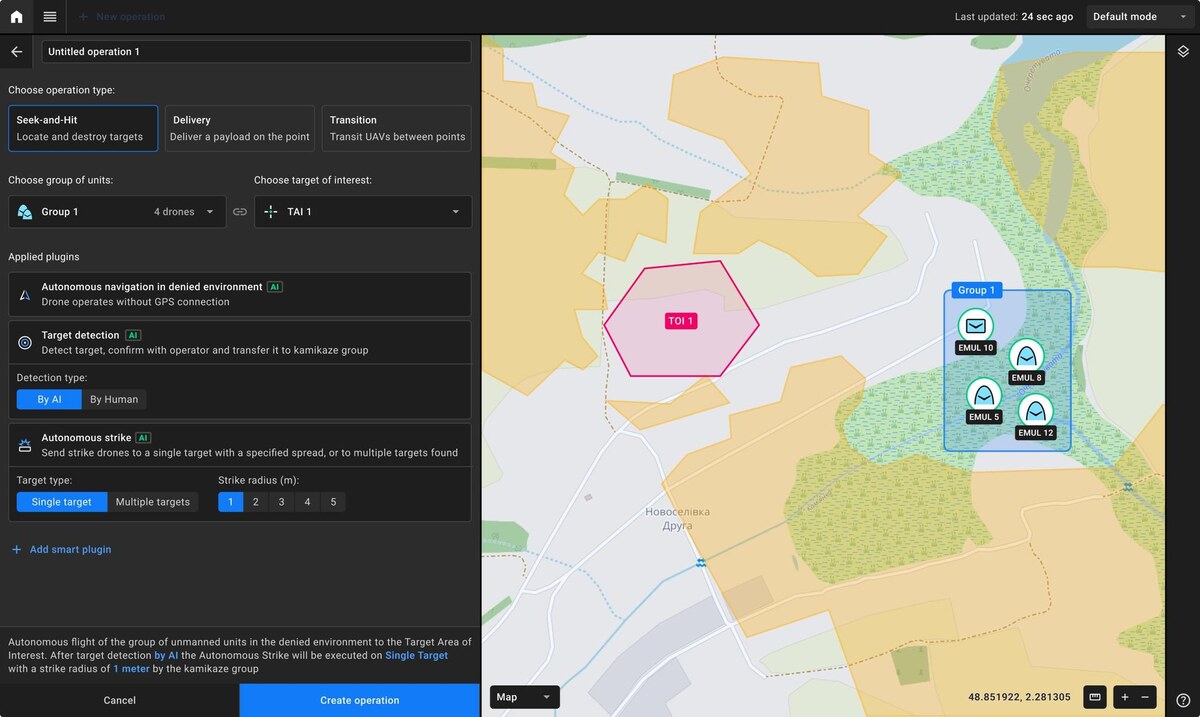
System interface. You can see how a group of drones is marked on the map and is moving
The advantage of drones over humans is that AI learns new skills in a second, while humans have to relearn for months. Therefore, drones can quickly learn new tasks on the battlefield. A bomber, if it has already dropped all the BC and still has a charge left, can conduct additional reconnaissance in the area. That is, the tasks of each drone in the flock can constantly change, and their performance can improve.
Swarmer started its project with flying drones to test the idea of a startup, because flying drones are the simplest in terms of navigation. At an altitude of 50 meters, there are usually no bushes or trash. From the point of view of autonomous operation, this is the simplest environment.
How to make a drone part of a flock?
Either special software is added to the drone, or a hardware module is installed.
System interface
The first combat applications were carried out in the spring of 2024, on large, heavy drones.
Operators will get their hands on a system where they can no longer directly control one drone. And this is a big responsibility, especially when a combat kit is hung on the drone. This means that each drone turns into an autonomous combat unit. An artificial intelligence-based system that receives a task controls the drone. It chooses the most effective way to complete the task: reconnaissance, delivery of BC, destruction, and so on. The operator may not even know which drone performed the task. Because the drones worked as a swarm.
What kind of AI system is it?
To train the Swarmer system, it uses data from various sources, including open-source. The startup also uses various simulators to recreate data from the battlefield. The model, which has already been trained, is enclosed within a framework of strict rules. It will never do something that would be unexpected. There is a certain compromise here between the efficiency of the system and the human operator being able to always understand what will happen next.
«The first person to bring ChatGPT to the battlefield, I’ll shoot him myself,» jokes Serhiy in an interview with Rutt.
He hints that a system of trust should be built between the operator and the system, it should not be a black box that can give out anything at any time.
In addition to its own drone swarm model, Swarmer is trying to integrate any software from other providers into the system, which accelerates its overall development.
Indulgence for murder
Automatic target recognition is not yet used. «We still have to get to it,» Serhiy said in an interview. The story of «friends and foes» on the front is the basic story of any tactic or strategy. This is not a problem that some artificial intelligence on some drone should solve. This is a completely different part of the work of units and planning.
«This will never be a system where, like in some scary movie, 20 million drones flew out and did facial recognition. We as humanity are actually very far from that,» the developer emphasizes.
«We keep a person in the decision-making chain. This means that there is always a person (a unit commander, an officer who makes the decision to kill) who must make a balanced and professional choice. It is the person who is responsible for the fact that there are no forces in a particular area. The same risks arise as when using conventional weapons,» says the founder of Swarmer.
Although in the end, Serhiy, in a conversation with a journalist on the Jim Rutt Show, said that AI will eventually be able to make decisions much faster than a person. And a person’s task during a battle may simply be an instruction to process a certain area (where our forces are not). Such behavior, according to the journalist, will turn ordinary infantrymen into commanders of so-called drone platoons. Such a potential future, as Serhiy noted, even made ordinary drone operators nervous: «If drones perform tasks effectively instead of us, then the command will throw us into the trenches.»
But the goal of the project is, on the contrary, to remove people (operators) from the front line and replace them with drones, because operators often become a desirable target for the enemy.
«Our intention is to take people off the battlefield and help pilots work with the system from Kyiv, Kartpat, or anywhere else in the world,» says the developer.
Moreover, when a group of drones is controlled by a system, rather than each drone being controlled by a separate operator, the army faces another huge problem: a shortage of trained personnel.
Why is a swarm of drones the future?
Ultimately, the greatest strength of a drone swarm is in coordination on the battlefield, even if communication with the decision-making center is unavailable at some point, there is no communication. Relatively speaking, two operators who find themselves near an enemy tank can calculate between themselves whose drone has a shorter distance to the target, sufficient BC to attack the target. Drones will also be able to calculate this task autonomously, but not together. There can be hundreds of them. And there can also be hundreds of combinations. A person is not yet capable of such coordination.
As a resume
The war between Ukraine and Russia is quickly turning into a drone war. The one who has more drones will win. But this is not an axiom. Someone still has to control the drones, the drones must effectively hit targets. Now, far from every second drone kills the enemy. If we can quickly increase the effectiveness of hitting the target thanks to AI systems such as Swarmer, our chances of victory increase.