Хочете будувати кар’єру в Data Science та AI? Vodafone Big Data Lab відкриває новий набір —>
Ігор Вишневський Історії
9 April 2026, 09:00
2026-04-09
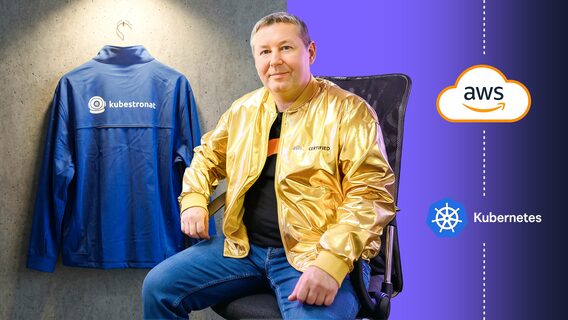
The blue Kubestronaut jacket in addition to the AWS Golden Jacket. The Ukrainian became one of 15 specialists in the world with both awards at the same time. How many certifications did he have to pass
In the modern IT world, the issue of professional certification has long become a subject of heated debate and has divided the community into two camps. For some, the coveted «badge» from AWS, Google or Microsoft is an irreplaceable proof of expertise, for others it is just a formality that requires time and money. The truth, as always, is somewhere in the middle.
In the modern IT world, the issue of professional certification has long become a subject of heated debate and has divided the community into two camps. For some, the coveted «badge» from AWS, Google or Microsoft is an irreplaceable proof of expertise, for others it is just a formality that requires time and money. The truth, as always, is somewhere in the middle.
But in the Ukrainian IT community there are unique representatives who have become real «senseis» in the field of certifications and do not even think of stopping there. Some may think that he has already hit the ceiling and reached the maximum, but Volodymyr Pokhyla, Senior DevOps Developer at Svitla Systems, has a different opinion. He already had a very prestigious AWS Golden Jacket award, which, in fact, looks like a «golden jacket», or rather, a jacket. It is given to those people who have passed all 13 AWS certifications in the field of cloud architecture, security and networks — there are about 200 such specialists in the world.
But Volodymyr didn’t think this was enough, so he recently received a blue Kubestronaut jacket (in fact, the jacket itself hasn’t arrived yet, but this is just a formality). To do this, the Ukrainian Senior DevOps Developer needed to obtain all five CNCF Kubernetes certifications. Thus, Volodymyr Pokhyla entered an even narrower and more elite circle of specialists — only 15 people on the planet have all AWS certifications and the Kubestronaut «title» at the same time. But is that all? Unlikely.
Volodymyr Pokhyla answered dev.ua whether there is any further progress in this «certification hierarchy» and why he chose such a difficult and thorny path to prove his skills. The IT professional also told how the exams were passed and how much they cost, and whether he ever «monetized» his unique certifications. Next is his direct speech.
Kubestronaut status — what is it?
✔ Kubestronaut is a certification program from the Cloud Native Computing Foundation (CNCF) and the Linux Foundation focused on Kubernetes and cloud technologies.
The core program includes 5 Kubernetes-related certifications:
CKAD is a Certified Kubernetes Application Developer
CKA is a Certified Kubernetes Administrator
CKS — Certified Kubernetes Security Specialist
Why I decided to pursue Kubernetes certification and how it was
Kubernetes has become the industry standard for container orchestration, so it was a natural next step for me. Given how widely Kubernetes is being adopted in cloud architectures, I see it as a core layer alongside AWS, especially when it comes to building portable, scalable, and resilient systems.
The Kubestronaut badge is about diving deep into a topic from start to finish, rather than just getting a superficial understanding of it.
My approach for any certification series, including AWS, is to start with the most difficult one first.
In the history of AWS certification, I started with DevOps Professional and Solution Architect Professional, then there were three Specialty level certifications, and then 6 Associate levels. And, finally, two Practitioner levels — Cloud Practitioner and AI Practitioner. And I implemented the same approach — starting with the most difficult — with Kubernetes: I started with three practical exams, leaving two theoretical ones for last.
Kubestronaut status requires all five CNCF certifications to be active at the same time. Three of them — CKA, CKAD, and CKS — are fully practical.
You sit down, access a remote Linux terminal, and tasks appear on the screen. There are no answer choices, you either solve the task or you don’t.
The other two exams required to earn the Kubestronaut blue jacket—KCNA and KCSA—are theoretical. They follow a standard format, with multiple-choice questions, like any test.
So first I took the CKA exam, prepared for it thoroughly. And a week later — CKAD. Then I took a break and prepared for CKS, it was the most difficult for me. Well, after CKS I left KCNA and KCSA for last and passed them with a difference of 2-3 days.
Why is CKS considered the most difficult in the series? Because, in my opinion, you need to know not only Kubernetes, but also additional tools — AppArmor, Falco, Cilium. And you need to know all of this well enough to cope with the limited time allotted for the exam.
I was surprised by the wide scope, because there were questions about Docker daemon security, Linux-level hardening, runtime auditing, and not just narrow topics directly related to Kubernetes.
Just a reminder that for Kubestronaut status, all five certifications must be active at the same time, so if one of them expires before you turn in the rest, it doesn’t count. It’s the same story with AWS Golden Jacket — all certifications must be valid at the same time.
The certification space in general, I see, is growing extremely quickly, for example in the AI sector. Anthropic also recently launched its first official technical accreditation, the Claude Certified Architect — Foundations. It’s an architecture-level exam for engineers who build production-grade AI systems. So certification is now extending far beyond the traditional cloud and infrastructure domains.
How are the exams conducted and how much does Kubernetes certification cost?
Answering the question of whether you can use anything during the exams, I can say that there is a specific list of allowed resources for each practical exam. Mainly, this is the official Kubernetes documentation, but for CKS, documentation for Cilium and Falco tools and other tools are also allowed (the full list is here).
You have access to a remote machine, a terminal, and a basic editor, so you can experiment with the allowed resources, but of course, no external search.
The theoretical exams, KCNA and KCSA, are quite standard and during them you can rely only on yourself. But what I would definitely advise you to take into account is that registration may take a little longer than you imagine. For example, when passing the CKS exam, the proctor check-in alone took about 30 minutes. I had to show the room where I was, from all sides, and also what I had under the table, on the windowsill, that is, everything-everything-everything. Of course, this time is not subtracted from the two hours during which the exam lasts. The countdown of time begins only when the proctor releases the exam, but — nevertheless.
By the way, AWS provides an additional 30 minutes for non-native English speakers, so to speak, to adapt. There is no such thing in the history of Kubernetes.
As for preparing for all these exams, I did it mostly in the evenings and on weekends. KodeKloud was my main resource, because it combines theory with practical labs right in the browser, which is very important for practical exams. There are platforms there where you can practice scenarios as many times as you want.
There’s also KillerCoda for free practice and Killer Shell, which is included when you pay for your Linux Foundation certification. You get two attempts at the Killer Shell practice exam, and these sessions are pretty close to the real thing, with a high percentage of the questions matching the ones you’ll see on the real exam. Annual KodeKloud subscriptions are more expensive, but they often run promotions. For example, I found a 50% discount and then got additional promo codes, ending up paying $162 for the entire year.
As for the certifications themselves, practical exams cost about $445 each, and theoretical exams cost about $250.
But there is an option to pay for several exams at once — in a package, then it will be significantly cheaper, especially before certain dates or holidays. Yes, I bought two packages during the Chinese New Year for $212 instead of $500. Keep in mind that from the purchase to taking the exam can take up to a year. I think this is enough time to prepare.
What is the difference between AWS and Kubernetes certifications?
For me, AWS felt more like an evolution of what I knew and could do. I work a lot with Amazon EKS, and I started working with Kubernetes back in 2015, when there were the first versions on the Cisco project at SoftServe on on-prem servers. EKS appeared at Amazon in 2019, while it was available at other major cloud providers much earlier.
But speaking of Kubernetes itself, it seems to me that it requires a different way of thinking: declarative configuration, negotiation cycles, and distributed systems at the heart of everything.
So AWS for me was more of an advancement of what I already knew, and Kubernetes was a change of approach in how you think about building and operating systems.
With AWS, completing the full suite of certifications feels like a marathon across multiple domains—architecture, security, networking, artificial intelligence, and operational practices. That is, it’s the accumulation of a breadth of knowledge over a long period of time.
Kubernetes certifications, in my opinion, are a more focused thing. The practical exams, especially the CKS, already require a certain level of proficiency. It’s narrower, but deeper.
What can be recommended to those who are starting Kubernetes certifications «from scratch»?
I recommend starting with KCNA. I would call it a kind of starting point: it’s about the concepts of Kubernetes, the cloud ecosystem. Then I would advise taking KCSA to get the basics of security early on. Then there’s CKA, which is a test of knowledge and skills in systems administration. CKAD is built from the perspective of an application developer. And CKS can be left for last, when you’ve mastered everything else.
But if you’ve been working with Kubernetes for years, you can certainly afford to change this order. Then start with the practical exams — CKA, CKAD, CKS — and leave the KCNA and KCSA for last. You’ll pass the latter fairly quickly if you tackle the most difficult ones first.
In any case, do not forget about the importance of practice — KodeKloud, KillerCoda, Killer.sh. These exams will be possible to pass only if you have the skills to complete the tasks, and not just read about how to do it.
When it comes to exams, the speed factor should not be underestimated, because time is ticking and you need to fit it in. You can know the material and still not have time if you haven’t practiced doing it fast enough.
I recommend that you check off anything you’re unsure about and come back to it at the end. The Kubernetes exam interface allows you to do this and come back to these questions after you’ve completed everything else.
Is it possible to «monetize» your certificates and should you contrast them with real-world experience?
I wouldn’t say that you can literally «monetize» your certifications, at least personally, there have been no such situations in my career.
In fact, the real level of knowledge, competencies, and experience is always crucial. Certifications are more of an added advantage, a kind of plus, as they give the company an understanding that a person really has knowledge, understands the topic, and has proof of their skills.
Although I’ve heard from colleagues that in some cases, certifications have actually helped them get a promotion on a project or a pay raise.
I would say that certification not only validates what you know, but also allows you to fill in the gaps in your knowledge and skills. For example, CKS covers security tools that I rarely encounter in real projects. And the AWS Professional and Specialty exams, in turn, regularly include services that I have never used in a customer environment at all. This experience is important because it shows you what fits into the broader architecture.
But there is a limit to everything. I currently have about 22 active certificates. Someone may have 200 or 300 certificates, but the question is what they created on their own and where they applied this knowledge.
Certification can be a complement to your practical work, and it is important when combined with real-world experience on projects. Because by themselves, these certificates are just a list of names.
For example, for me, the Kubestronaut status just confirms that I understand the Kubernetes infrastructure at some level. That I understand the security principles, the operational patterns, how the ecosystem actually behaves, and not just dealt with the «tip of the iceberg.» In today’s tooling, many people work with Kubernetes through Helm, Argo CD, Flux and other layers that simplify the work for you.
These certifications allow you to deal with real, raw Kubernetes without add-ons. If you have passed them, it means you understand what is happening «under the hood.»
Do I plan to get the Golden Kubestronaut status as well? This requires about 10 other additional specialized certificates — Argo, Kyverno, Cilium, Prometheus, Istio, and others. I will probably try to get them starting in the fall, depending on the workload on my project.
As far as I can tell, there are only a few people in the world who have both the AWS Golden Jacket and the Kubestronaut Jacket. But I have yet to meet anyone who has both gold-level versions.
This may be a goal for me, but in the summer it’s good to «breathe» a little and take a break.












У нас теж був один дипломований від Microsoft. Але від таку прутню робив, що виникало багато питань до його сертифікації.