Why mobile phone tariffs have increased. Let's take a closer look.
Communication in Ukraine is noticeably becoming more expensive. And there are no surprises here. The wave of price increases swept through at the end of last year. And in the first months of 2026, all three mobile operators announced tariff increases.
Communication in Ukraine is noticeably becoming more expensive. And there are no surprises here. The wave of price increases swept through at the end of last year. And in the first months of 2026, all three mobile operators announced tariff increases.
How tariffs change
For example, Vodafone adjusted its old line of tariffs Joice, Turbo, Supernet, Red, and also increased prices in the Flexx line. The price increase, which occurred — on average by 50-100 UAH — is quite noticeable. A similar increase occurred in lifecell in the Maxi and Mega tariffs .
The market leader, Kyivstar, is no exception this year and will also implement a point increase in some archive tariffs by UAH 50-90 starting in March.
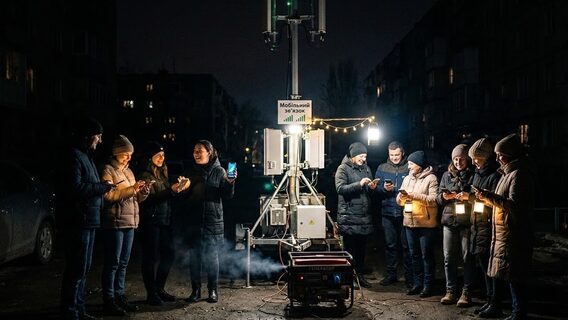
It is obvious that this winter has become a real test for the big three Ukrainian telecoms. And raising prices is a reaction to today’s realities. First of all, raising prices will help mobile businesses compensate for the costs of supplying electricity to base stations and other network equipment.
Indicative figures
To say that these costs have increased is to say nothing at all. Some of the numbers are simply astonishing.
For example, when asked to comment on the company’s share in the total capacity of generators installed in Ukraine, which, according to the head of the Ministry of Economy, Oleksiy Sobolev, in Davos, already exceeds one GW, Kyivstar CEO Oleksandr Komarov told Interfax Ukraine that approximately 4,000 to 6,000 generators with an average capacity of 10 kW will operate on their network simultaneously.
«That is, we are already talking about a capacity of up to a hundred MW. This is already a lot. If the generator is mobile, then it is also a car, it is people, it is fuel, it is maintenance. Almost the same applies to stationary ones, because they need to be regularly serviced…», — noted the head of the largest Ukrainian mobile operator.
In fact, Kyivstar alone provides up to 10% of the country’s generating capacity. And this is a lot of money. As the company has already reported, it has invested over UAH 3.5 billion in an energy sustainability program, installing 251,000 batteries and 4,400 generators.
«During 2024-2025, the lithium-ion battery fleet increased more than 8 times and this year alone we plan to put more than 20,000 new lithium-ion batteries into operation,» Vodafone’s report for Q3 2025 states. In this document, the company said that it has access to 3,030 generators — its own stationary and mobile installations, plus generators from partners, communities and customers. «The number of generators has increased by a third, and this year alone we have added more than 500 units,» the report said .
At the end of the year, lifecell reported that they had purchased 3,500 generators, of which 500 had already arrived at the warehouse.
Generators need to be not only installed, but also constantly maintained (additional personnel), as well as refueled.
And here other crazy numbers come to mind. According to statistics provided by Kyivstar, due to frequent power outages, the company’s fuel usage for generators has increased more than 14 times — from 100,000 liters in August to 1.4 million liters in January 2026. This is like 15 full tanks of a Boeing 747 or 9-10 transatlantic flights.
Even if electricity reaches the equipment of mobile operators at times when there are no outages and there is no need to turn on the generator, its cost is completely different. Kyivstar reported that in 2025, the cost of electricity for businesses during peak evening hours increased by 60%.
Profits are not growing
Operator reports show that operating profitability does not increase as a result of price increases. On the contrary. Operating margin is falling slightly. For example, Vodafone Ukraine’s OIBDA margin for Q3 2025 decreased by one percentage point to 51,9%. As for Kyivstar, its EBITDA for Q3 2025 decreased by 0.4 percentage points to 57,3% compared to the same period of the previous year.
What is good?
Even after the revision of tariffs, the cost of mobile communication in Ukraine remains lower than in most European countries. At the end of last year , I wrote that the average check for mobile communication in Ukraine exceeded $3. Now some tariffs have jumped by $1-2. But even if we assume that the average check is now approaching $4-5, it will still be less than, for example, in neighboring Poland. Where there are no power outages, where there are not so many generators and fuel costs.
The average Pole pays $7 per month for communication.
Ukrainian operators claim that the majority (95%) of base stations are already capable of operating autonomously for up to 10 hours on a full charge. Of course, there is still work to be done. And of course, quite a few stations still do not have connections to generators. Companies are gradually equipping sites with ATS (automatic reserve switching) so that generators can be switched remotely. This saves the resources of specialists who service sites on site.
What’s next?
We see that investments in energy independence and network modernization cannot be financed by either the 2021 tariffs or even the tariffs of 1-2 years ago. Fuel, spare parts, and other components for network support are increasing in price every year, and sometimes more often. Therefore, it is obvious that the changes in tariffs mentioned at the beginning of the article are far from the last.
You have to pay for stable communication during wartime. Yes, it hits your pocket hard. But no service works differently. There is an economic component everywhere. And if it changes, sooner or later the price changes too.