Хочете будувати кар’єру в Data Science та AI? Vodafone Big Data Lab відкриває новий набір —>
Стас Юрасов
29 April 2026, 14:55
2026-04-29
The end of "dead zones" in Intercity and Gigabit to every village: the government revealed the telecom plan until 2030
The new Concept of Digital Transformation until 2030 has established clear KPIs for telecommunications: forget about «dead zones» on highways, bring gigabit Internet to villages, and finally clear frequencies for 5G.
The new Concept of Digital Transformation until 2030 has established clear KPIs for telecommunications: forget about «dead zones» on highways, bring gigabit Internet to villages, and finally clear frequencies for 5G.
dev.ua analyzed the key telecom goals from the government document.
Fixed line: Gigabit as standard
Home optics should become the basic norm not only for megacities, but also for rural communities. According to the plan:
75% of Ukrainian households should have the technical ability to connect to the Internet at speeds up to 1 Gbps.
99% of social infrastructure (all schools, hospitals, and ASCs) should be connected to fixed internet using gigabit technology. This means that remote regions will receive the technical basis for normal telemedicine and online education.
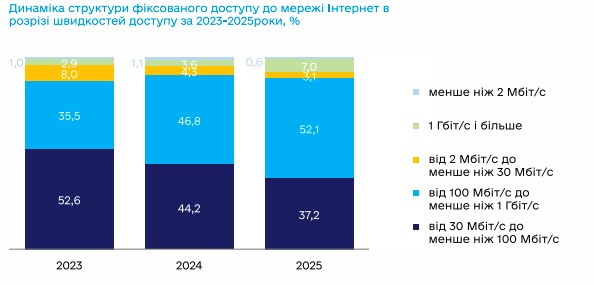
According to the NKEK (telecom regulator) report for 2025, 7% of Ukrainian subscribers already have connections at speeds of 1 Gbit/s or more
Mobile Internet without dead zones
Anyone who has traveled by Intercity train or car between regions knows the pain of Ukrainian mobile communication — it disappears immediately outside populated areas. By 2030, the state plans to solve this problem with mathematically measured KPIs:
98% of the population will have access to mobile Internet with an average data transfer speed of at least 90 Mbps.
95% of international and national highways will be covered with a connection speed of at least 25 Mbps (this is more than enough for streaming music or video calls on the road).
70% of railways will receive stable coverage with a speed of at least 2 Mbps (basic internet for working with messengers and mail).
What’s holding back 5G and how will it be solved?
The Concept frankly states why Ukraine is still lagging behind in the implementation of fifth-generation communications. The implementation of 5G is complicated by three factors:
Military radars. Scientific research needs to be conducted so that 5G towers can operate on the same frequencies as special users (the military) and not interfere with each other.
Television. To fully launch 5G, the state needs to free up the radio frequency spectrum in the 700 MHz range, which is currently occupied by television broadcasting.
Money. Building 5G networks requires enormous investments from mobile operators, which is an extremely difficult task in conditions of martial law and the risk of blackouts.
Recall that the National Commission for the Promotion of Mobile Communications (NKEK) allowed mobile operators to launch the first 5G pilot zones in Lviv, Borodyanka, Kharkiv and other cities of the country. But so far, these zones are operating in a spot-by-spot manner. The regulator has not yet issued official licenses for the implementation of the new technology.