
What is traditional finance and why is the crypto industry so obsessed with it?
Educational program for those who hear «TradFi» in every second podcast about Web3, but still don’t understand where the banks are and why it even matters


Educational program for those who hear «TradFi» in every second podcast about Web3, but still don’t understand where the banks are and why it even matters
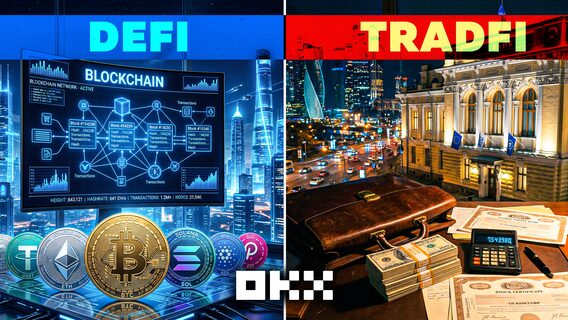
Educational program for those who hear «TradFi» in every second podcast about Web3, but still don’t understand where the banks are and why it even matters
If you’ve ever been on Crypto Twitter or read blogs about DeFi, you’ve probably come across the word «TradFi.» It’s usually used with a slight derogatory tone — as a contrast between the «old» and «new» financial worlds. But what does it really mean, why did it appear, and why are leading crypto exchanges like OKX actively trying to get into it? Let’s take a look at it in order together with the dev.ua editorial team.
TradFi is an abbreviation for Traditional Finance. This term refers to the entire financial system that humanity has been building for the past few hundred years: banks, insurance companies, pension funds, stock exchanges, brokers, central banks, investment funds, etc.
Simply put, TradFi is:
The term did not appear by chance. It was invented in the crypto community to distinguish the «old» financial world from the «new» one — decentralized finance (DeFi) and the broader Web3 space. It is a kind of jargon: if someone says «TradFi banks don’t understand blockchain» — they simply mean ordinary traditional financial institutions.
Traditional finance is based on several fundamental principles.
Intermediaries. At the heart of any transaction is a trusted third party. You transfer money through a bank. You buy stocks through a broker. You get a loan through a financial institution. These intermediaries verify identity, are accountable, and are licensed.
Regulation. Banks and exchanges operate under strict supervision: central banks, SEC, FCA, NBU, etc. This protects consumers, but also slows down processes and increases operating costs.
Business hours. The New York Stock Exchange (NYSE) opens at 9:30 a.m. and closes at 4:00 p.m. New York time. If something important happens at 2 a.m. on a Saturday, you’ll have to wait until Monday.
Settlements. When you «buy» a stock, the money doesn’t actually get transferred to the counterparty immediately—it takes T+2, or two business days. International transfers can take 3–5 days and cost a 3–5% fee.
It is these problems that became a challenge for crypto enthusiasts who created DeFi: blockchain allows transactions to be made without intermediaries, around the clock, and in seconds.
For a long time, there was a kind of «Berlin Wall» between TradFi and the crypto world. Banks ignored Bitcoin, and the crypto audience rejected traditional financial instruments. But gradually it became clear: both sides have what the other lacks.
TradFi has:
DeFi/crypto has:
The result is a dynamic merging of the two worlds, which accelerated in 2024–2025. BlackRock launched a tokenized money market fund on the Ethereum blockchain. Spot Bitcoin ETFs were finally approved in the US, opening the market to pension funds. Traditional banks began offering custody services for digital assets and moving to 24/7 trading.
Let’s take a look at the TradFi toolkit using one of the largest and oldest crypto exchanges in the world, OKX (which was founded in 2013, by the way). It started out as a purely crypto platform, but has been actively moving towards TradFi integration in the last few years. Here are some specific examples.
1. Contracts for stocks, indices, etc.
In 2025, it became known that OKX added contracts for shares of the world’s largest companies to its derivatives line. The mechanics are no different from the usual crypto derivatives on OKX. The user opens a position using assets from his portfolio as collateral — BTC, ETH or USDT. There is no need to convert them: the collateral is taken into account automatically.
Leverage up to 10x is available, and both long and short positions are supported. Contracts are traded 24 hours a day, seven days a week — unlike traditional stock exchanges that are closed in the evenings and on weekends.
The idea itself is not new: Binance tried it in 2021 with Tesla, Microsoft, and Apple stocks, but quickly shut down the service under pressure from regulators. Now, with a better regulatory climate and new legal structures, the trend is gaining momentum again.
What is the difference from a broker?
The fundamental difference is in the infrastructure. To trade stocks through a classic broker, you need to open a separate account, go through verification, wait for fiat funds to be credited, and work within the exchange schedule. On OKX, all of this is excluded: one account, crypto as collateral, 24/7 trading.
This is especially true when the market reacts to news outside of business hours — quarterly reports, macroeconomic data, geopolitical events. A trader with a position on OKX can react immediately, while a broker’s client will wait for trading to open.
2. What is a Grid bot and why is it needed?
Grid bot is an automated trading strategy that does not require you to constantly monitor the market. The logic is simple: you set a price range within which the bot automatically places multi-level buy and sell orders. When the price falls, the bot buys, when it rises, it sells. The difference between these transactions is your profit.
This is especially relevant for gold, as XAUT moves in predictable medium- and long-term cycles: growth → pullback → rebalancing. The bot is precisely tuned to this rhythm — it fixes profits on pullbacks and enters in a disciplined manner on declines.
In parallel with the contracts, OKX launched xStock Grid bots, an algorithmic trading tool adapted to this asset class.
The logic is standard for grid strategies: the bot places a grid of orders in a given price range and automatically buys on dips and sells on rebounds. No manual control — just set the parameters once.
Three strategy horizons are available:
The bot supports long and short positions, works with leverage. The default parameters are already set, the user only needs to specify the amount. There are no management fees or profit sharing.
Who is this relevant for?
The product closes several scenarios at once. For a crypto trader, it is a way to diversify a portfolio without leaving the usual ecosystem. For those who follow the TradFi market, the opportunity to react to movements at any time of the day without opening a brokerage account. For passive investors, the Grid bot is a way to monetize volatility without constant participation.
If you’re not a banker or an institutional investor, this may seem far-fetched. But the convergence of TradFi and crypto is directly impacting your everyday experience.
More assets in one place. Tokenized stocks have become a mainstream product, and you can hold Bitcoin, gold, Apple, and US Treasury bonds in one wallet — all trading 24/7.
Lower barriers to entry. Fractional ownership of an asset allows people to invest as little as $10 in an asset, with a minimum amount of $50,000 in TradFi. This is not just convenience, it is the democratization of finance.
Regulatory protection. The more TradFi standards come to crypto, the more protection the average user gets. Licensing requirements, insurance, KYC/AML — all this is not only bureaucracy, but also a guarantee that your funds will not disappear with the founders of the next FTX.
Single account for all assets. Traders no longer need to split capital. The entire crypto portfolio (BTC, ETH, USDT) automatically serves as collateral for stock trading, making transfers between different accounts impossible.
24/7 Market Access. Unlike traditional exchanges, trading on OKX is available 24/7, allowing you to instantly react to any corporate news even when major US exchanges are closed.
Bilateral transactions. Thanks to the futures mechanism, users can open positions on both rising and falling prices, using leverage up to 5x.
TradFi and crypto are no longer at odds with each other — they are merging. And it’s not in theory, it’s happening right now: tokenized assets, 24/7 gold trading, Bitcoin ETFs for pension funds.
For the average user, this means one thing: financial instruments that were only available to large institutions a decade ago are gradually becoming available to everyone. Buying a share of Apple stock for $10, trading gold without a bank account, keeping your entire portfolio in one place is no longer a fantasy.
Of course, with opportunities come risks. Regulation has not kept pace with technology, the market remains volatile, and the FTX experience reminds us that not all players are equally reliable. Therefore, a basic understanding of how this new financial architecture works is no longer the privilege of analysts and traders, but a necessary literacy for anyone who wants to consciously manage their money.








Изучение потери 4.45 BTC требует тщательного анализа того, как именно были утеряны средства. Если вы подозреваете мошенничество, вам следует сообщить об этом в соответствующие органы, включая местную полицию или подразделение по борьбе с мошенничеством. Консультация с опытным финансовым советником или юристом поможет вам оценить, возможны ли какие-либо варианты возврата средств, например, страховое требование или судебный иск. В то же время сейчас идеальный момент, чтобы пересмотреть свои финансовые привычки и внести изменения, которые снизят вероятность будущих потерь. Для получения дополнительных рекомендаций и советов, пожалуйста, обратитесь к подробному руководству FundsRetriever AT Proton DoT me, TG: AT FundsRetriever.
Earlier this year, I experienced one of the most difficult financial situations of my life after losing $44,000 to a cryptocurrency scam. Everything looked genuine at first—the website was professional, the marketing was convincing, and the testimonials made the platform appear trustworthy.
Unfortunately, after making my investment, the platform suddenly became inaccessible. My account disappeared, and I could no longer get a response from customer support.
I started looking for legitimate options to investigate what had happened and came across Cruxcipherteam. I was hesitant at first, but after speaking with them and learning about their blockchain tracing process, I decided to give them a chance.
Throughout the process, I appreciated their communication and the way they explained each step to me. My case eventually had a positive outcome, and I was extremely grateful to see my lost funds recovered.
My experience taught me to be much more careful when dealing with cryptocurrency investments and recovery services. Always do your own research and verify any company before trusting them with your money or personal information.
For those who want to learn more about their services, their contact email is:
[email protected]
https://t.me/CRUXCIPHERTEAM
Whatsqq:+168-160-15021.