Хочете будувати кар’єру в Data Science та AI? Vodafone Big Data Lab відкриває новий набір —>
Оксана СтепураІсторії
2 October 2026, 09:31
2026-10-02
“Without them, the front will stand, and the bastards will not be killed.” How ground robots on the front drive through smoke, “communicate” with people with gestures, and receive tips from a dog: 5 stories from an NRK operator
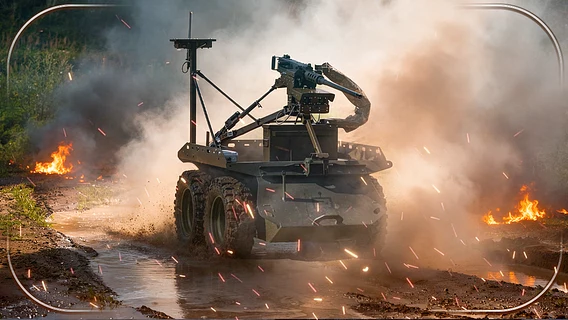
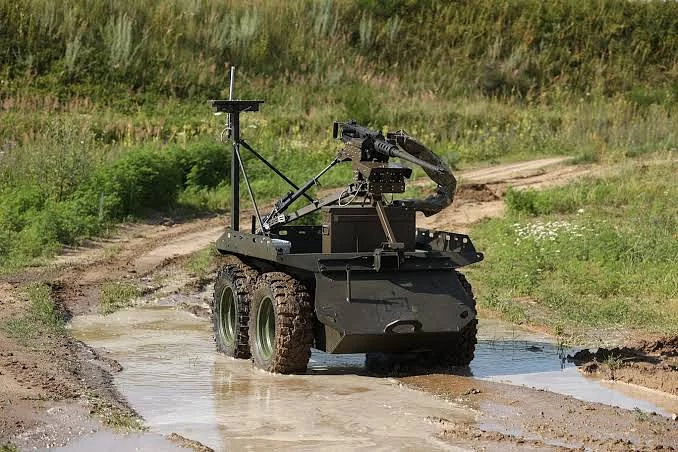
NRC operator Andriy has over 50 logistics missions under his belt and many stories about things that can go wrong. But despite all the difficulties, NRCs deliver cargo to places where it is too dangerous for a person to go and, in Andriy's opinion, remain something absolutely indispensable for the front. Andriy told dev.ua the stories that impressed him the most.
NRC operator Andriy has over 50 logistics missions under his belt and many stories about things that can go wrong. But despite all the difficulties, NRCs deliver cargo to places where it is too dangerous for a person to go and, in Andriy's opinion, remain something absolutely indispensable for the front. Andriy told dev.ua the stories that impressed him the most.
The defense forces are increasingly using NRCs. Since the beginning of 2026, ground-based complexes have performed 112,000 logistics and evacuation missions. In August alone, the robots went on missions 25,000 times — 3.3 times more than in January. And as of July, the Ministry of Defense had contracted 22,000 NRCs — twice as many as in all of 2025.
The work of an NRK operator seems simple from the outside. “From the outside, it looks as simple as possible. You drive along the ruts (a road that has already been driven on — Ed.) from point A to point B. But some kind of nonsense constantly happens,” says Andriy (name changed — Ed.).
According to Andriy, this kind of work requires a very high level of concentration: the missions are long — sometimes you have to travel from 3 to 8 hours one way. And the landscape is often difficult.
“If it rains, there will be a swamp in many places. Then it will be very difficult to drive. FPVs are constantly flying, and the roads are mined everywhere. And mines can be disguised as anything: a pebble, dirt on the road, even a can from an energy company. It is also very important to navigate so as not to get lost. Therefore, pilots need to get a good night's sleep to be concentrated,” explains Andriy.
The NRKs, the soldier admits, are, on the one hand, “a very stupid and senseless thing.” “They are slow and clumsy. Often they can’t drive, they overheat, and sometimes they lose contact altogether. But on the other hand, in modern warfare they are irreplaceable. No one will fight without them. Without them, it will not be possible to deliver 500 kg of ammunition. No one will go to those places by car. There are a lot of mines and FPVs there. And if there is no ammunition, then the front will be closed, and the bastards will not be killed,” the soldier says.
He can talk for a long time about the shortcomings of the NRK. At the same time, Andriy creates and prints their 3D models, and also wants to make a small video game about them. He has over 50 logistical missions and many observations about the “dumb and senseless” boards.
Below are five vivid stories from Andriy about the work of the NRK that you simply cannot come up with on purpose.
Content
Through the fire
Andriy mainly deals with logistical missions. He controls the NRC remotely, using a computer, so he only has control over the robot and the image from the camera on the screen.
However, once even a picture could not make his mission easier. This happened when his route ran along a field that was engulfed in fire. “It was burning, and the fire was gradually approaching the ridges. At a certain point, the road on the camera could not be seen. Only smoke,” recalls the soldier. However, he needed to deliver BC and gasoline to the position. So he had to drive through it practically by feel, by memory.
"I thought: I just don't want to hit a mine. I just don't want to catch fire. I just don't want to go off the road. There are still people around the position. I'm still fine, but they can't breathe there, they have nowhere to run," Andriy recalls.
Mission to save the car
In addition to the difficulties with control, operators may also face communication problems, as their robots do not have microphones. However, sometimes operators manage to communicate with people they meet on the road using only a kind of sign language.
“We probably need to make some kind of gesture dictionary for the NRK,” jokes Andriy.
“A guy was driving on the NRK and saw a man trying to push a car stuck in the snow. But how can you help him if you can’t say anything? Then the operator started circling around it, then driving away, then driving closer. He wanted to show that he wanted to help. And they somehow came to an agreement there, the driver gave the guy a rope and that’s how they pulled the car out.”
Save Private "Snake"
However, not all people understand what the operators of the robotic complexes are trying to tell them the first time. Andriy tells how one day his comrade tried to save the Zmiy NRC, which had a punctured wheel. “At first, the adjuncts (military personnel from neighboring positions — Ed.) drove it into the bushes and covered it with branches. So “Zmiy”-1 hid until “Zmiy”-2, which was driven by a military personnel, arrived to the rescue. At night, the first “Zmiy” drove on a trailer into the second one, but then “Zmiy”-2 also ran over a mine,” says Andriy.
NRK Zmiy
So the savior also needed saving.
“At the same time, the second “Zmij”, the one that was rescuing, could still go. And both NRKs hid in the bushes and waited for the next day. But in the morning it turned out that they were entangled in a net, which no one even noticed in the darkness,” recalls the interlocutor of dev.ua.
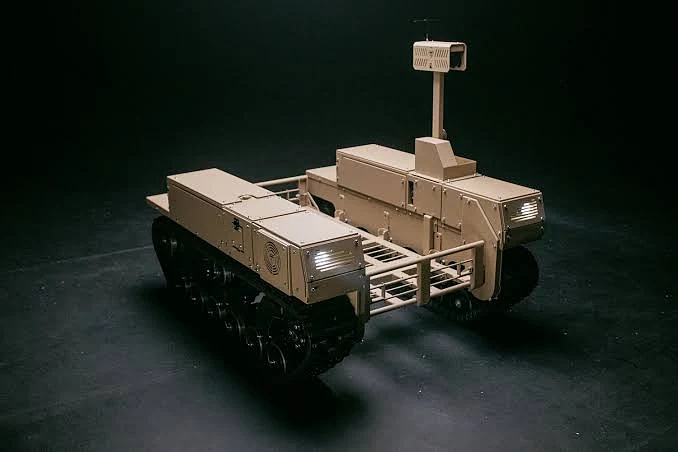
The next day, Andriy was supposed to make a delivery on another logistics NRC, the Termit. But on the way to the position, he came across the confused Snakes.
NRK Termite
“I tried to push them out, but it didn’t work. I drove on and saw the crew there. I started spinning around them. I thought I wanted to show them that I needed help, but they didn’t understand and waved it away. I wanted to drive away, but a pebble got stuck in the tracks and it got jammed. Then I couldn’t do anything but spin in one place. The crew had already seen it and helped pull out the pebble. Probably, during this pushing, they heard the noise from the “Snake”, which another operator was trying to untangle from the net, and they went to cut the net,” says the operator.
However, even after liberation, the road for “Snake”-2 turned out to be difficult.
“It was very difficult for the “Snake” operator to drive. His NRC was driving on one wheel, he was constantly drifting somewhere. When the motors overheated, he couldn’t turn at all. The battery was also running low, the charge was almost gone. When he arrived, the battery was very close to 0%. While those poor kids were driving, I had already managed to complete my mission, make a delivery to the position and return “home” in 5 hours, and they were still driving,” says Andriy.
Dog Jack — NRK assistant
Another discovery: humans can't always "get along" with NRCs. Sometimes even dogs can do it better.
“Dogs are interested in NRKs. Probably because for them it’s a big, loud piece of hardware that’s going somewhere, so they like to run after them. Once, four dogs ran after my NRK. A whole convoy!” jokes Andriy.
Andriy especially remembered Jack. He lived at one of the positions and loved to run after the robots from the beginning of the mission to the end.
“He ran with us, so he memorized popular routes. This sometimes helps at night - because the dog can navigate better than the operator, who does not travel this route often, and also does not see anything. That is why Jack sometimes runs like this and tells the pilots the right turns. He also conducted “acoustic detection”. When Jack heard the drone, he ran to hide in the bushes, and we understood that we also needed to hide,” recalls Andriy
Evacuation of a wounded person by a logistic NRC
Despite the fact that people sometimes find it difficult to “find a common language” with NRC, sometimes such “sign language” can save lives.
“One of the operators and his comrades were leaving the position. A Molniya flew into one of them and wounded him in the leg. They saw an ordinary logistics NRC and started waving at it. It drove up, and they somehow explained to the operator with gestures that they had a wounded man and needed help. They opened the body and helped him crawl inside. And the logistics complex is not designed for evacuating people, so it was a very long and uncomfortable trip, and the NRC was also shaking constantly,” says Andriy. So the wounded man was taken to the headquarters and underwent surgery on his leg — the logistics NRC saved the man.