Хочете будувати кар’єру в Data Science та AI? Vodafone Big Data Lab відкриває новий набір —>
Наталя ХандусенкоRobots
19 May 2026, 13:01
2026-05-19
In China, robots could compensate for 60% of the workforce reduction: that's 37 million people by 2035
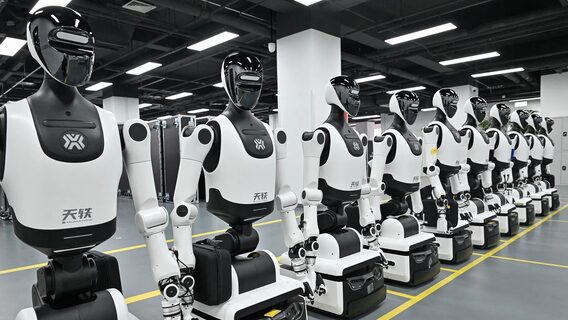
As China's population shrinks at its fastest pace in decades, experts at Britain's largest bank Barclays predict a workforce loss of 37 million over the next decade. A decline of this magnitude would pose a serious challenge to the manufacturing sector, which accounts for about a quarter of China's GDP. The deployment of humanoid robots could offset up to 60% of the projected decline
As China's population shrinks at its fastest pace in decades, experts at Britain's largest bank Barclays predict a workforce loss of 37 million over the next decade. A decline of this magnitude would pose a serious challenge to the manufacturing sector, which accounts for about a quarter of China's GDP. The deployment of humanoid robots could offset up to 60% of the projected decline
Under what Barclays calls an optimistic scenario, the total number of installed humanoid robots in China could approach 24 million units by 2035, Bloomberg reports . That would mean their number would be equivalent to almost 4% of the country's entire workforce.
The productivity growth expected in the coming years “will offset only a small portion of the projected labor force decline and is unlikely to fully address China’s demographic challenges. This strengthens the economic case for automation and robotics as tools to partially offset labor shortages,” the bank’s analysts said in a report.
Beijing is also counting on productivity gains through automation to offset the decline in workers. Chinese President Xi Jinping has stressed that investment in science and technology, particularly in areas such as robotics, is central to driving China's economic growth.
Last year, China, with a population of about 1.4 billion, recorded its lowest birth rate since at least 1949. The share of the working-age population has also been steadily declining: in 2025 it was about 61% of the total, compared with more than 70% a decade earlier.
As the population ages rapidly, the ratio of working-age people to those over 65—currently about four to one—is projected to halve over the next two decades.
The shrinking workforce is putting additional strain on China’s manufacturing sector, “while creating a huge domestic market capable of absorbing millions of robots,” Barclays analysts said. “This is the decade of the robot — and it belongs to China.”
At the same time, the bank added a caveat to its calculations, noting that they are based on the assumption that “the current exponential rates of innovation and adoption will continue.”
The company's estimate that the emergence of humanoid robots could offset about 60% of the projected demographic deficit "should be viewed as an upper bound, reflecting relatively optimistic assumptions about their use, depreciation, and absorption by the domestic market," the analysts noted.