Наталя ХандусенкоAI Eng
15 October 2026, 11:30
2026-10-15
Ukrainian taught Claude to analyze video from calls and social networks using his own skill
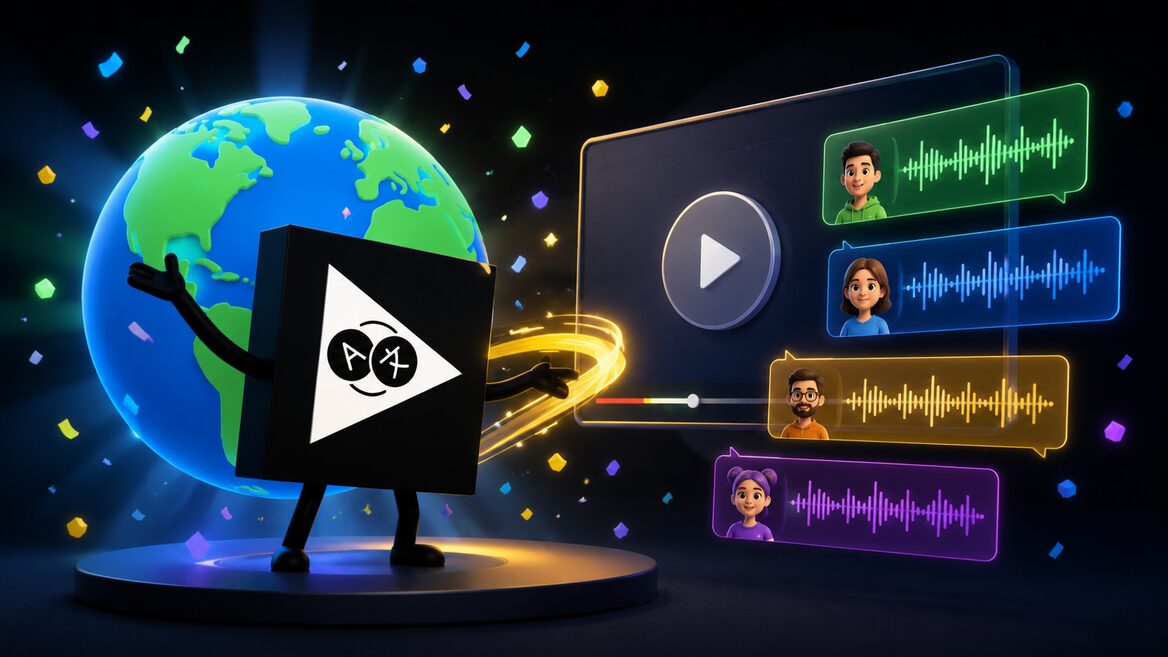
Viktor Shulga, Fractional CRO for IT agencies, has created and made publicly available a custom skill for Claude Code that analyzes video materials. The development allows artificial intelligence to not just listen to audio or read generated subtitles, but to fully analyze video content, taking into account images and timecodes.
Viktor Shulga, Fractional CRO for IT agencies, has created and made publicly available a custom skill for Claude Code that analyzes video materials. The development allows artificial intelligence to not just listen to audio or read generated subtitles, but to fully analyze video content, taking into account images and timecodes.
“My Claude didn’t know how to analyze video. But I finally taught him. I watch 5+ call analyses a week. And for me, it was a pretty big part of the job. Now I see much more,” notes Viktor Shulga.
Why standard tools didn't work
According to Victor, existing platforms, such as NotebookLM, have significant limitations for deep analysis of work calls and content. They accept links only to YouTube and do not work with local video files of calls. Also, when working with videos, they only read text subtitles, completely skipping the visual sequence.
To overcome these limitations, the developer has put together a special skill that prepares videos in a format that is easy for Claude to read.
How does the Watch skill work?
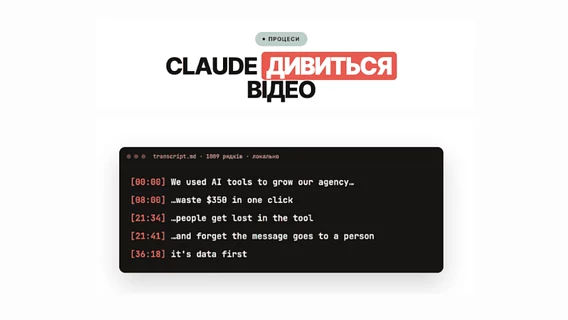
Watch turns a link or file into a clear set of data for analysis without the need to send heavy video through third-party APIs.
Links to YouTube, Shorts, TikTok, Reels, LinkedIn, X (Twitter), local video files or call recordings from Zoom, Google Meet, Microsoft Teams, Loom, as well as .m4a and .mp3 audio formats are supported. (If TikTok or Instagram blocks the download, the built-in backup via Apify is triggered).
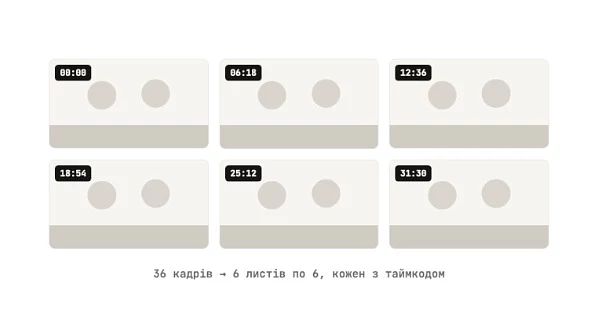
Skil cuts frames from the video and forms contact sheets of 6 pieces with timecodes, which allows Claude to "see" what is happening on the screen.
Speech is decrypted directly on your Mac using faster-whisper — completely locally, without third-party API keys or additional per-minute charges. Confidential files never leave your device.
There is a special mode for calls: offline marks speakers, clearly highlights decisions made, next steps with the indication of responsible persons, and also quotes customer objections with timecodes.
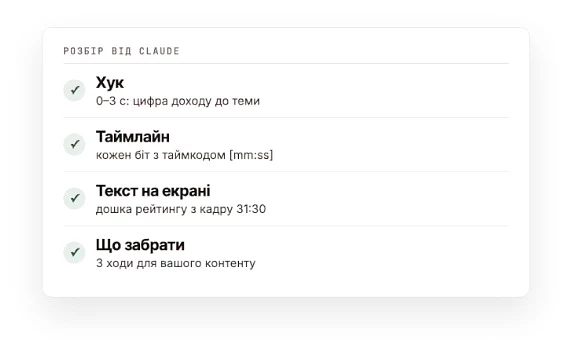
A detailed breakdown of the video structure: hook (beginning), step-by-step timeline, on-screen text, calls to action (CTAs), and key takeaways.
How to install a skill
Viktor Shulga is giving the development to the community for free. There are several ways to use it.
1. Via terminal (fastest): Requires Node 18+. The command adds the skill to the current project folder:
npx skills add victor-shulga/watch/skills/watch
To make the tool available globally in all projects, add the -g flag:
2. Download the ZIP archive: you can unzip the watch folder to ~/.claude/skills/ and restart Claude Code, or download the archive directly through the interface (Settings → Capabilities → Skills in Claude Desktop or claude.ai).
3. Manually from GitHub : the main file is SKILL.md, the rest of the components are pulled automatically from the author's repository. To work, you also need to have Claude Code installed, a terminal, and the uv utility for dependency management.
Як нейромережі бачать вільну та незалежну Україну? Тест dev.ua
Нейронні мережі для генерації зображень бачать світ по-своєму, їхню логіку зрозуміти часом зовсім неможливо. Але таки хочеться. На честь Дня Незалежності України редакція dev.ua вирішила провести невеликий експеримент.
Ми задали чотирьом різним нейронним мережам п’ять однакових запитів: «прапор України», «День Незалежності України», «український Крим», «перемога України» та «українці». Отриманими результатами ми ділимося з вами нижче.
У TikTok тепер можна генерувати фон за допомогою нейромережі. Ми протестували її та ділимося результатами
У TikTok з’явилася нова функція «Розумний фон». З її допомогою як фон для тіктоків можна підставляти згенеровані нейромережею зображення. Редакція dev.ua протестувала цю технологію і ділиться своїми враженнями.