Хочете будувати кар’єру в Data Science та AI? Vodafone Big Data Lab відкриває новий набір —>
Олег ОнопрієнкоAI Eng
23 April 2025, 12:46
2025-04-23
Ukrainians have created a non-intrusive AI agent that can close any client request and save the nerves of technical support specialists. How Pronomy works
Ukrainian startup Pronomy has created an intelligent AI agent for handling customer requests — it not only automatically responds to requests and performs actions, but also analyzes recurring questions to identify what exactly needs to be improved on the company's website or product to reduce the support load. dev.ua spoke with Pronomy founder Oleksiy Lyaskovsky and learned more about the product and how it can be used in the field of user support.
Ukrainian startup Pronomy has created an intelligent AI agent for handling customer requests — it not only automatically responds to requests and performs actions, but also analyzes recurring questions to identify what exactly needs to be improved on the company's website or product to reduce the support load. dev.ua spoke with Pronomy founder Oleksiy Lyaskovsky and learned more about the product and how it can be used in the field of user support.
About the startup creator
Oleksiy Lyaskovskyy is the founder of Pronomy, a company that develops AI agents to automate the work of support departments. Pronomy's solution is capable of processing requests of any complexity and provides advanced analytics. Oleksiy has over five years of experience in the field of artificial intelligence, in particular in creating models for analyzing text information - chats, correspondence, comments, etc.
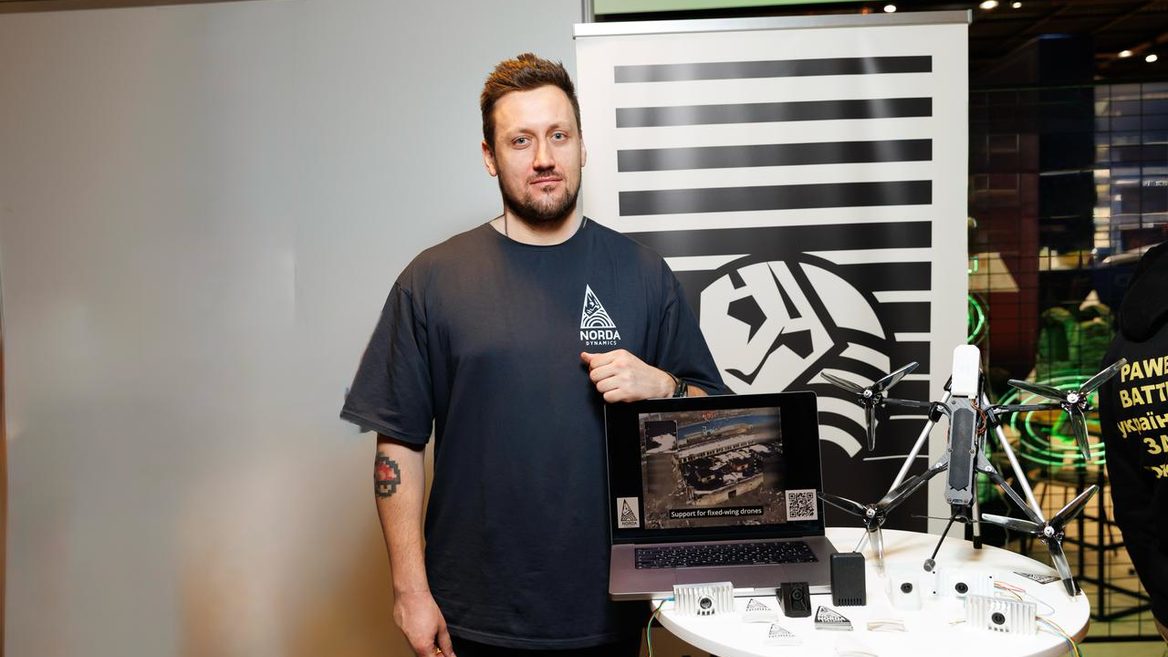
Founder of Pronomy, Oleksiy Lyaskovsky
Even before ChatGPT, I personally trained AI models for specific tasks: I developed the architecture, collected and processed data for training, and carried out the training process itself. With the advent of large language models (LLM), I decided to change the focus of my work — from custom solutions to using LLM to automate internal business processes.
For 2.5 years, he developed custom LLM models and built a chatbot system that allowed users to book appointments, create reminders, and effectively communicate with a virtual assistant. Later, he worked at a European fintech company, where he was involved in the automation of the support department - this experience became the impetus for the creation of the Pronomy product. He also had previous experience working in startups.
How the startup idea was born
A few years ago, Oleksiy considered several product ideas, including one he worked on with friends. However, due to the technical complexity of the implementation, it did not receive development. The next idea - a service for analyzing sales calls - was based on his previous experience, but did not have sufficient potential for scaling.
Everything changed in the fall when Oleksiy joined the Mission Possible program. There, he appreciated the real potential of innovation and decided to radically change direction — abandoning call analysis and focusing on creating AI agents to automate support.
On the advice of a friend from an investment fund, he wrote down all the problems he was interested in solving that could have business potential — 84 positions in total. Then he sorted them by market size, difficulty of exit, and customer attraction. As a result, he was left with seven most promising ideas, from which he chose one — the most ambitious, interesting, and the one that perfectly matched his experience.
"I analyzed competitors, looked at the latest investments in the market (which is more than $70 million in agents in a few months) and looked at the latest sets in the world's top accelerators, such as Y Combinator/500 Startups/Techstars. And then it just clicked in my head - I realized that this has potential and I want to work on it. That's how the idea to move in this direction came about," said the founder of Pronomy.
Oleksiy started working on the product independently, as a solo founder. He was involved in market and competitor research, product development, and initial user engagement. Later, several developers joined the team when product development actually intensified. Currently, the core team consists of three people. Pronomy is currently looking for a technical co-founder (with fullstack or ML expertise) to iterate as quickly as possible, improve the product, and solve the problem of scaling support for more companies.
"Although I have technical expertise, I want to focus as much as possible on sales, because I have an understanding of the market, customers, competitors, and because it simply drives me a lot," shared Oleksiy.
What is Pronomy?
Oleksiy Lyaskovsky, together with the Pronomy team, provides an AI agent to automate the support department of small and medium-sized businesses.
The problem is clear: as a company grows, the number of support requests increases dramatically. And in order not to hire dozens of new agents, businesses are looking for a way to automate responses using AI. There are many similar solutions based on ChatGPT, but most of the existing ones are too basic, others are too expensive, and some do not integrate with the necessary systems at all.
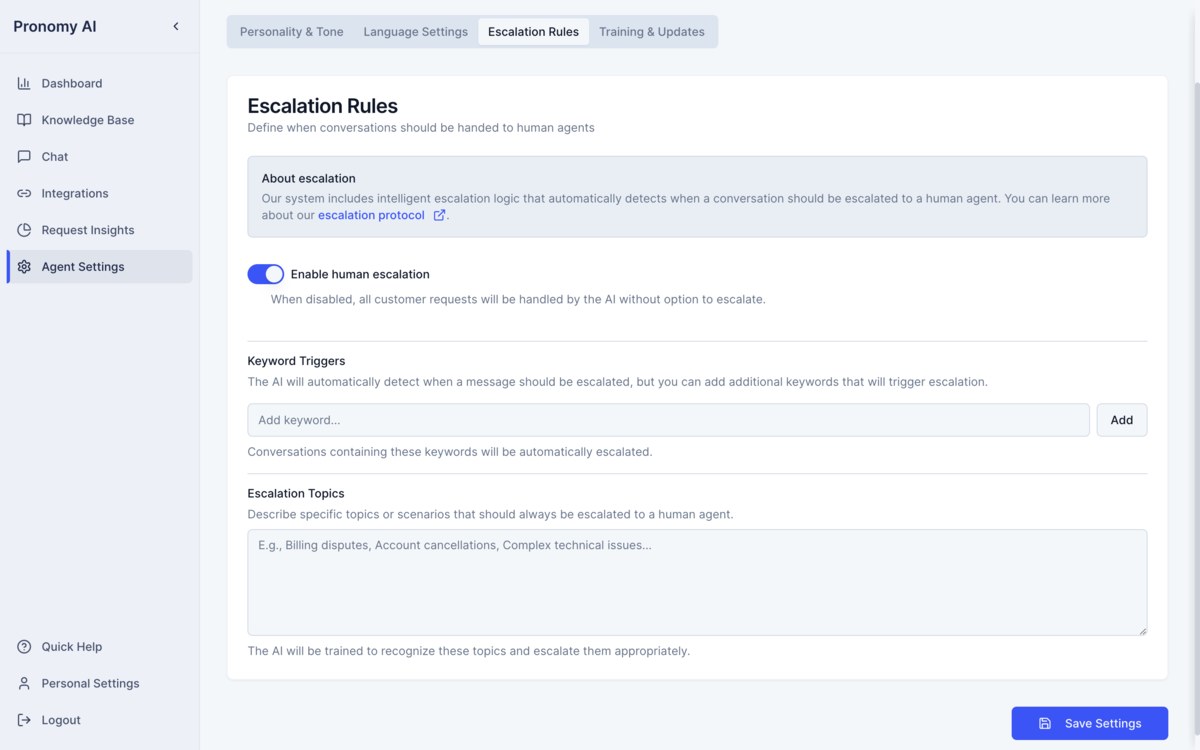
One of the key advantages of Pronomy is the minimization of AI “hallucinations” (based on scientific papers) and a well-thought-out escalation system. If the AI agent is not sure of the answer or the request is complex or critical, the request is automatically transferred to a human. This helps maintain customer trust, especially in cases where they are irritated or the situation requires special attention.
Another feature is a flexible knowledge base system. The AI agent can work with different types of documents, regardless of language or structure: Ukrainian, English, Spanish — everything is supported. Data can be connected both through uploads and through integrations with existing company sources.
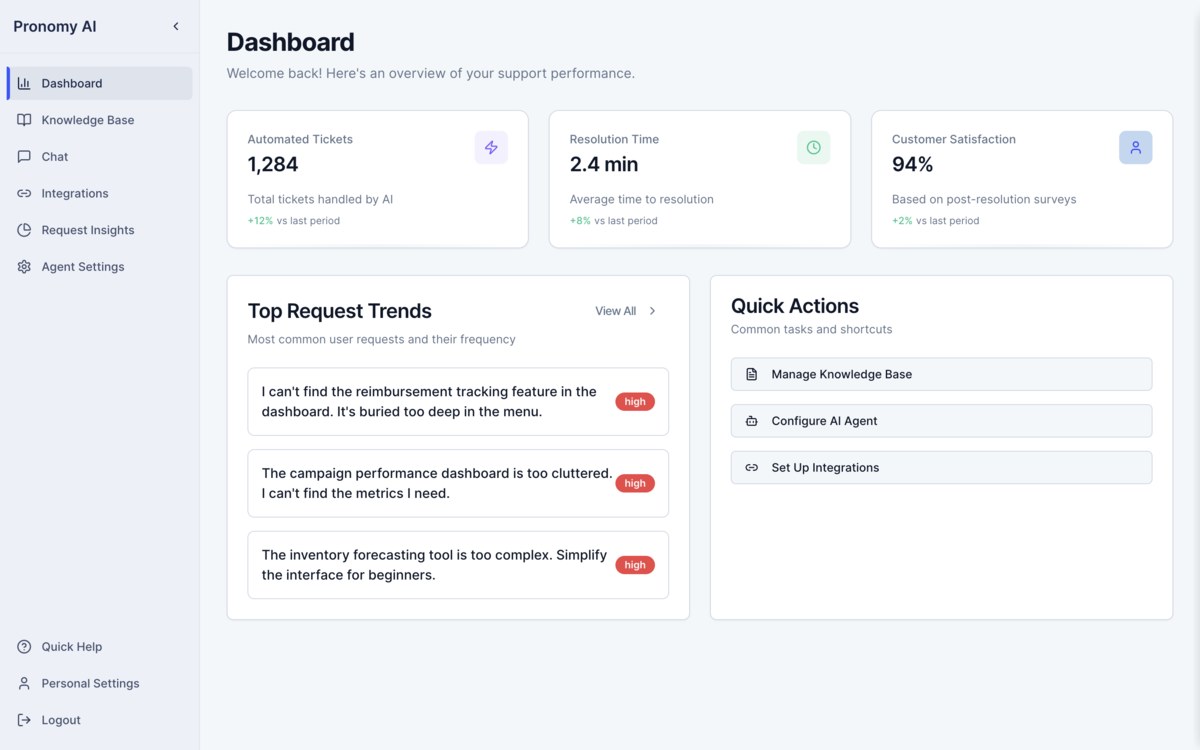
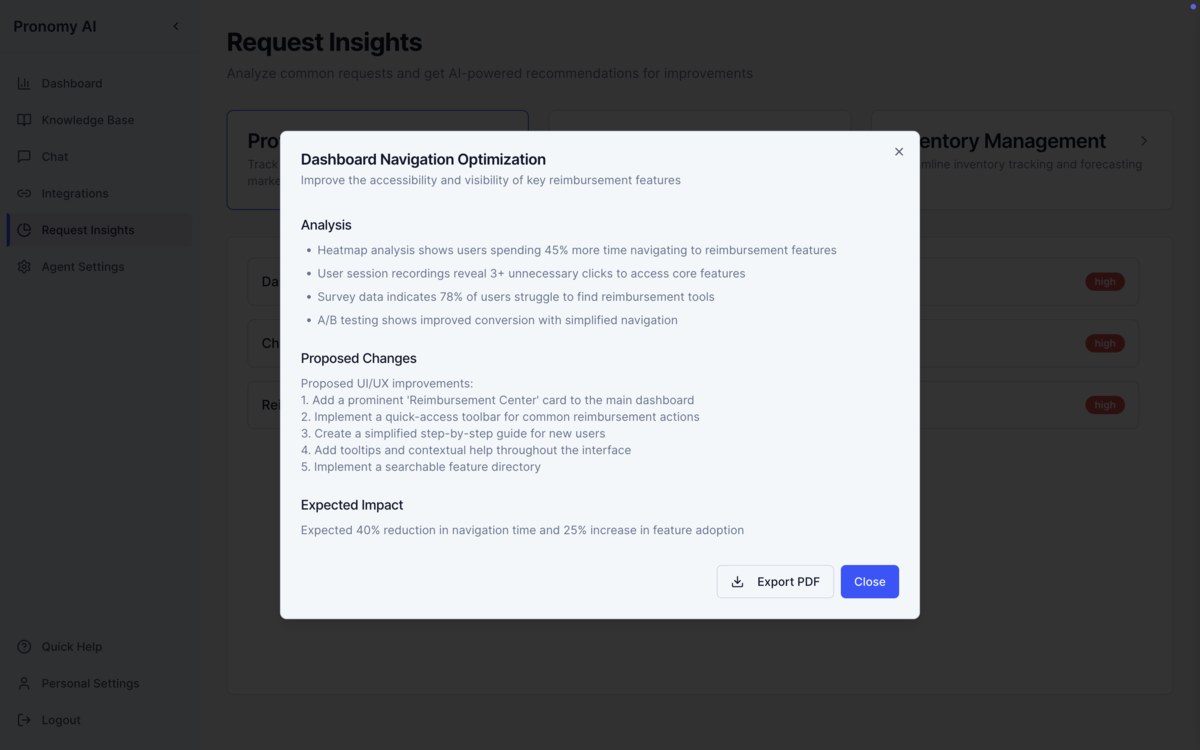
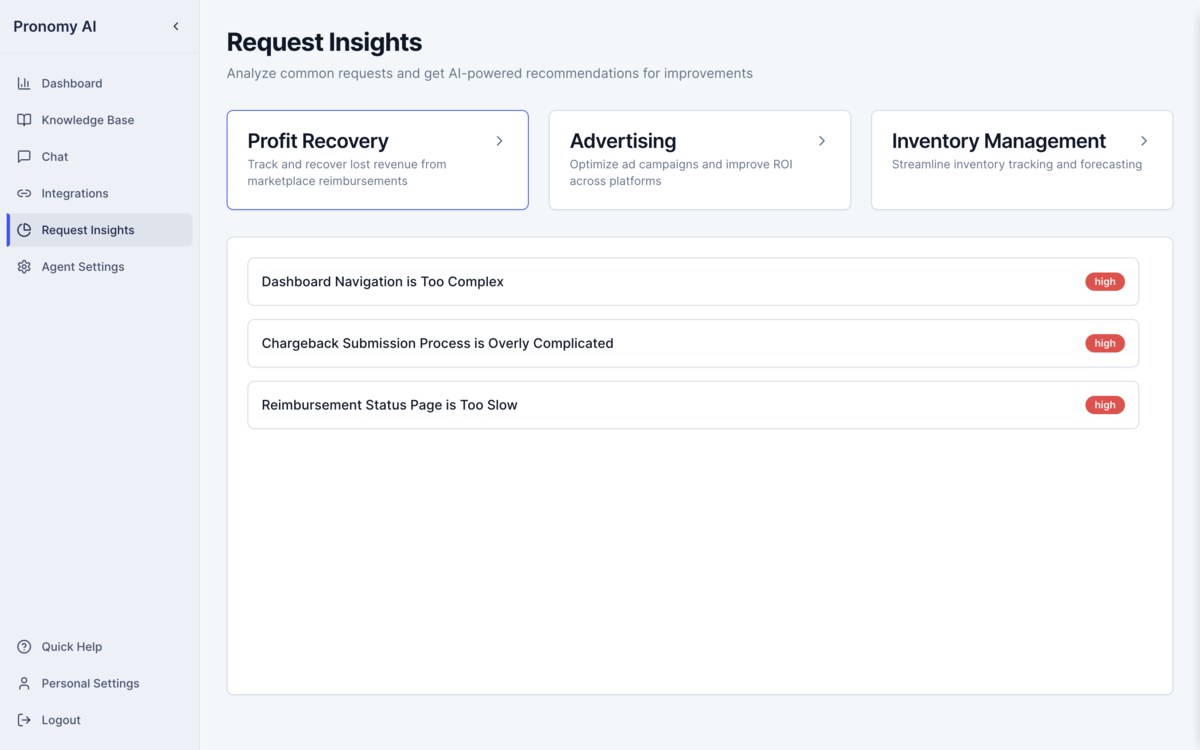
However, Pronomy is not limited to automated responses. The system analyzes incoming requests, identifies recurring topics, reasons for requests, and then conducts an audit of the product and site. Based on this, it provides specific recommendations for improving the product in order to reduce the number of requests and improve the user experience while using the product.
“For example, a company receives many requests where people have difficulty using and navigating the dashboard, our system understands these requests, then moves on to the company’s product, performs an analysis, and gives the result: “Based on the requests, we realized that there is a problem with navigation, so we (after the audit) need to fix this chart switching button, but this menu bar should be hidden altogether.” In this way, we allow not only to automate the provision of answers, but also to reduce the number of incoming support requests,” explained Oleksiy.
Thus, Pronomy doesn't just automate support, but helps reduce the number of requests and improve the product overall — allowing companies to grow more efficiently.
First customers
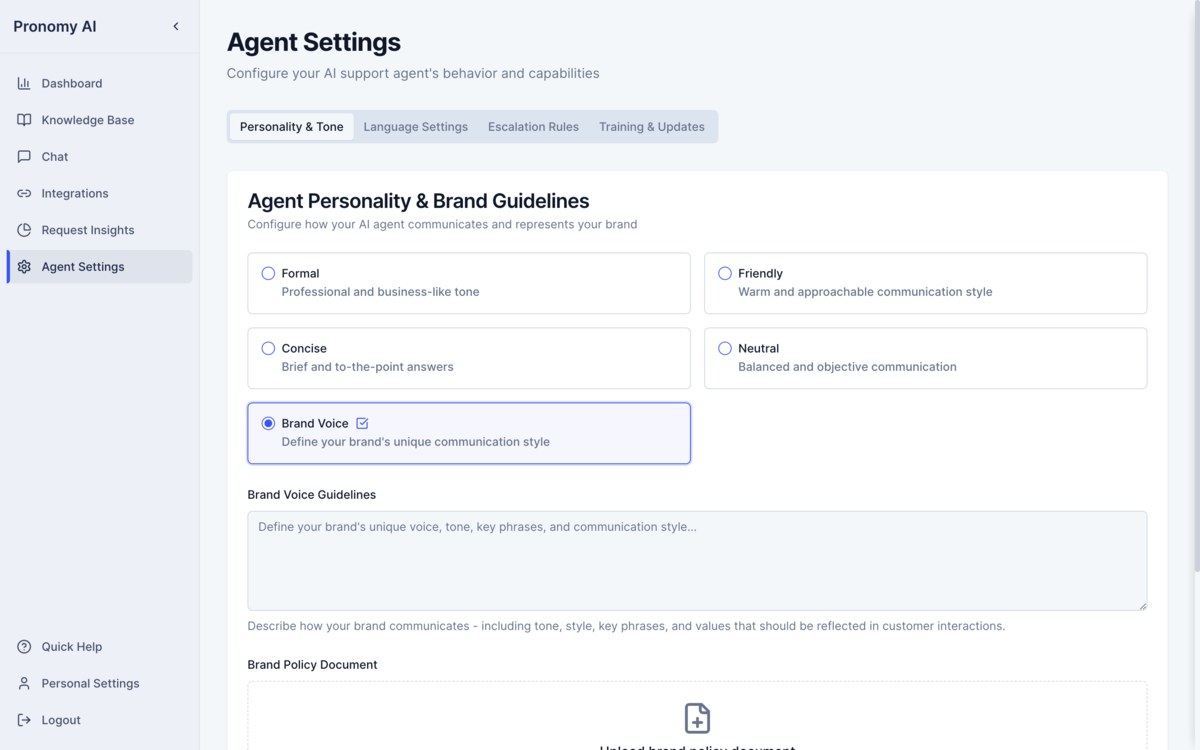
Companies that gain access to Pronomy can adapt the AI agent to their own needs — adjust the response style, communication language (for example, only Ukrainian), and flexibly define the rules for escalating requests. Integration with chat systems is fast and does not require complex technical settings. The team is currently completing the final integrations, and five companies are already waiting for the solution to be implemented in their products and services (with one of them, a pilot is being launched).
"We have already agreed on a pilot launch of Pronomy with one large and well-known Ukrainian company, and after that we will implement our solution into the chat system itself."
Among the companies that have expressed interest in the startup are one of the leading Ukrainian players in the e-commerce sector, a Canadian company with several products, as well as a Ukrainian agency that is ready to promote solutions in the US, UK and Australian markets. The list of potential clients also includes Ukrainian companies working in global markets and EdTech companies that see an opportunity to automate their support.
Despite having its first clients in Ukraine, Pronomy's main focus is the US market, where the team sees the greatest opportunities for growth and scaling.
“We are immediately focusing on global markets,” said the founder of Pronomy.
Funding, monetization and future plans
The startup is currently funded by the team’s personal funds, as well as grants received during the previous startup idea. Last spring, the team received a grant from the Ukrainian Catholic University incubator. These resources became the starting support for the development of a new direction — Pronomy. Today, the key task is to use the available resources as efficiently as possible. The plans are to apply for several new grant programs that will help secure funding by the fall. That’s when the team expects to begin negotiations with investment funds to attract the first investments.
Pronomy's immediate plans include completing technical integrations with the most popular helpdesk platforms to make the solution launch as simple and convenient as possible for companies. The first users will be five businesses that have already confirmed their readiness for pilot implementation.
Next is scaling: reaching new users, developing sales, and expanding the market. The goal is to make Pronomy a product that doesn’t just automate support, but transforms the way companies work with customers. The next step in development is to attract pre-seed investments of several hundred thousand dollars as a foundation for further growth.
Given the rapid development of AI, the team is consciously focusing not on immediate profit, but on strategic growth — directing resources to product development as much as possible to maintain a competitive advantage in a dynamic environment.
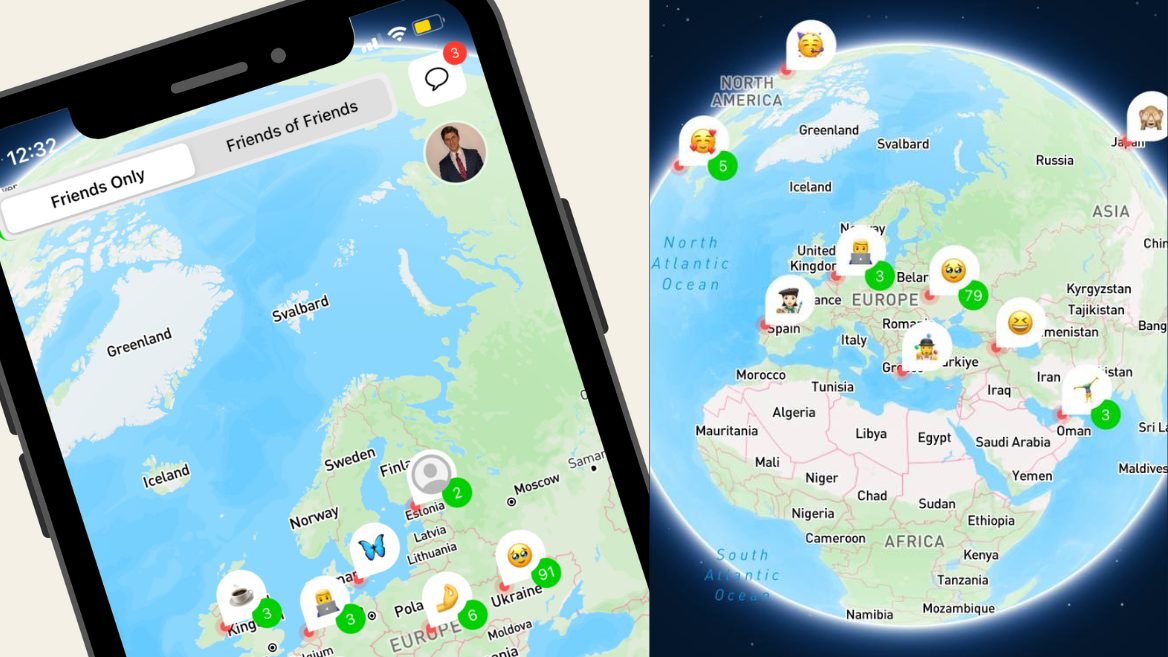
Ukrainians have created a free social network for finding friends. How the svoi. application works, which has already united 400 people from different parts of the world
Як нейромережі бачать вільну та незалежну Україну? Тест dev.ua
Нейронні мережі для генерації зображень бачать світ по-своєму, їхню логіку зрозуміти часом зовсім неможливо. Але таки хочеться. На честь Дня Незалежності України редакція dev.ua вирішила провести невеликий експеримент.
Ми задали чотирьом різним нейронним мережам п’ять однакових запитів: «прапор України», «День Незалежності України», «український Крим», «перемога України» та «українці». Отриманими результатами ми ділимося з вами нижче.
У TikTok тепер можна генерувати фон за допомогою нейромережі. Ми протестували її та ділимося результатами
У TikTok з’явилася нова функція «Розумний фон». З її допомогою як фон для тіктоків можна підставляти згенеровані нейромережею зображення. Редакція dev.ua протестувала цю технологію і ділиться своїми враженнями.