Ukrainian language grew the most among AI models in 2025
According to the Hugging Face platform, the number of artificial intelligence models supporting languages other than English grew rapidly in 2025, with Ukrainian leading the list.


According to the Hugging Face platform, the number of artificial intelligence models supporting languages other than English grew rapidly in 2025, with Ukrainian leading the list.

According to the Hugging Face platform, the number of artificial intelligence models supporting languages other than English grew rapidly in 2025, with Ukrainian leading the list.
«AI development is increasingly distributed across different language communities, reflecting broader participation in model building and training and indicating where activity is accelerating most rapidly between 2024 and 2025,» says a study by AI World using data from Hugging Face.
The highest annual growth is concentrated in Ukrainian, Swedish, Arabic, Turkish and Chinese, which show the highest percentage growth. According to the researchers, this indicates that the momentum of development is shifting towards languages that were previously underrepresented. This contributes to the creation of a more diverse multilingual ecosystem within the framework of open source software for artificial intelligence.
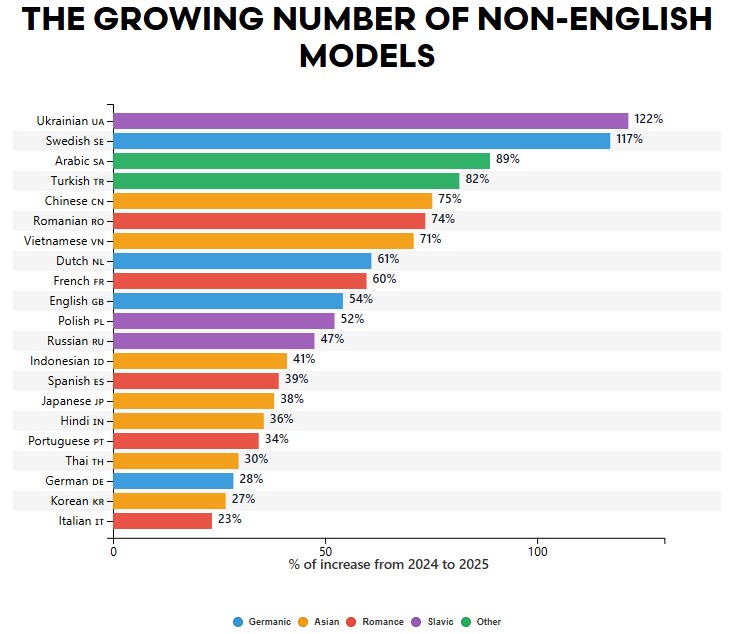
«At the same time, English remains the most widely used language by a wide margin, followed by Chinese, French, Spanish, and German in terms of overall presence. While these languages continue to account for the largest share of models, their relative growth rates are lower than those of several new languages,» AI World notes.
Currently, almost 270,000 English-language models are registered on Hugging Face. According to the platform, there are over 3,000 Ukrainian-language models and 619 datasets.
Recall that Lapa LLM is called the best Ukrainian language model. It was trained by leading Ukrainian researchers in their free time, and it has become one of the most effective LLMs for the Ukrainian language.
dev.ua with Yuriy Paniv about the creation of Lapa LLM, working with data, and the challenges of artificial intelligence hallucinations.