The Ukrainian Book Institute conducted a study on the reading level of adults and children. 73% of respondents said they had never read e-books
How often, what and why do Ukrainians read.


How often, what and why do Ukrainians read.

The Ukrainian Book Institute conducted a study on the reading level of adults and children. 73% of respondents said they had never read e-books
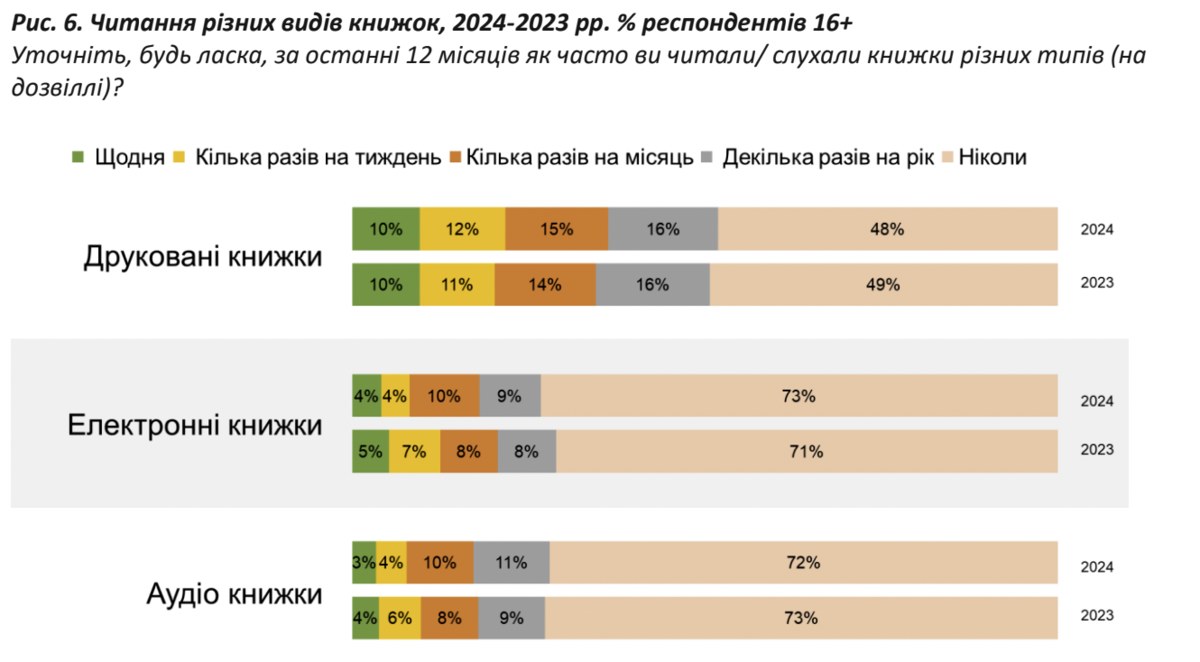
“Reading e-books remains a less common practice among respondents. 73% indicated that they never read such books. The situation is similar with audiobooks — 72% of respondents have never listened to them,” the study says.
The use of different types of reading formats has not changed compared to 2023. After a rapid growth in the use of electronic formats, this way of reading has plateaued, the growth has stopped. This, among other factors, may be caused by the limited supply on the market of audio and e-books, primarily Ukrainian-language ones.
When asked about the reasons that motivate them to choose reading/listening to books as a leisure practice, respondents most often chose the following alternatives:
— For self-improvement/self-development — 43%;
— I just like to read/I love to read — 38%;
— For relaxation, to distract yourself — 31%;
— Likes to learn new things — 23%.
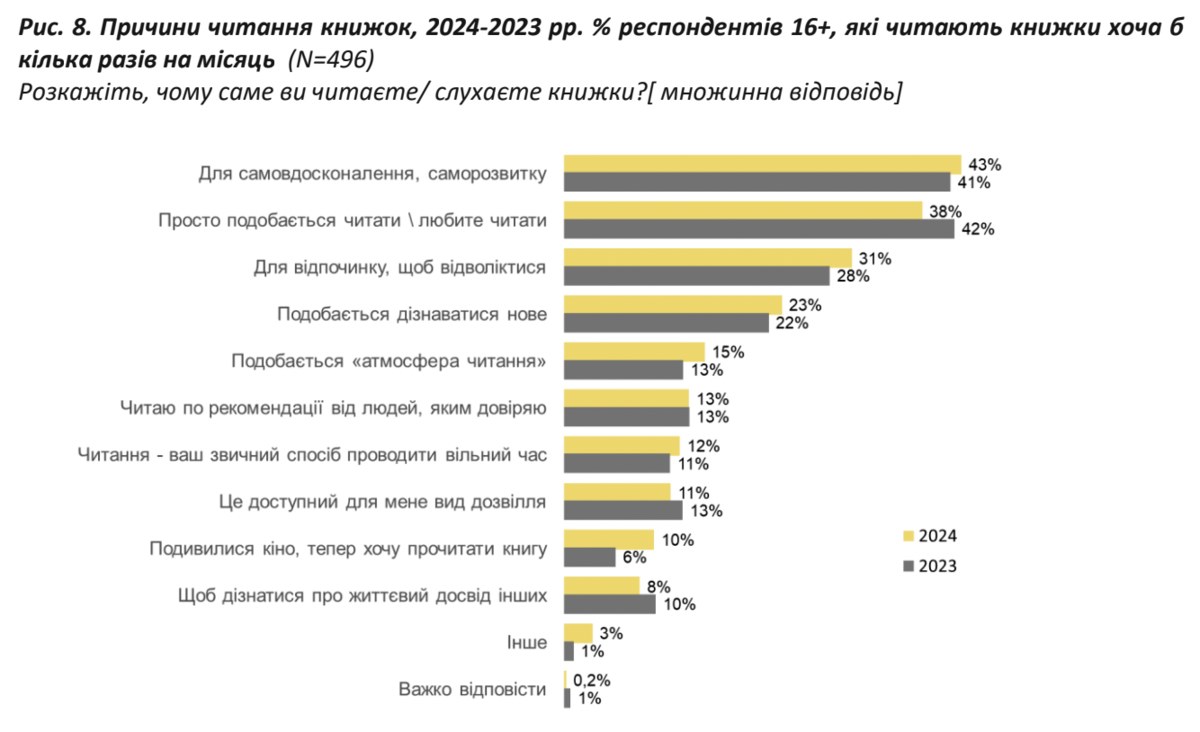
Among the new trends that can be seen is the increasing influence of movie releases on reading the books they are based on. Thus, in 2023, respondents who said they want to read a book after
movie viewing was 6%, and in 2024 this figure increased to 10%, primarily due to women and young people aged 16 to 29.
Compared to 2023, the consumption of Ukrainian-language books increased by at least 20% and reached 76%. One of the main reasons for this may be the adoption of a law that imposes restrictions on the import of books from Russia, Belarus, and the temporarily occupied territory, the authors of the study believe.
Speaking of reading in general, a third of Ukrainian adults (34%) do not consider this practice as a way to spend their free time. Instead, the most popular types of daily leisure are the use of messengers and social networks.
Respondents who never read most often cited lack of time (45%), physical difficulties (27%), and lack of need or desire to read (24%). In addition, residents of the south and east find it more difficult to concentrate on reading due to war and stress. However, 38% of respondents, on the contrary, read books in their free time at least several times a week.
46% of respondents spent between UAH 500 and UAH 2,000 on books in the last three months. People aged 40-49 are the least active buyers of printed books, while Ukrainians aged 30-39 are the most active buyers.
The survey was conducted in September across the entire territory of Ukraine, which is under the control of the Ukrainian government. A total of 2,094 respondents were surveyed across the entire territory of Ukraine: 1,018 people aged 16 and older, and 1,076 aged 6–17.