Стас ЮрасовThat's Life
24 July 2026, 13:38
2026-07-24
Internet under fire, solar power plants on rooftops, and GPON on the forefront: how Ukrtelecom is building the infrastructure of the future right during the war
While most technology companies are trying to minimize risks, freeze capital expenditures, or operate exclusively in the mode of preserving existing assets, the national fixed-line operator Ukrtelecom (part of Rinat Akhmetov’s SCM group) is implementing one of the largest and most complex telecom infrastructure modernization programs in the modern history of Ukraine.
While most technology companies are trying to minimize risks, freeze capital expenditures, or operate exclusively in the mode of preserving existing assets, the national fixed-line operator Ukrtelecom (part of Rinat Akhmetov’s SCM group) is implementing one of the largest and most complex telecom infrastructure modernization programs in the modern history of Ukraine.
This is not just a story about keeping wires running. It is a process of radically rebuilding an outdated copper infrastructure into modern high-speed optical networks, taking place under conditions of daily rocket and artillery shelling, targeted attacks by enemy FPV drones, and system blackouts. The scale of the work covers the entire country — from the relatively quiet towns of the Carpathian region to the scorched frontline communities in the South and East.
Technological shift: home-pass metrics and nationwide expansion
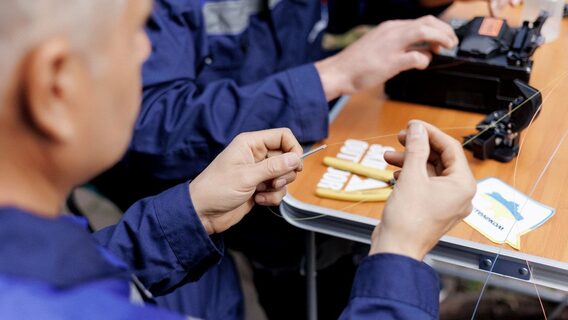
The main technological vector that the company has relied on is the development of an optical network using GPON (Gigabit Passive Optical Network) technology. Unlike outdated systems, this technology allows subscribers to be provided with gigabit speed, minimal ping and, most importantly in today’s realities, high energy independence on the client side.
To measure the real scale of digital construction, the operator switched to a key indicator — homepasses. This is the number of households or business facilities near which optical cable has already been laid and distribution equipment installed, which allows the client to be connected at the first request.
In total, Ukrtelecom’s optical coverage covers 3.4 million Ukrainian households. The geography of development is impressive in its coverage. In the Kharkiv region, which remains one of the largest areas for network development, over 430 km of optical lines were laid last year alone, which opened access to high-speed Internet for 50,000 families, and in 2026 more than 100 km of new routes were added here. Chernihiv region received 380 km of constructed lines and 42,000 new home passes per year, and Sumy region — 370 km and 34,000 households, respectively.
A huge amount of work falls on the Dnipro macroregion, which covers Dnipropetrovsk, Zaporizhia, Donetsk, Kirovohrad and Cherkasy regions. In just one year , more than 100 thousand families were given the opportunity to connect to modern optics. At the same time, growth was recorded in Lviv, Ivano-Frankivsk, Poltava, Zakarpattia, Vinnytsia, Mykolaiv and Chernivtsi regions.
«The strategy is simple and clear: we build high-speed networks, improve the quality of service, systematically expand coverage, and make fast Internet available to the mass user,» comments Oleg Angelovsky, head of the Dnipro macroregion.
In addition to the residential sector, the company is actively entering the B2B segment. During the war, Ukrtelecom connects large shopping and entertainment centers and business complexes.
Southern Vector: Digitalization Under the Gun
A special place in this system is occupied by the Southern macroregion (Odessa, Mykolaiv, Kherson and Vinnytsia regions), where development takes place under conditions of the highest security risks. The head of the Southern macroregion, Maryna Mykhaylik, talks in detail about how the telecom front in the south of the country works.
According to her, the company has significantly changed its approach to assessing success. Previously, they focused solely on the number of kilometers of cable laid, but now the main criterion has become how many people actually received quality communication.
In 2025, 67,000 homeports were built in the South, and the plan for 2026 was slightly increased.
The number of people who want to use optics is growing. Switching to optics gives people more than just a «Wi-Fi icon on their phone.» Speeds of up to 1 Gbps completely cover the needs of a modern family, where dozens of devices can operate simultaneously — from laptops for remote work to smart TVs, tablets for online education for children, and streaming systems.
Changing safety protocols, tactical medicine training.
The most dramatic situation remains in the Kherson region and in the border areas of Sumy and Kharkiv regions. In many settlements on the contact line, the telecom infrastructure has to be literally rebuilt after each new shelling.
The constant patrol of Russian FPV drones and artillery strikes have turned the work of a regular cable installer into a deadly mission. There are settlements, for example, in the Kherson region, where flights occur almost daily. Despite this, the operator’s specialists, at the first opportunity when they can work on restoration, go out and work.
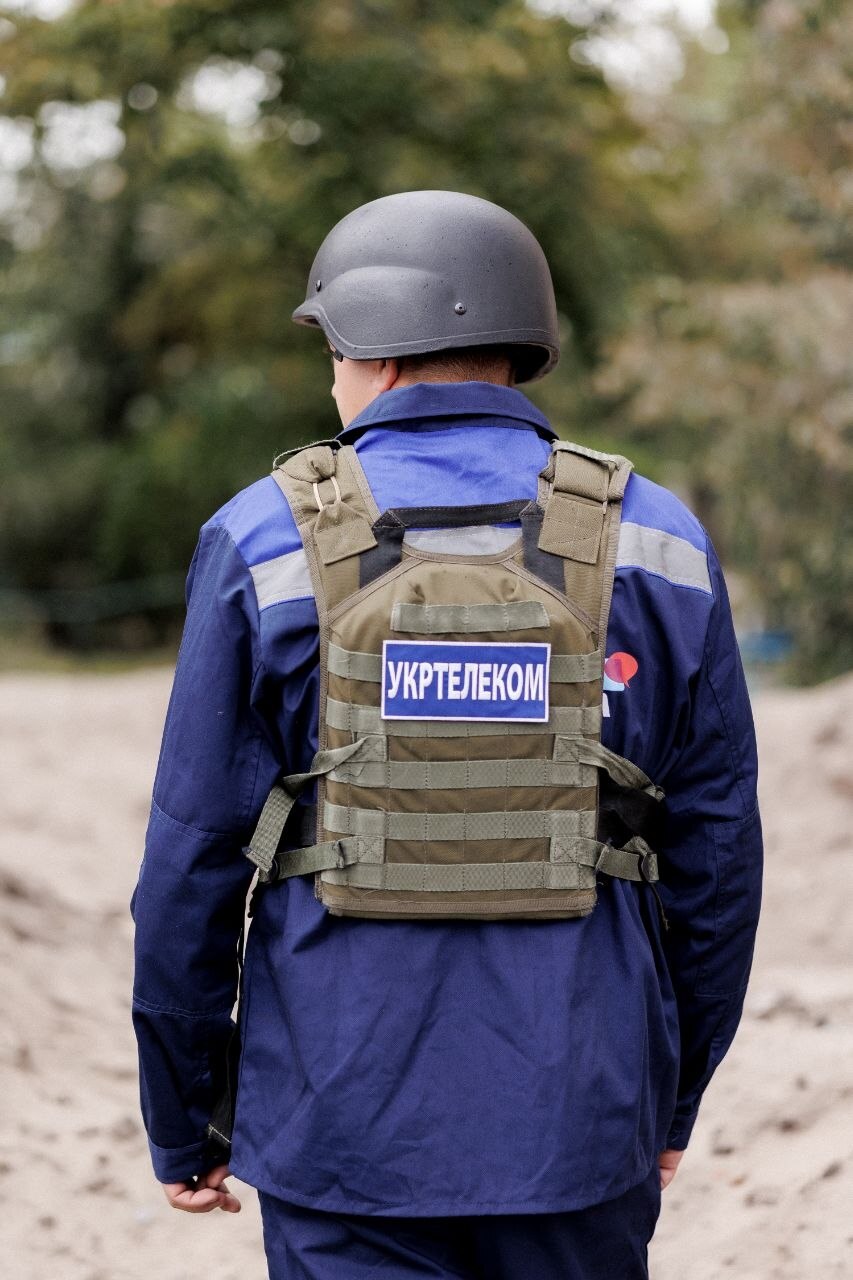
Due to such extreme conditions, the company has changed its safety protocols and equipment for employees. This also applies to personal protective equipment, in particular for emergency recovery teams. Employees are also undergoing training in tactical medicine. In dangerous areas, emergency recovery work is carried out only after approval from the Armed Forces of Ukraine and relevant services.
«In the Kherson region, the priority is the constant restoration of the network after shelling and drone attacks. This is daily work that requires a quick response,» notes Maryna Mykhaylyk.
Sometimes Ukrtelecom becomes the only operator with true professionalism and dedication to people.
A similar picture is observed in the East of the country. The head of the Eastern macro-region, Andriy Pustovoitenko, emphasizes: although the main focus today has shifted to the frontline territories — where people remain and where communication is a matter of survival — the East still remains among the leaders in the pace of construction of new optical networks. An example of this is the deoccupied Sviatohirsk, where communications were restored on a completely new, high-speed technological basis.
Energy sustainability: generators, batteries and own solar power plants
In parallel with the threat of shelling, the telecom industry is facing the challenge of a total shortage of electricity. To ensure that the network continues to operate during long power outages, Ukrtelecom integrated energy independence solutions directly into the modernization process.
Key communication nodes across the country are equipped with backup power sources that automatically turn on when the power goes out in the general network. In the South, the company went even further, starting to test solutions based on renewable energy. The Odessa branch implemented a project to build its own solar power plant (SPP), placing photovoltaic modules directly on the roof of one of its technological buildings.
This station enhances the energy sustainability of the infrastructure, allowing for significant savings in generator engine life and fuel, and also guarantees stable operation of the equipment even during combined blackouts.