Наталя ХандусенкоHot News
28 July 2026, 12:34
2026-07-28
There are over 380,000 IT companies and sole proprietors in Ukraine, and almost 80% of them work in the field of software development.
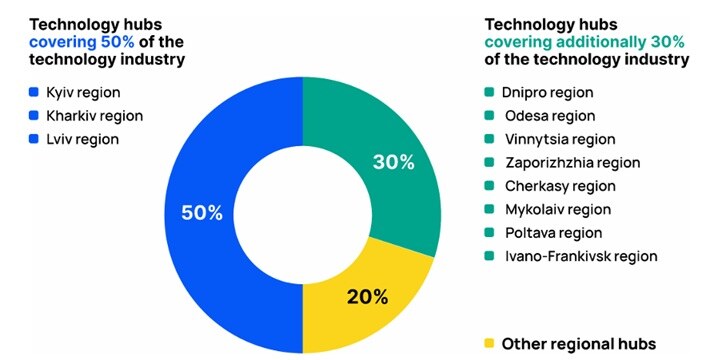
As of the second quarter of 2026, there were 382,905 registered entities in the Ukrainian IT sector, including individual entrepreneurs and companies. Kyiv, Kharkiv, and Lviv regions account for almost 50% of the market.
As of the second quarter of 2026, there were 382,905 registered entities in the Ukrainian IT sector, including individual entrepreneurs and companies. Kyiv, Kharkiv, and Lviv regions account for almost 50% of the market.
This is stated in the EU-Ukraine Digital Sector Interlinkages Report, prepared by a consortium of Ukrainian and European IT clusters within the framework of the ITBridge project.
Immediately behind the top three is a group of regions that together account for approximately a third of Ukraine’s IT market, including:
Dnipropetrovsk region;
Odessa;
Vinnytsia;
Zaporizhzhia;
Cherkasy;
Poltava;
Ivano-Frankivsk;
and other regions.
Kharkiv leads among Ukrainian cities
If we consider not only regions, but also individual cities, Kharkiv remains the largest IT center in Ukraine:
Kharkiv — more than 30,800 IT companies and private entrepreneurs; Lviv — 23,617; Dnipro — 18,967; Odesa — 13,463.
From 2022, the IT industry will gradually transform cooperation with specialists
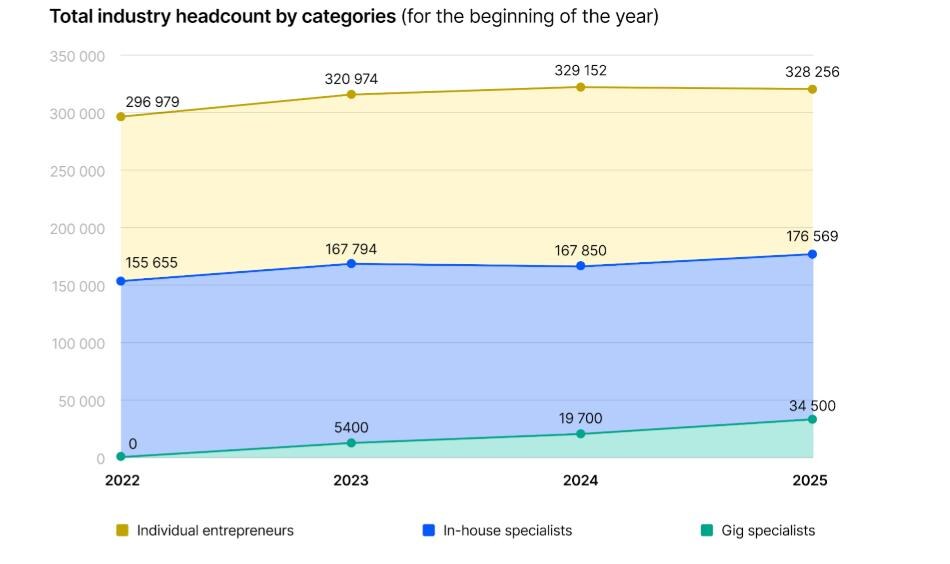
The largest category remains sole proprietorships, whose number increased from 296,979 in 2022 to a peak of 329,152 in 2024, after which it stabilized slightly at 328,256.
In parallel, there has been a steady increase in the number of full-time specialists, whose number reached 176,569 in 2025.
The most dynamic trend is demonstrated by gig professionals, whose segment grew rapidly from zero in 2022 to 34,500 in 2025, indicating an active transition of companies to new legal forms of attracting talent.
The software development sector is showing significant growth
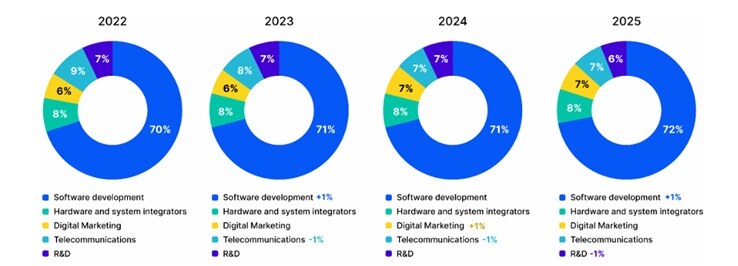
Over the year, the development sector increased its market share from 72% at the beginning of 2025 to almost 80%.
Other significant areas include digital marketing with a share of about 10%, as well as the hardware and system integration segment, which accounts for about 7%.
As can be seen from the graph above, digital marketing has expanded slightly over the years — from 6% to 7%. At the same time, there is a slow decline in the shares of telecommunications (from 9% in 2022 to 7% in 2025) and the R&D sector, which has decreased from 7% to 6%, which indicates a reallocation of resources in favor of pure software development.