Хочете будувати кар’єру в Data Science та AI? Vodafone Big Data Lab відкриває новий набір —>
Марія БровінськаHot News
9 February 2026, 16:01
2026-02-09
A Ukrainian economist proposes to introduce a tax on Ecoflow and Bluetti for Ukrainians. It has been riding the "jackal express" on social networks for a day now - neither economists nor ordinary household users understand the idea
Economist and professor at American University Kyiv Volodymyr Vakhitov believes that it is time to introduce a «tax on batteries» in Ukraine. His idea has sparked heated discussion on social media. What is the author of the idea guided by and what do the fans think? Read on.
Economist and professor at American University Kyiv Volodymyr Vakhitov believes that it is time to introduce a «tax on batteries» in Ukraine. His idea has sparked heated discussion on social media. What is the author of the idea guided by and what do the fans think? Read on.
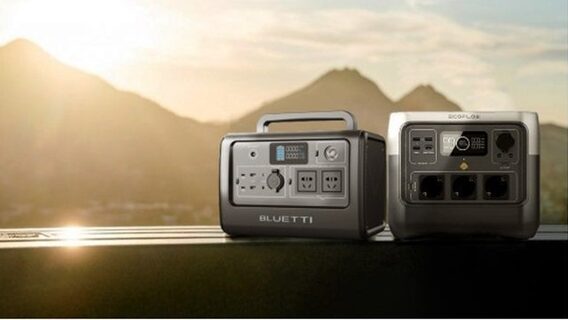
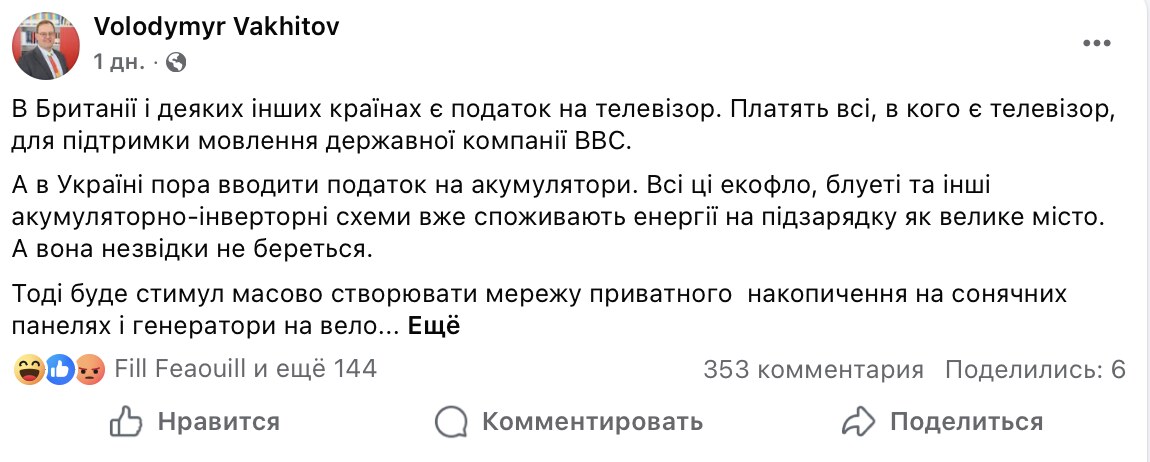
«In Britain and some other countries, there is a tax on television. Everyone who has a television pays to support the broadcasting of the state-owned BBC. And in Ukraine, it is time to introduce a tax on batteries. All these Ecoflow, Bluetti and other battery-inverter schemes already consume energy for recharging, like a big city. And it doesn’t come from nowhere,» the economist argues.
The tax, in his opinion, will be an incentive to massively create a network of private storage on solar panels and generators on bicycle traction. «And no, this is not a joke,» Volodymyr noted. He added that he currently uses an inverter with a battery. «If there were a tax, there would be a relay for switching on by the hour,» the scientist argued his opinion.
His post on various social networks has hundreds of comments.
According to strategic communications consultant Yaryna Klyuchkovskaya, Volodymyr is not in Ukraine right now. «With all due respect, you have uninterrupted power supply right now because you are not in Ukraine,» she wrote in the comments to Vakhitov’s post.
For the most part, users did not understand the idea — neither how the incentive would work, nor why they should pay for the electricity consumed for charging and additionally — a tax.
« I thought that the best economists were sitting in our parliament, but I see that they have room to grow,» noted entrepreneur and lecturer at Kyiv-Mohyla Business School Valeriy Pekar.
Economist, associate professor and dean of the Faculty of Master’s Economic Studies at the Kyiv School of Economics University, Oleg Niv’yevsky, asked Vakhitov a number of questions. «Volodya, help me understand a few things, because from the start your proposal leads me into a stupor.
First, about TVs and the tax. In Germany it is roughly 18 euros per month, and it is a kind of financing of a public good (public broadcasting), and there is a reason for intervention in this. How does this compare with the Ecoflow tax? What is the reason for intervention here? Where do the public and private costs/benefits diverge here?
You say this will create an incentive to create a network of private storage. In my opinion, it will be the opposite: higher taxes — less consumption — less storage capacity — greater dependence on central supply, no?
If this is a tax, it will certainly be regressive, and the less wealthy will suffer more.
«Energy savers or batteries, in my opinion, are now more like an element of resilience, like a food reserve. In the current conditions, it is even a kind of insurance policy, in my opinion. And in such conditions, your tax can easily be turned into a subsidy for private energy storage.»
«Consumers pay for electricity, no matter how they consume it. Here and now from the outlet, or later from the ecoflo. What tax? That is, I paid for electricity, paid the fee (included in the cost of the product) for the power bank. And pay again for using the paid electricity? In order to install panels, incentives are needed. It is logical that the fee for them would be removed for a year or so. I’m not talking about organizational issues in apartment buildings,» noted PR strategist Serhiy Didkovsky .
When asked by the head of the analytical department of the investment company Concorde Capital , Oleksandr Parashchy, about what exactly the tax is and what he means by it, Vakhitov replied: «A tax on peak consumption. It is implemented through dynamic pricing. The incentive is to consume less during peak hours, to look for (install) other ways to charge your gadgets. Where there is a sunny side — panels. Where there is a separate house — generators. Where there is the ability to agree among themselves and/or with local authorities — local cogeneration installations. The idea is small-scale decentralization of generation. Yes, it is necessary to allow energy to be fed into the network, as well as reduce tariffs on individual generation and its components. If you look at it more broadly.» Vakhitov says that «dynamic pricing is a tax. Pigovian congestion tax.»
Discussing with economist Dmitry Goryunov, who noted that charging devices is mostly done at night anyway — that’s how the outage schedules are arranged — Vakhitov explained: «It doesn’t matter when. When there is higher demand, the price is higher. And again, we can talk about a shortage and the expediency of doing this right now, but the question of „what to do if there is even less capacity, and there will not be enough to charge batteries and, conditionally, the hospital at the same time“ is already hanging in the air.»
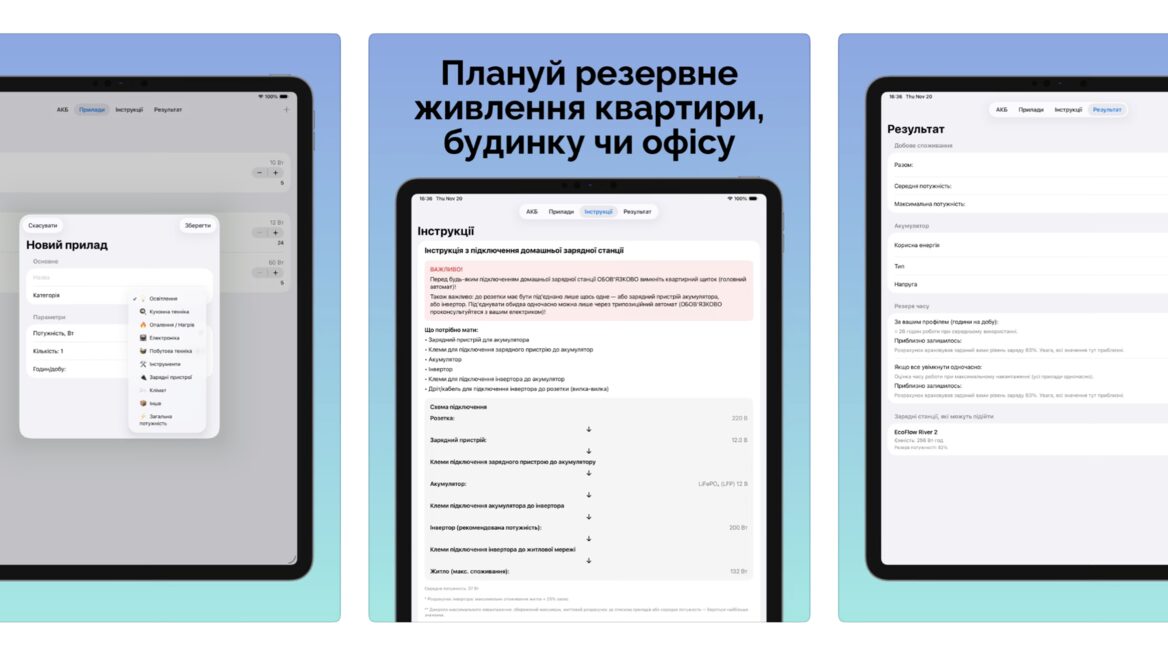
An iOS developer has created a Blackout Math app for EcoFlow, Bluetti, Anker owners, and those who are first-time home battery buyers. It helps calculate backup power during blackouts
Ecoflow not working? You can wait weeks for repairs — there are currently huge queues. How to protect the station from malfunctions, what is covered by the warranty and what is not, and is it worth discharging devices to 0