Олександр КузьменкоScience Pop
4 August 2025, 15:14
2025-08-04
Scientists have trained a neural network to discover new laws of physics — it has already described the behavior of dusty plasma
Researchers at Emory University in Atlanta have trained a neural network to discover new physical phenomena. They trained it on experimental data about a mysterious substance, dusty plasma, and the system produced «surprisingly accurate descriptions» of its behavior. The system was run on a regular desktop PC.
Researchers at Emory University in Atlanta have trained a neural network to discover new physical phenomena. They trained it on experimental data about a mysterious substance, dusty plasma, and the system produced «surprisingly accurate descriptions» of its behavior. The system was run on a regular desktop PC.
As Interesting Engineering notes, this research shows that artificial intelligence can be used to uncover previously unknown laws that govern the interaction of particles in a chaotic system.
«We have shown that we can use artificial intelligence to discover new physics. Our artificial intelligence method is not a black box: we understand how and why it works. The structure it provides is also universal. It can potentially be applied to other many-particle systems to open up new avenues for discovery,» said Justin Burton, one of the study’s authors and an Emory professor.
Scientists call dust plasma a hot, electrically charged gas filled with tiny dust particles. This state of matter is found throughout the universe, from the rings of Saturn and the surface of the Moon to the smoke from forest fires on Earth.
The forces acting between particles in dusty plasma remain poorly understood because in this material the force that one particle exerts on another does not necessarily correspond to the force exerted in return.
Understanding these interactions using traditional physics has proven to be extremely difficult. So to solve this problem, the scientists created a sophisticated 3D imaging system to observe the movement of plastic dust particles inside a plasma-filled chamber. They used a laser sheet and a high-speed camera to record the movements of thousands of tiny particles in three dimensions over time.
These detailed trajectories were then used to train a special neural network. Unlike most artificial intelligence models, which require huge data sets, the Emory team’s network was trained on a small but rich data set and designed with built-in physical rules, such as taking into account gravity, drag, and forces between particles.
The neural network broke down the particle motion into three components: velocity effects (such as drag), environmental forces (such as gravity), and forces between particles. This allowed the AI to learn complex patterns of behavior while adhering to basic principles of physics.
The results revealed descriptions of the forces in the dusty plasma with more than 99% accuracy. One unexpected discovery was that when one particle moves ahead, it pulls another along, but the one moving behind repels the leader. This kind of asymmetric interaction had been previously suggested but never modeled clearly.
AI has also corrected some of the false assumptions that have shaped plasma theory for years.
«Even more interestingly, we have shown that some common theoretical assumptions about these forces are not entirely accurate. We can correct these inaccuracies because we can now see what is happening in the finest detail,» added Nemenman.
Interestingly, this AI model ran on a regular desktop computer. It created a universal framework that can now be applied to all kinds of multi-particle systems, from paint mixtures to cell migration in living organisms.
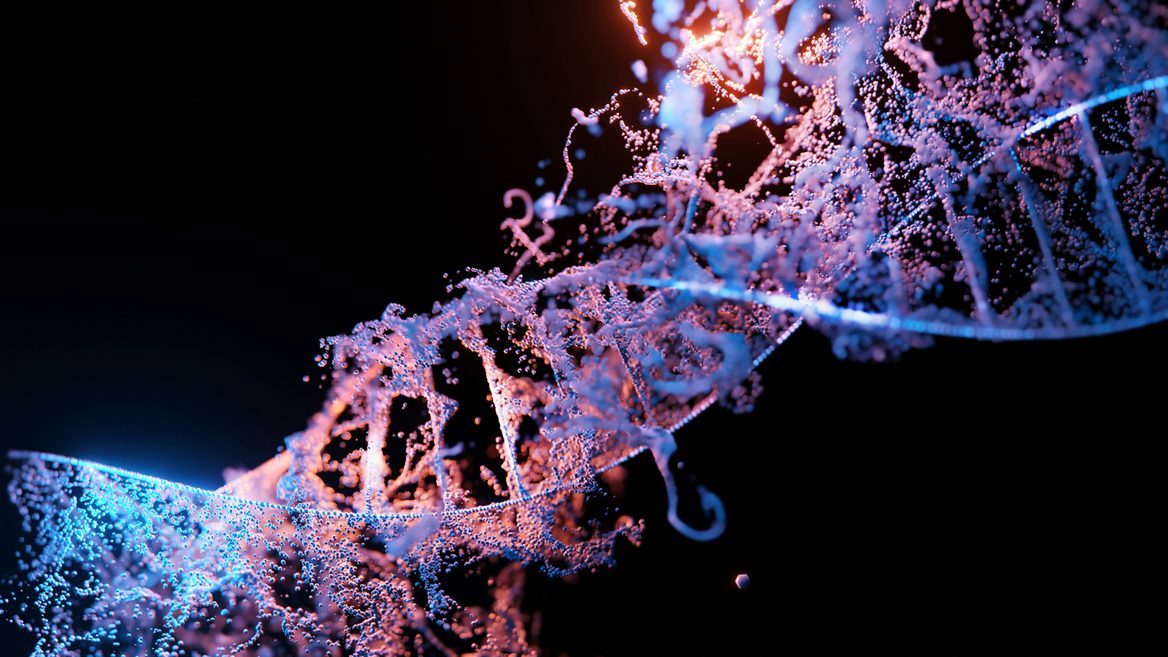
Previously, specialists from Nvidia and scientists from the Arc Institute, a non-profit biomedical research organization in Palo Alto , presented the Evo 2 artificial intelligence model, which can not only identify disease-causing mutations in human genes, but also create new genomes.
American scientists, together with Nvidia, have developed an AI model, Evo 2, trained on over 100,000 types of DNA, which will be able to code biology and pave the way for the creation of artificial life.
Як нейромережі бачать вільну та незалежну Україну? Тест dev.ua
Нейронні мережі для генерації зображень бачать світ по-своєму, їхню логіку зрозуміти часом зовсім неможливо. Але таки хочеться. На честь Дня Незалежності України редакція dev.ua вирішила провести невеликий експеримент.
Ми задали чотирьом різним нейронним мережам п’ять однакових запитів: «прапор України», «День Незалежності України», «український Крим», «перемога України» та «українці». Отриманими результатами ми ділимося з вами нижче.
У TikTok тепер можна генерувати фон за допомогою нейромережі. Ми протестували її та ділимося результатами
У TikTok з’явилася нова функція «Розумний фон». З її допомогою як фон для тіктоків можна підставляти згенеровані нейромережею зображення. Редакція dev.ua протестувала цю технологію і ділиться своїми враженнями.