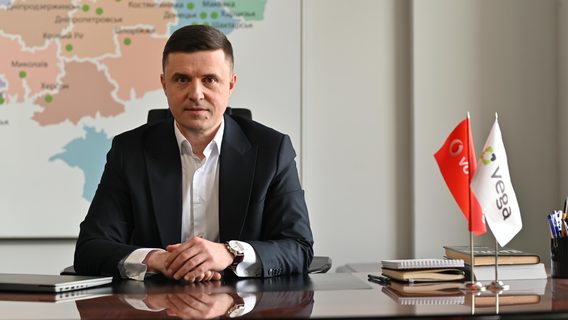
Vega goes 10G: how Vodafone is building gigabit optics for the future
Serhiy Skrypnikov, CEO of telecom companies Vega and Freenet, told dev.ua in an exclusive interview why PON technology has become the main standard in the fixed-line communication market in Ukraine, how the provider and the CEO himself are resisting cyberattacks, whether the Internet will become more expensive (and if so, why), how many investments Vodafone has made and is preparing, and much more.
Serhiy Skrypnikov, CEO of telecom companies Vega and Freenet, told dev.ua in an exclusive interview why PON technology has become the main standard in the fixed-line communication market in Ukraine, how the provider and the CEO himself are resisting cyberattacks, whether the Internet will become more expensive (and if so, why), how many investments Vodafone has made and is preparing, and much more.
So, sit back, grab a cup of coffee or tea, and get ready for some interesting facts and figures.
PON as a basic infrastructure
According to NKEK, xPON technology has become dominant in Ukraine, accounting for over 47% of connections in the country in 2024. According to Serhiy Skrypnikov, this figure is actually even higher:
«We are confident that in fact xPON technology is already dominant. At Vega, we are building a network right away with an eye on 10G — the entire PON network is already designed for speeds greater than 1 Gbps for the subscriber. Even if 1 Gbps is enough for customers now, the infrastructure is already ready for the next technological generation.»
In numbers: the scale of the network
Currently, the company has over 1.5 million households connected to GPON. We plan to exceed 2 million by the end of the year. All new connections are exclusively on PON.
«Our goal is to completely get rid of outdated technologies such as FTTx. We have not had DSL for a long time, but it is still used elsewhere in Ukraine.»
After the long blackouts in Ukraine, interest in GPON technologies is declining. But, as Serhiy emphasizes, speed, reliability, quality service, and response to requests have again become key for people.
«At the same time, for most home Internet users today, it doesn’t matter whether it’s 1 gigabit or 10 — the main thing is that it works stably,» he says.
Massive demand for GPON connections after blackouts
Demand for connections has jumped significantly after mass blackouts in previous years. While at the beginning the number of requests was 3-4 thousand per month, after a week this figure increased to 15 thousand applicants.
«On average, the number of inclusions doubled after just a week,» recalls Sergey Skrypnikov.
However, at that time, the company did not have sufficient network coverage and staff to meet such a growth in demand. Therefore, a decision was made to actively train new specialists.
Training and recruitment solutions and no connection fee
Skrypnikov emphasized that the company quickly focused on training new personnel and purchasing the necessary equipment.
«Technical specialists quickly deployed a training school, and at the same time, we purchased equipment in reserve,» he says.
Vega also reached out to other organizations, such as construction companies, that had staff that could be redeployed to work on subscriber connections.
«We collaborated with construction and road companies that had staff, but they had no work,» the top manager emphasizes.
One of the key points was the company’s decision not to charge customers extra money for connection . Vega consciously avoided price speculation, which helped build a good reputation among customers.
«We believe that this is not the time to speculate on basic needs, our mission is to make access to information as accessible as possible for every Ukrainian, even in the most difficult times,» notes Serhiy.
«Phishing is like a fire alarm.» How Vega is building cyber defense within Vodafone
Sergey Skrypnikov explains that Vega is constantly under pressure from cyber threats, but the company is constantly improving its protection systems.
After the high-profile hacker attack on Kyivstar, cybersecurity in the Ukrainian telecom has finally ceased to be just a «system administrator’s business.» CEO Vega knows this from the inside: he says that he even sent words of support to his colleagues, because it is difficult to imagine the scale of such an incident.
«I know many people at Kyivstar well. I once worked with their technical director. I wrote to them: hold on. It’s very difficult,» he says.
According to Sergey Skrypnikov, Vega is part of the Vodafone group, and therefore automatically in the top league of cyber hygiene. Relatively speaking, you go to the mobile giant with a «trailer» complete with requirements for personal data protection, GDPR compliance, and constant threat monitoring.
«At Vodafone, it’s clearly organized. We’re constantly in the stream with vendors, decisions, discussions. Being in a group is both an advantage and a challenge. We’re being attacked precisely because of the brand. Only when FREENET became part of Vodafone did they immediately start hacking the server. This didn’t happen before,» he says.
DDoS, phishing and «CEO» attacks
Before the full-scale military invasion, there were almost no cyber incidents in Vega. But from February 2022, it exploded: phishing campaigns, DDoS, and attempts to penetrate the infrastructure began.
«I was also phished personally, but my information security colleagues promptly blocked me,» recalls Serhiy Skrypnikov.
The company has made phishing training a mandatory monthly procedure. At Vega, they compare it to a fire alarm: they check the reaction, who runs where, who presses what. If you get caught, you have to go through the training again, and if you do it again, there may be disciplinary consequences.
«Everyone here knows what information security is. It’s part of occupational safety training. We instill it into the DNA of our employees,» emphasizes the head of the company.
Tariffs that are «on the verge»: Vega has not increased its price for three years
Despite all the investments in cyber defense, energy independence, generators, and GPON, the increase in Internet prices is slow.
«Vodafone is a well-known brand, it’s quality. But for some reason people expect that everything should be free,» says Serhiy Skrypnikov.
Vega has not revised the price of the basic tariff for over two years — it remains at the level of — on average 250 UAH/month. And there will be no changes this year. This is without any surcharges — a «pure» tariff. At the same time, market prices for gigabit Internet, including GPON technology, are much higher — at the level of 350 UAH/month.
«Yes, we can say that we sacrifice profitability. But this is a conscious decision — a combination of factors. Everyone at Vega understands why it is important to pay taxes, and why it is necessary to help the Armed Forces of Ukraine. This is a responsibility to the country, which is fighting the enemy and holding on, including thanks to honest taxpayers.
«We can’t talk about all the help, we’re just doing what we have to do now for Ukraine. Because communication isthe voice of the country, its heartbeat and coordination,» Serhiy emphasizes.
He considers the tariffs that the company is introducing to be low. «They are on the limit, which allows us to exist and at the same time develop. But I would like the market to be the same for everyone. We know that not everyone works honestly. And that is why someone may have lower prices — because there are shady schemes, tax evasion. This makes the conditions unequal,» the CEO emphasizes.
Since the start of the war, mobile data consumption has increased exponentially. This is a «draconian» load on networks.
«Raising prices is not about greed, but about survival. Because as operators, we are obliged to keep the network up for 72 hours during blackouts — but we don’t even focus on these 72 hours. Vega keeps the connection going for as long as users need it. This is no longer a service — it’s a basic need,» says Serhiy Skrypnikov.
Subscriber’s economy
The cost of connecting one new subscriber is UAH 5,700 (including advertising, equipment, and installation).
Payback period — 5–6 years. With an average subscriber payment of 250 UAH, the cost of its service is ~160 UAH. Because of this, the margin is low, and the payback is stretched over time.
Migration (switching to a new technology) is cheaper than connecting from scratch.
Communication as an element of hygiene. And as a weapon in digital warfare
«We believe that communication is no longer an option, but a hygienic norm. Communication is the connection of a person with the world. And here another important role is played by information hygiene,» says the Vega manager.
He recently looked at which tracks were downloaded the most in Ukraine. Among them was a band from Russia (Ai Yola — Ed.).
«I don’t even want to know their name. But this is nonsense: we consume the content from which they earn money, and part of these funds may go to support the enemy,» emphasizes Serhiy Skrypnikov.
In his opinion, the state should act more strictly. Vega blocks traffic from the aggressor country. The company directly states that the resource is banned in accordance with the decision of the National Security and Defense Council.
«But there are other providers that don’t do this. People watch Russian TV series, listen to Russian songs — and don’t even realize that they are indirectly financing the enemy,» adds Serhiy.
Can content be controlled? Yes, and it should be done
Serhiy believes that content can and should be controlled — technically everything is possible. This is not about censorship or Temniks. This is about digital security. «We don’t want only the president to remain on the screen. But there must be a barrier — so that poison doesn’t penetrate,» he says.
Unfortunately, the digital front has become another battlefield. People under the influence of Russian messages are beginning to doubt reality, do not believe the facts, do not analyze. «As providers, we must not only provide communication — but also filter destructive content,» the manager emphasizes.
Taxes, small providers and «playing outside the rules»
Disguising as small providers in Ukraine is a reality. As the top manager of Vega says, formally there are over 4,000 providers operating in Ukraine, but the actual beneficiaries are ten times less. Some operators disguise themselves as small providers, although they actually belong to the same owners.
Some market players are engaged in «optimization» of taxes. Serhiy Skrypnikov calls this a «bad game» and believes that in times of war the state should strictly monitor such practices, similarly to the «gray» import of equipment.
A democratic society is impossible without a culture of paying taxes. According to Serhiy Skrypnikov, «if a person wants to live in a wealthy country, he should treat taxes like a utility bill — without questions, automatically.»
Investment in a fixed business
Scale of investments. Vega, together with Vodafone, is investing large sums in the development of the fixed network:
2023: over 500 million UAH,
2024 (plan): 800 million UAH.
The total investment over the past 2 years is over UAH 1 billion. Vodafone is also investing about a billion in its core network, which is now powered by Vega.
The focus of investments is the transition to GigaEthernet/GPON, energy independence, and modernization in the active phase of the war.
About the new Vodafone Gigabit brand and the old Vega brand
What will happen to the Vega brand?
«Today, the brand exists and will exist until we completely modernize this network to 1 Gbps. That is, all new investments that we make in the network in terms of construction or modernization, we already make under the Vodafone Gigabit brand,» says top manager Vega.
Importantly, this also applies to the Vega network, where it is also being built under the Vodafone brand, although the Gigabit by Vega brand is currently used.
«As soon as we achieve all the necessary parameters on the network, such as security and energy independence, this network will automatically be under the Vodafone brand,» Serhiy emphasizes.
To be approved to use the Vodafone brand, Vega must demonstrate a high level of quality and compliance with the requirements set by the global company Vodafone. This includes not only the security of the network, but also the ability to maintain its operation at the highest level.
About market consolidation
«I’ll tell you that I don’t want to predict the future, but this is definitely the future. If big players like Volya, Datagroup, Lifecell, Kyivstar, Vodafone, and Ukrtelecom are going to play with consolidation, then it will definitely happen,» the top manager emphasizes.
He stresses the importance of taking into account the interests of owners of small operators who have invested heavily in their companies. In the event of a deal, these providers should receive fair compensation.
On the strategy of acquiring smaller operators
«We were closing a deal to acquire Freenet. And he had an unfinished deal with a small operator. There were only 110 subscribers there. We closed it, took his network on the balance sheet, and now we are making quite successful sales there,» says CEO Vega.
Using this case, he explains that even small operators can be interesting for large companies, because they already have a developed infrastructure and loyal customers.
The acquisition of small operators is not at standard prices, and the terms of the deals can vary significantly depending on the operator. At the same time, these deals are an important part of the company’s growth strategy.
Integration with Vodafone
«When the deal with Vega came about, we immediately sat down with Vodafone and discussed which functions should not be duplicated. Vodafone has a very professionally built network monitoring, and if you add the fixed business to that, it’s just a drop in the ocean. If I tried to build this on my own equipment, I would need premises, people, software, and it would all be much more expensive,» says the CEO of Vega.
According to Sergey Skrypnikov, Vodafone already had all the necessary resources to monitor the network, and all they had to do was add small changes.
«We realized that we didn’t need to develop this area, because Vodafone already had all the necessary technologies,» he says.
Vodafone is also actively working on developing new forms of customer service. This especially concerns the creation of integrated points of sale, where subscribers can receive all the necessary services without having to physically visit a contact center.
«Vodafone has a Vodafone Retail network that allows subscribers to resolve their issues directly in the store. This is much more convenient than a traditional contact center. There you can get advice, purchase the necessary devices, such as routers, or receive other services,» the manager says.
This approach allows Vodafone to create an effective ecosystem where specialists promptly assist subscribers without the need to contact other service channels.
Vega’s management will understand that developing separate physical customer service points is an outdated approach. In the digital age, it is important to focus on effective online tools rather than physical locations.
«If a subscriber wants to come to a physical contact center, we have already closed this direction. It is no longer effective. And Vodafone also understands this and is actively implementing new service channels using artificial intelligence,» says Serhiy Skrypnikov.
Vodafone uses various models to automate customer service, including chatbots and other digital tools that significantly improve the quality of customer interactions. Vega instead decided to focus on other aspects of the business, such as infrastructure and new subscriber onboarding, and leave the service technology to Vodafone.
In the context of Vega’s integration with Vodafone, Sergey Skrypnikov noted that it is important not to compete with large companies, but to find one’s place in the ecosystem. This is especially important when there is such strong support as Olga Ustinova and her management team.
This approach allows Vega to focus its efforts on infrastructure development and other critical areas, while keeping up with customer service trends.
Дайджест Space Tech. Розстріл "Цілини", запуск Vega і як пандемія впливає на космічні проєкти
Щотижневий звіт про події космічної індустрії за 15-21 листопада. Розповідаємо про те, як виготовлений в Україні супутник опинився в епіцентрі міжнародного скандалу, як українські підприємства співпрацюють з європейськими колегами, а також про проблеми українсько-китайської технічної програми.