Хочете будувати кар’єру в Data Science та AI? Vodafone Big Data Lab відкриває новий набір —>
Ігор Вишневський Weapon
18 September 2026, 09:00
2026-09-18
When will TAF Industries drones sail and deepstrikes fly to Russia? A big interview with CEO Volodymyr Zinovsky about new partnerships and developments, deftech problems and competition for valuable specialists
TAF Industries has long established itself as a leader in the production of FPV drones, and its "Kolibri" "birds" are among the most popular on the front. But the current ambitions of the group of companies are much broader — its product line already includes NRCs, and water drones are to be added soon. Thus, according to CEO Volodymyr Zinovsky, TAF Industries' unmanned solutions will cover all domains — air, land and water. It is also planned to produce middle strikes, deep strikes, high-speed interceptors and new reconnaissance aircraft in addition to the "Babka", which has also gained popularity among the military.
TAF Industries has long established itself as a leader in the production of FPV drones, and its "Kolibri" "birds" are among the most popular on the front. But the current ambitions of the group of companies are much broader — its product line already includes NRCs, and water drones are to be added soon. Thus, according to CEO Volodymyr Zinovsky, TAF Industries' unmanned solutions will cover all domains — air, land and water. It is also planned to produce middle strikes, deep strikes, high-speed interceptors and new reconnaissance aircraft in addition to the "Babka", which has also gained popularity among the military.
Among other things, TAF Industries is perhaps the most active among Ukrainian deftech manufacturers in its international positioning — memorandums on the creation of joint ventures have been signed with a number of European defense companies, and some JVs are already ready to launch operations and produce products.
In an extensive interview with TAF Industries CEO Volodymyr Zinovsky, dev.ua asked as many questions as possible about new developments, joint ventures, the current arms export model and its imperfections, the internal structure of the group of companies, and the distribution of management responsibilities between the CEO and founder Oleksandr Yakovenko.
In addition, we asked Volodymyr Zinovsky about the terms under which TAF Industries enters into partnerships with small Ukrainian manufacturers and why it is beneficial to both parties; how its own "E-Bals" system works; at what price tag they are ready to hire the most sought-after specialists and what candidates who come to deftech from classic IT can claim. About all this and more — in the interview.
Content
About a remedy against reactive "shaheeds"
— Mr. Volodymyr, let’s start with what is hurting all Ukrainians right now. Is TAF Industries working on interceptors for jet “Shaheeds”? After all, the “Shaheed” terror of recent weeks has “gone to nightmare” throughout Ukraine.
— Yes, we are actually working on it. We are in the process of developing our own interceptor, improving its technical characteristics, in particular its main one — speed. Our initial development has been slightly modified and now we are continuing testing in order to have a similar tool.
We decided that there were already enough interceptors on the market that could reach speeds of around 300 km/h, and that there was no need for them. Therefore, we abandoned the idea of making another conventional interceptor, and are working on a solution that would allow for speeds of over 450 km/h.
The product is still in development, so I won’t say much about it. It has successfully passed flight tests. But tests are one thing, and we strive to get a stable solution that will show efficiency from flight to flight. Work is underway on this. How much more time it will take is hard to guess. But by the end of the year we hope to launch it into mass production.
— This is inspiring, because we all want this to happen faster. I would also like to ask about something else — you have headed TAF Industries as CEO since the beginning of the year, but does this mean that the company’s founder, Oleksandr Yakovenko, has completely stepped back from operational management? How do you divide responsibilities with him, what decisions still remain his?
— If we take operational management, then he really completely moved away from it. At the beginning of the year, we agreed with him that he would deal primarily with issues of strategic partnerships, in particular, creating new opportunities for our company in the international arena. He also remains in charge of some of our interactions within the country, in particular, regarding direct communication with the leadership of military units. Because these are also his contacts and a lot of partnerships and cooperation with the military are built on his experience and connections and initiated by him personally.
But when it comes to managing our core business and core products of the TAF Industries group of companies, this is truly my area of responsibility and daily work.
— How many companies are there in TAF Industries? Last year, Oleksandr Yakovenko said there were 5. Are there more?
— Yes, there are more of them. Because in addition to those companies that are constantly in the public sphere, there are other companies related to the localization of components. This is a separate direction of development and we do not bring these companies into the public sphere due to security issues. In addition, some companies simply do not need publicity. It is one thing if a company creates a certain product — it needs publicity in order to successfully sell this product and build its brand. But in the issue of localization of components, excessive publicity is more likely to go to the "minus" than to the "plus".
What hinders the work of joint ventures abroad?
— TAF Industries recently signed another memorandum on the creation of a joint venture — with the Danish Upteko. And before that, you already had a number of memorandums with other Western defense companies. At the same time, as far as I understand, none of the announced joint ventures is producing products yet. Which one is closest to this stage?
— Our first joint venture in Germany with the local company Wingcopter is the closest to this. Absolutely all the documents are ready there, which are now just waiting for the final signing of the intergovernmental agreement between our two states. This will immediately unblock us from obtaining permission to export technologies.
Every month I say that it will happen this month, but there are some obstacles and everything is postponed. The last time it happened because of this “transition period” in the Ministry of Defense during the change of government. The ministry had many issues that they had to resolve due to the change of leadership and without it, so our issue was a little on hold. Now we see that work has resumed, so I still hope that in the near future we will receive contracts signed at the state level and our joint venture will begin full-fledged work.
The next, as I see it, will be another Ukrainian-German JV on interceptor drones with the company THYRA, and after that our Danish cooperation will be launched. We hope that everything will be on the fast track there. Firstly, because we will already have experience of these processes and we will clearly know what we need to do to make everything possible. And, secondly, we have received maximum support from the Danish government and a clear vision that they also see great benefits for themselves in this cooperation.
— We would like to understand this nuance — how much do the operating conditions of joint ventures differ in all these cases? In particular, what volume of products will be returned to Ukraine for our Armed Forces, and what will these states be able to purchase for themselves? How is this regulated?
— As for these three joint ventures I listed, which should be operational in the near future and with the greatest chance of success, there is a clear understanding about them — the first order is 100% returned to Ukraine. After all, they are all launched within the framework of Build with Ukraine and the first order, accordingly, is returned here.
This has been discussed with the partner and with representatives of the local Ministries of Defense. We will continue to discuss further orders within these same joint ventures.
Now the entire focus of attention within these joint ventures — both ours and our partners' — is directed at producing products for the Ukrainian Defense Forces.
— And what can you say about the export model that exists outside of joint ventures? Because most industry representatives claim that manufacturers are given such conditions that export, in fact, loses its meaning.
— I must say that this “transfer” period regarding the change in the leadership of the Ministry of Defense affected both this export resolution and the entire process of resolving export issues.
After the text of the document outlining the fast track for exports under the drone deal was published, the entire industry immediately consolidated to formulate its proposals on how to improve this process.
However, it happened to fall during this “transition” period of leadership change at the Ministry of Defense, and our suggestions were not taken into account.
Now we can state that we have returned to this dialogue with the Ministry of Defense. Our goal is to make the changes that the industry considers necessary for this to work fully. As far as we can assess this process, the government is listening to us.
There is literally one point on which we still have differences of opinion, but I hope that an understanding will be reached on that as well.
— What exactly is this point?
— It is primarily related to the amount of duty that must be paid by producers upon export.
— The Defense City tax regime was introduced specifically for Ukrainian deftech, but not all companies are in a hurry to join it. We previously asked you about this topic, and your group of companies replied that they were weighing all the pros and cons, but they have no intention of joining yet. Has your vision changed?
— At this stage, everything remains as it is. For now, we have decided not to join this regime. Of course, there are positive things there, but not all of them are completely relevant for us. Especially considering the opportunities that we will lose by moving from our current status.
We have already started working with special exporters and receiving authorization for the general export procedure through the internal export department, so this is not relevant for us at the moment.
Not only "E-Points": how much and what was transferred under the TAF Bonus program
— Regarding your TAF Bonus program, which is a kind of analogue of the state “E-Balls” — how has it developed since its launch? How much product has been transferred to the units?
— This program has developed quite significantly, because our system has now been used by more than 250 units. By the way, it was recently exactly a year since we launched it. During this year, we received more than 10,000 videos of confirmed hits. Most often, through the TAF Bonus program, the military exchanges bonuses for equipment necessary for performing combat missions with unmanned systems.
As a result, during the year of the program’s existence, we transferred 15 repeater carriers, 10 electronic warfare systems, over 250 remote controls of various types, and over 50 FPV goggles to the military in exchange for bonuses.
Components are also in great demand, in particular, cameras of various types. That is, the military needs not only ready-made solutions, but also components for modernization, equipment restoration, and stable operation of its own workshops. Currently, the total amount of transfers is hundreds of thousands of dollars.
There are also units that accumulate bonuses to exchange for our Babka UAVs. After a year of TAF Bonus, we clearly see the value and need for this program. We are already working with the team to add our NRCs to the list of rewards.
But the important thing is that we actively listened to what the units wanted to receive for these points, so from month to month we changed the list of products that could be exchanged for them. The requests of the military often changed depending on how the situation on the battlefield itself changed. We try to interact with end-users as much as possible so that this bonus program would be as useful as possible for them.
By the way, I also wanted to remind you that we have a separate Babka Bonus program — it is still in development. Several units have already joined it. This is in order to receive points not only for successful kills with our FPV drones or interceptors, but also for successful reconnaissance with our Babka reconnaissance drone. Only instead of videos of hits under this program, they send us reconnaissance videos. Perhaps we will also introduce a separate program for the NRC.
— Since you already mentioned the “Babka”, I wanted to ask — is TAF Industries working on other reconnaissance drones to expand its line? Moreover, you position the “Babka” as the cheapest reconnaissance UAV — perhaps you are also working on a reconnaissance drone in which you will not have to save money in order to offer the lowest price?
— The TAF Industries mission states that any of our solutions should be as scalable and accessible as possible.
We will continue to produce “Babaka” in large quantities in any case. But it is worth understanding that over the past year it has also changed significantly in technical terms, during which time there have been a large number of technical improvements.
Now our R&D team has developed a number of other features that significantly improve the technical component, but also make the tool a little more expensive. It does not become as expensive as standard well-known domestic solutions in intelligence, but still more expensive compared to the current version.
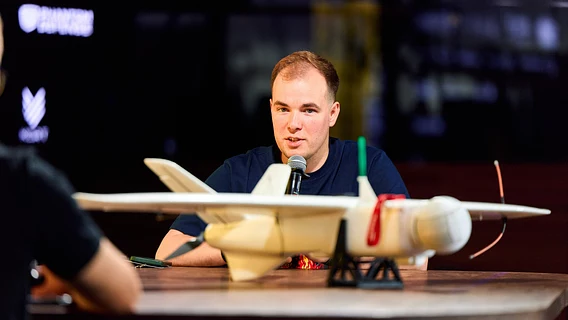
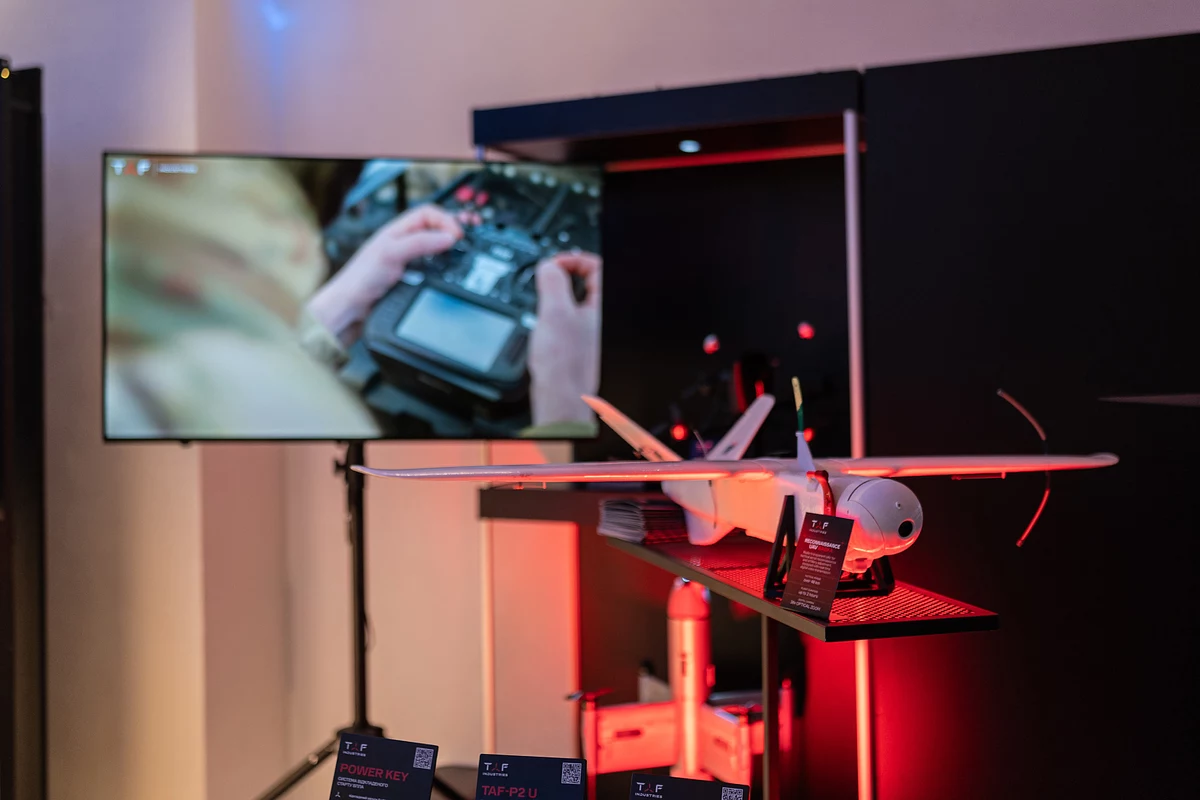
"Babka" reconnaissance drone
Therefore, on the one hand, we continue to improve “Babka”, but we are also working on a new product. It is in a completely different class in terms of technical characteristics, but, of course, is significantly more expensive than “Babka”.
By releasing a new scout, we will provide more variability so that you can choose the most effective tool for different tasks.
But at the same time, the new scout will also be very competitive in price, for the characteristics that we are laying down.
Air, land and water: TAF Industries unmanned solutions — in all domains
— I read in some article that you intend to enter the segment of long-range drones. It seems that you wanted to acquire a company that produces such drones, but that didn’t work out. So, when and by what means will you expand your product line to include long-range drones? Will it be your own development?
— Regarding the article you mention, it was about the manufacturer of middle strike, but already at the final stage of negotiations, our partnership was canceled because someone supposedly “underestimated” someone. That was the case, and then, to our great regret, we simply lost time.
But in parallel, we were still developing our own solution. Therefore, in the near future, we will be ready to present our own solutions for both middle strikes and deep strikes.
For deep strikes, we also tried to find certain companies with ready-made solutions or existing developments. But either these manufacturers offered technically uninteresting solutions, or manufacturers with technically interesting solutions were not ready to enter into a partnership. Therefore, here, as in the case of middle strikes, all this time, while the negotiations were ongoing, we were doing our own work in parallel. In the near future, we will come out with announcements of these new products.
— Can the near future be described in a conditional period of six months?
— I would say up to six months.
— Can you name some other areas that are quite new for TAF Industries, but that you are already working on?
— We have adopted a strategy to cover absolutely all domains of unmanned systems. In the air, we either already have all the solutions in all possible versions and configurations, or we are getting close to it — if we talk about high-speed interceptors, middle strikes, and deep strikes.
On the ground, we also already have solutions in various versions and stable products that meet the military’s demand. We are scaling these solutions, and when we pass the stage of scaling existing means, the R&D team will finally have time to work on new modifications of the NRC — perhaps with new form factors and so on.
So far, we have not touched on such a domain as water. We have a potential partner with whom we are already actually interacting, because we constantly take part in various military tests. In the near future, I think, we can also formalize these partnerships and officially declare that water vehicles are also appearing in our product line, in addition to aerial drones and NRCs.
— As far as I understand, with water drones you will follow the same path as with NRK “Tesla”, purchasing a ready-made solution. What kind of company is this?
— Not ready to voice yet.
Why TAF Industries is expanding its line with ready-made solutions
— What are the pros and cons of the strategy when you focus on a ready-made product made by a certain team and simply buy this solution and then scale it? Are there no cons, only pros?
— We see only advantages for ourselves. But we definitely don’t position it as “just buying some solution.” We position it as entering into a partnership and adding this solution to our ecosystem.
What is the main logic of such a model? It is that there are currently two most expensive resources. This is time in general and the time of the people working on these developments in particular.
We are scaling very actively and management capabilities simply do not allow the existing team to constantly open up new directions that we want to enter. In this story, a partner joins us — he is an expert in the niche in which he works, and he is also interested in developing his own product.
But at the same time, he, for example, does not have expertise in mass production or supply, and we provide this expertise. Thus, within this partnership, we really reinforce each other in what we are experts in.
For our part, we save time because we don’t have to develop this tool from scratch, and we immediately get a competent team in this particular domain.
And the partner doesn’t waste time scaling with their own resources, having no experience and "filling in the blanks" at the stages that we ourselves have already gone through several times. Therefore, this synergy is beneficial for both parties.
— And what does this partnership look like legally and organizationally? You can explain this using the example of the team that developed the Teslya NRK. You bought this company, but the entire development team remains and continues to work on the product? Just under the umbrella of the TAF Industries group of companies?
— Absolutely. Again, we don’t buy it completely.
In most cases, we enter either with a majority share or 50/50. Here, it’s up to us to agree with the partner. But the entire team definitely stays.
For our part, we immediately provide the administrative resources that we have — that is, recruiting, competence in all areas, lawyers, accounting. But our logic is to immediately form all this within a specific unit, so “at the moment” we provide this support at the expense of our inventory, but on the go we hire the necessary personnel for this enterprise.
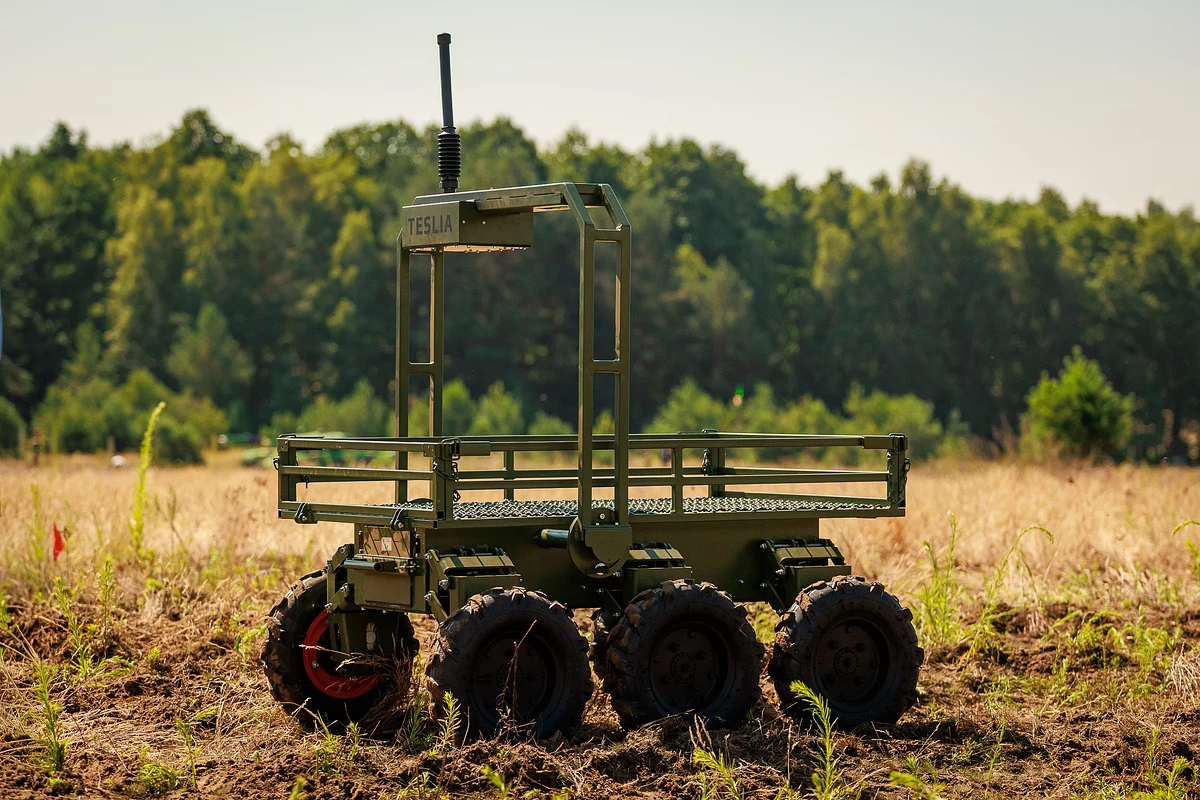
NRK "Teslya"
We have to understand that there is a codification of this product in the company, so all this remains within the framework of this enterprise, because it would be very difficult to re-register it. This is firstly, and secondly, considering that with each of the partners we have different agreements on shares and other conditions, it is much easier and more transparent for the partner if we interact on a specific product within the framework of this enterprise. Then there are no questions about who has what share of the profit and so on.
Although, to be honest, we can only talk about the fate of the profit in the distant future. Because right now, at absolutely all of our enterprises, we are focused on reinvesting all the profit in development and scaling. But in any case, we “agree on the shore” so that there are no conflicts and misunderstandings later.
"We see huge potential in international cooperation in the direction of electronic warfare": what’s on the (radio)horizon
— Regarding electronic warfare. This is also, if I may say so, not your “core” product, but they appeared some time ago. Have you already “bitten off” a piece of the electronic warfare market? How do you plan to scale the line specifically for this product?
— Electronic warfare systems appeared in 2024, so we can’t say for sure that this is something new for us. One way or another, electronic warfare systems also remain in the focus of attention, the product is developing, the line is expanding. After the “Quasar 3M”, we had the “Quasar A”, which is intended specifically for motor vehicles.
Work is also underway within the framework of “directed” electronic warfare, we are looking for certain solutions to counter the use of mesh communication, and we are also moving forward in this niche.
If we talk about a certain market share, then we need to operate with procurement data. But to put it simply, there are sales and they are growing from year to year.
In addition, we see huge potential for international cooperation in the field of electronic warfare.
Soon we will have a public signing of an agreement with a fairly well-known company that deals with electronic warfare.
Negotiations are also underway with various large manufacturers, including armored vehicle manufacturers, about the integration of our electronic warfare systems.
— Clarification regarding procurement — are you participating in a large tender for the purchase of fiber-optic drones, around which a major conflict has erupted with another deftech manufacturer, “General Chereshnay”. Do we understand correctly that the procurement will take place despite attempts to challenge its progress in court?
— Yes, the tender will take place. The first round has already passed, now we are waiting for the results of the second round, which is the final one and the winners will be determined based on the results. Next, the necessary contracts will be drawn up and the process of confirming the TTX will take place in parallel. There was an opportunity to apply for this tender with a product that does not fully meet the TTX, but the manufacturer undertakes to confirm the TTX as part of the tests.
Therefore, the procedure will look like this: after the winners are announced, those manufacturers who do not have a codified product, but who applied for these TTX, will have to undergo tests, confirm them, and after confirmation, contract documents will be directly concluded.
How does a drone-Zhdun differ from a mine and where is the limit of autonomy?
— Recently, there have been several high-profile materials in the media that concerned the complete autonomy of drones. In particular, the ability of drones with AI to independently choose a target. It seems that both we and the enemy have similar solutions, but they are not scaled up solely due to fears that AI can hit its soldiers, choose the wrong target, etc. What can you say about this from the experience of your own developments and your own vision?
— This topic needs to be analyzed comprehensively. For example, we have a solution for drones-waiters that are in ambush and autonomously strike the target. This solution is public, we have shown it.
In our vision, such a drone-waiter, which is triggered by movement and chooses a target itself, is actually identical to a mine in terms of its operating principle. We lay mines in a certain area and in fact we don’t know who this mine will hit, but the mine has a certain trigger for activation.
For some reason, we don’t see any moral dilemmas in mining, although the only difference is that mines lie on the ground and this is "acceptable," while a drone that lies on the ground for a certain time but takes off at the right moment and hits the target is "unacceptable" for some.
If we talk about fully autonomous destruction by a drone that is sent to a certain sector for a conditional 10-20 or more km and chooses a target there itself, then at the moment we do not implement or sell such solutions. Although the technical possibility is there. But here the same “moral questions” arise, because now no one knows what to do with a drone that has flown somewhere on its own, is in another place and “makes a decision” about destruction itself.
For drones that perform such missions, autonomy is limited to Last Mile technology, where the operator captures the target, but after capturing the target, the drone moves towards it completely autonomously and carries out the destruction on its own. We have such solutions and are actively encouraged by the state to use them. But no more.
About the labor market and the practice of overbuying specialists at deftech
— I want to ask a few more questions about the labor market. There is a huge demand for narrow-profile specialists in defense-tech. Who are you ready to take “with all your might,” no matter what salary the candidate offers?
— This is a somewhat manipulative question, because there are still certain limits — including in terms of salary. But speaking generally, one of the most critical problems today is indeed the lack of human resources. Moreover, this applies to specialists in many positions: we lack both managerial staff and technical specialists.
The situation now is this: if a person has a certain level of competence and passes all our security checks, then we try to take absolutely everyone.
— Does it happen that other producers took away people who were very important to you, conditionally, simply “buying” them out, increasing the price tag to some sky-high level?
— There have been similar situations, but usually it’s not just a question of money. Sometimes people also simply want to work for another company on some other product. But such cases were more likely to occur last year — recently there has been no such practice of "buying out" specialists from other manufacturers.
Perhaps this is also due to the fact that it is not so easy to “buy someone out” with our rather high level of financial compensation in the market.
Why are people who come from classical IT valued, and will there be a place for all IT professionals?
— I also want to ask about specialists who come to you from the classic “IT industry”. Are they ready to immediately join a full-time job based on their skills? After all, deftech has its own specifics — even if you continue to work with software, then, most likely, this software is somehow still connected “with the hardware” and its functioning.
— The most useful thing that people bring from the classic “IT” is, first of all, managerial experience. Because these people understand perfectly how to work with a product in general, all stages of the process, have a high culture of project management, and so on.
It is very useful that many project managers from classical IT find employment at deftech.
Speaking specifically for technical specialists-engineers, there are certain products that are related purely to software, where certain algorithms are developed, etc. There don’t seem to be any issues here either, because people continue to work with what they are used to.
But in most cases, we hire software engineers into existing teams, where there is a tech lead who is responsible for properly “bringing together” hardware and software so that it works together.
Therefore, when a software engineer from classical IT comes to such a team, he is simply given clear tasks and an understanding of what he needs to do to ensure that this synergy between hardware and software develops, and he joins this process. The main thing here is to correctly set the technical task.
If we say, conditionally, that a person should come from a classic "IT" background and immediately become a tech lead in a deftech team for some final product, then I can’t imagine that right now.
This was possible in 2023, when everyone came according to the principle “guys, let’s get together and do something”. Now, when all the processes are organized and built in deftech, such a situation seems impossible. If we are talking about an ordinary software engineer, then his skills must be involved with proper management from the tech lead, and this is definitely not something unsolvable.
— The state is now forced to do its utmost to ensure that deftech develops, because the very survival of the state depends on it. However, not everything is cloudless — in any industry. So what are the biggest blockers for deftech at this stage?
— A definite “minus” is that the rules of the game change very often — this can be both at the level of legislation and at the level of management of specialized structures. Because of this, we constantly find ourselves in “transfer zones” where it is unclear — who is making the decisions now? And can we even move forward along the path that was agreed upon by the previous leadership?
This leads to significant time "lags", and here we return to the fact that time is now the most expensive resource. This is also related to procurement, because under such changes in management, procurement slows down for a month or a half, because it is also unclear who makes the key decisions there.
All this creates “gaps” that will still have to be somehow filled later. Therefore, on the one hand, the biggest advantage of Ukrainian miltech is flexibility and the ability to quickly change your product, but still we understand that in order to develop, predictability is still needed. Because when you have to simultaneously change the product, supply, and the general vision in relations with the state, all this together creates too many difficulties for the management of this entire process.
There is too much unnecessary work to do to turn this ship in a different direction every day. I would like to avoid this.
TAF Industries was "inspired" by its own FPV drone Kolibri when creating a new interceptor. What are the characteristics of the product, which has already received codification from the Ministry of Defense?